flowchart LR
    subgraph PK["Pharmacokinetics"]
        Dose --> ADME[Absorption<br/>Distribution<br/>Metabolism<br/>Excretion]
        ADME --> Cp[Concentration<br/>at Site of Action]
    end
    subgraph PD["Pharmacodynamics"]
        Cp --> Receptor[Drug-Receptor<br/>Interaction]
        Receptor --> Effect[Pharmacological<br/>Effect]
    end

Introduction to Pharmacodynamic Models
1 Learning Objectives
By the end of this tutorial, you will be able to:
- Understand the purpose and clinical relevance of pharmacodynamic (PD) modeling
- Distinguish between pharmacokinetics (PK) and pharmacodynamics (PD)
- Recognize the four major PD model paradigms
- Select the appropriate model type for different drug-effect scenarios
- Navigate the PD modeling tutorial series effectively
TipRecommended Learning Path
New to PD modeling? Start with this introduction, then proceed to Direct Response (01). Familiar with basics? Jump to the model type relevant to your application. Model selection challenges? Go directly to Tutorial 05.
2 What is Pharmacodynamic Modeling?
Pharmacodynamics (PD) is the study of what the drug does to the body, in contrast to pharmacokinetics (PK), which describes what the body does to the drug.
2.1 Why Model Pharmacodynamics?
PD modeling serves several critical purposes in drug development and clinical practice:
- Dose Optimization: Determine the dose that maximizes efficacy while minimizing toxicity
- Efficacy Prediction: Predict therapeutic effects for new dosing regimens
- Biomarker Development: Link drug exposure to measurable biomarkers
- Clinical Trial Design: Inform dose selection for Phase II/III trials
- Personalized Medicine: Account for patient-specific factors affecting drug response
NoteThe PK-PD Disconnect
A common misconception is that higher drug concentrations always lead to greater effects. In reality, the concentration-effect relationship can be complex, involving delays, saturation, tolerance, and feedback mechanisms. PD modeling helps characterize these relationships quantitatively.
3 The Concentration-Effect Relationship
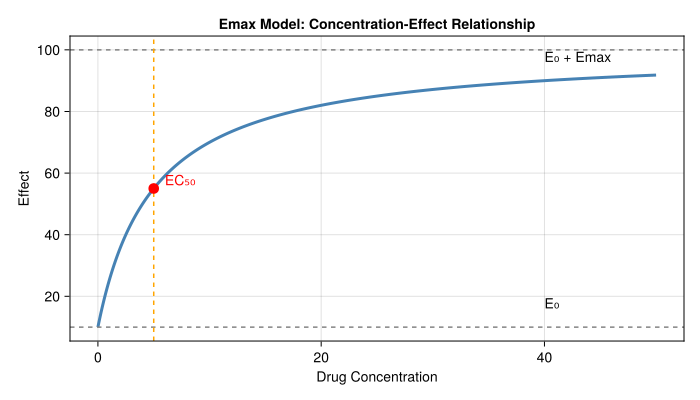
At the heart of PD modeling is the relationship between drug concentration and its effect (Holford and Sheiner 1981). The most fundamental model is the Emax model:
E = E_0 + \frac{E_{max} \cdot C}{EC_{50} + C}
Where:
| Parameter | Description |
|---|---|
| E | Observed effect |
| E_0 | Baseline effect (without drug) |
| E_{max} | Maximum drug-induced effect |
| C | Drug concentration |
| EC_{50} | Concentration producing 50% of E_{max} (potency measure) |
3.1 Key Concepts
TipPotency vs. Efficacy
- Potency (EC_{50}): How much drug is needed to produce an effect. Lower EC_{50} = more potent.
- Efficacy (E_{max}): The maximum effect the drug can produce. Higher E_{max} = more efficacious.
A drug can be highly potent but have low efficacy, or vice versa.
4 The Four Paradigms of PD Response
PD models can be broadly categorized into four paradigms based on the temporal relationship between drug concentration and effect:
flowchart TD
    Start[PD Data Available] --> Q0{Concentration<br/>data available?}
    Q0 -->|No| KPD[<b>K-PD Model</b><br/>Virtual compartment]
    Q0 -->|Yes| Q1{Immediate<br/>equilibrium<br/>between Cp and Effect?}
    Q1 -->|Yes| DR[<b>Direct Response</b><br/>Effect = f Cp]
    Q1 -->|No| Q2{Hysteresis<br/>observed in<br/>Effect vs Cp?}
    Q2 -->|Yes| EC[<b>Effect Compartment</b><br/>Effect = f Ce]
    Q2 -->|No| IDR[<b>Indirect Response</b><br/>dR/dt = kin - kout·R]

    IDR --> Q4{Drug effect<br/>direction?}
    Q4 -->|Inhibits production| IDR1[IDR Type I]
    Q4 -->|Inhibits removal| IDR2[IDR Type II]
    Q4 -->|Stimulates production| IDR3[IDR Type III]
    Q4 -->|Stimulates removal| IDR4[IDR Type IV]

    style DR fill:#e1f5fe
    style EC fill:#fff3e0
    style IDR fill:#e8f5e9
    style KPD fill:#fce4ec
4.1 Paradigm 1: Direct Response Models
When to use: The drug effect is in immediate equilibrium with the plasma concentration.
flowchart LR
    subgraph PK
        Dose --> Cp[Plasma<br/>Concentration]
    end
    subgraph PD
        Cp --> Effect[Effect<br/>E = f Cp]
    end
Characteristics:
- Effect rises and falls in parallel with concentration
- No time delay between Cp and effect
- Maximum effect occurs at peak concentration
Clinical examples:
- Anesthetics (rapid onset/offset)
- Bronchodilators
- Some antihypertensives
4.2 Paradigm 2: Effect Compartment Models
When to use: There is a temporal disconnect (hysteresis) between plasma concentration and effect (Sheiner et al. 1979).
flowchart LR
    subgraph PK
        Dose --> Cp[Plasma Conc<br/>Cp]
    end
    subgraph Biophase
        Cp -->|ke0| Ce[Effect Conc<br/>Ce]
    end
    subgraph PD
        Ce --> Effect[Effect<br/>E = f Ce]
    end
Characteristics:
- Effect lags behind plasma concentration
- Hysteresis loop observed when plotting Effect vs. Cp
- The k_{e0} parameter governs the rate of equilibration
Clinical examples:
- Digoxin (cardiac effects)
- Warfarin (initial anticoagulant effect)
- Morphine (CNS effects)
4.3 Paradigm 3: Indirect Response Models
When to use: Drug effects are mediated through modulation of physiological processes with inherent turnover (production and elimination) (Dayneka et al. 1993).
flowchart TD
    subgraph Turnover
        kin[k_in<br/>Production] --> R[Response<br/>R]
        R --> kout[k_out<br/>Removal]
    end
    Drug -->|Inhibit or<br/>Stimulate| kin
    Drug -->|Inhibit or<br/>Stimulate| kout
The Four IDR Types:
| Type | Drug Effect | Response Direction | Example |
|---|---|---|---|
| I | Inhibits k_{in} | Decreases | Corticosteroid suppression of cortisol |
| II | Inhibits k_{out} | Increases | Proton pump inhibitors |
| III | Stimulates k_{in} | Increases | Erythropoietin stimulation |
| IV | Stimulates k_{out} | Decreases | Enzyme induction |
Characteristics:
- Effect persists after drug concentration declines
- Baseline is maintained by production/removal balance
- Drug perturbs this equilibrium
4.4 Paradigm 4: K-PD (Kinetics without PK Data) Models
When to use: When pharmacodynamic data is available but plasma concentration measurements are not (Jacqmin et al. 2007).
flowchart LR
    subgraph Input
        Dose[Dose]
    end
    subgraph Virtual["Virtual Compartment"]
        A["Drug Amount A(t)"]
    end
    subgraph PD["PD Model"]
        Effect["Effect E(t)"]
    end
    Dose -->|Input| A
    A -->|KDE| Elimination
    A -->|EDK50| Effect
Characteristics:
- No plasma concentration data required
- Uses virtual compartment driven by dose
- Parameters: KDE (apparent elimination), EDK50 (apparent potency)
- Cannot predict concentrations or exposure metrics
When applicable:
- Phase I studies with limited sampling
- Exploratory dose-finding studies
- Retrospective analysis of response-only data
5 Comparison of PD Model Types
| Feature | Direct Response | Effect Compartment | Indirect Response | K-PD |
|---|---|---|---|---|
| Equilibration | Instantaneous | Delayed | Via turnover | Via virtual compartment |
| Hysteresis | None | Yes | Variable | N/A (no Cp measured) |
| Effect duration | Parallels Cp | Lags Cp | Outlasts Cp | Predicted from dose only |
| Key parameter | EC_{50} | k_{e0} | k_{in}, k_{out} | KDE, EDK50 |
| Data required | Cp + Effect | Cp + Effect | Cp + Effect | Dose + Effect only |
6 Tutorial Series Overview
This PD modeling tutorial series is designed to build your skills progressively:
| Tutorial | Title | Content |
|---|---|---|
| 00 | Introduction (this tutorial) | Overview and model selection |
| 01 | Direct Response Models | Emax, sigmoid Emax, full workflow |
| 02 | Effect Compartment Models | Hysteresis, k_{e0}, biophase |
| 03 | Indirect Response Models | All 4 IDR types, turnover concepts |
| 04 | K-PD Models | Virtual compartment, modeling without PK |
| 05 | Model Selection | Comparison, diagnostics, case studies |
7 Prerequisites
Before diving into the PD tutorials, you should be comfortable with:
- Basic Pumas model structure (
@model,@param,@dynamics,@derived) - Fitting models using
fit()and FOCE - Basic simulation with
simobs() - Data manipulation with DataFrames
NotePK Foundation Required
All PD tutorials assume a linked PK model. If you need a refresher on PK modeling in Pumas, we recommend completing the Introduction to PK Modeling tutorials first.
8 Quick Reference: Mathematical Formulations
8.1 Emax Model (Direct Response)
E = E_0 + \frac{E_{max} \cdot C}{EC_{50} + C}
8.2 Sigmoid Emax Model
E = E_0 + \frac{E_{max} \cdot C^\gamma}{EC_{50}^\gamma + C^\gamma}
Where \gamma is the Hill coefficient controlling steepness.
8.3 Effect Compartment
\frac{dC_e}{dt} = k_{e0} \cdot (C_p - C_e)
8.4 Indirect Response (General Form)
\frac{dR}{dt} = k_{in}(C) - k_{out}(C) \cdot R
At baseline steady-state: R_{ss} = \frac{k_{in}}{k_{out}}
8.5 K-PD Model (Virtual Compartment)
\frac{dA}{dt} = \text{Input}(t) - \text{KDE} \cdot A
Where effect is typically: E = E_0 + \frac{E_{max} \cdot A \cdot \text{KDE}}{\text{EDK50} + A \cdot \text{KDE}}
9 Summary
In this introduction, we covered:
Pharmacodynamics studies what the drug does to the body
The Emax model is the foundation of concentration-effect relationships
Four paradigms exist for PD modeling:
- Direct response (immediate equilibrium)
- Effect compartment (delayed equilibrium)
- Indirect response (turnover-mediated)
- K-PD (virtual compartment when no PK data)
Model selection depends on the temporal relationship between concentration and effect
This tutorial series provides comprehensive coverage of all paradigms
In the next tutorial, we will explore Direct Response Models in detail, including implementation in Pumas, simulation, fitting, and diagnostics.
References
Dayneka, N. L., V. Garg, and W. J. Jusko. 1993. “Comparison of Four Basic Models of Indirect Pharmacodynamic Responses.” Journal of Pharmacokinetics and Biopharmaceutics 21 (4): 457–78.
Holford, N. H. G., and L. B. Sheiner. 1981. “Understanding the Dose-Effect Relationship: Clinical Application of Pharmacokinetic-Pharmacodynamic Models.” Clinical Pharmacokinetics 6 (6): 429–53.
Jacqmin, P., E. Snoeck, E. A. van Schaick, et al. 2007. “Modelling Response Time Profiles in the Absence of Drug Concentrations: Definition and Performance Evaluation of the K-PD Model.” Journal of Pharmacokinetics and Pharmacodynamics 34 (1): 57–85.
Sheiner, L. B., D. R. Stanski, S. Vozeh, R. D. Miller, and J. Ham. 1979. “Simultaneous Modeling of Pharmacokinetics and Pharmacodynamics: Application to d-Tubocurarine.” Clinical Pharmacology & Therapeutics 25 (3): 358–71.