using Pumas
using PumasUtilities
using AlgebraOfGraphics
using CairoMakie
using DataFrames
using Random
TMDD Part 1b: Understanding TMDD Dynamics Through the Four Phases
1 Introduction
This tutorial builds intuition for Target-Mediated Drug Disposition (TMDD) through the elegant four-phase framework introduced by Peletier & Gabrielsson (2012). Rather than focusing on model fitting, we explore TMDD dynamics through simulation and visualization to develop a deep understanding of what drives the characteristic TMDD profile.
Learning Objectives:
By the end of this tutorial, you will be able to:
- Recognize and interpret the four phases (A, B, C, D) of TMDD profiles
- Understand how each phase relates to underlying biological processes
- Predict how parameter changes affect the concentration-time profile
- Identify which parameters can be estimated from each phase
- Apply this framework to interpret real TMDD data
NoteAttribution
This tutorial is based on the seminal work of Peletier & Gabrielsson (2012), which provides a comprehensive mathematical analysis of TMDD dynamics. We use their parameter sets and reproduce key figures with permission (CC BY license).
2 Libraries
3 The TMDD Model
We use a one-compartment full TMDD model as the foundation for our exploration. The complete model equations are covered in Part 2 of this series; here we focus on the dynamics and interpretation.
3.1 Model Definition
tmdd_model = @model begin
    @metadata begin
        desc = "One-compartment Full TMDD Model (Peletier Parameters)"
        timeu = u"hr"
    end

    @param begin
        """
        Linear elimination rate constant (hr⁻¹)
        """
        tvKel ∈ RealDomain(lower = 0)
        """
        Association rate constant (nM⁻¹hr⁻¹)
        """
        tvKon ∈ RealDomain(lower = 0)
        """
        Dissociation rate constant (hr⁻¹)
        """
        tvKoff ∈ RealDomain(lower = 0)
        """
        Receptor synthesis rate (nM/hr)
        """
        tvKsyn ∈ RealDomain(lower = 0)
        """
        Receptor degradation rate (hr⁻¹)
        """
        tvKdeg ∈ RealDomain(lower = 0)
        """
        Complex internalization rate (hr⁻¹)
        """
        tvKint ∈ RealDomain(lower = 0)
    end

    @pre begin
        Kel = tvKel
        Kon = tvKon
        Koff = tvKoff
        Ksyn = tvKsyn
        Kdeg = tvKdeg
        Kint = tvKint
    end

    @init begin
        Receptor = Ksyn / Kdeg  # Baseline receptor level (R0)
    end

    @vars begin
        # Derived constants
        R0 := Ksyn / Kdeg
        KD := Koff / Kon
        KM := (Koff + Kint) / Kon
        Rstar := Ksyn / Kint  # Maximum receptor pool

        # Totals
        Ltot := Ligand + Complex
        Rtot := Receptor + Complex
    end

    @dynamics begin
        # Free ligand dynamics
        Ligand' = -Kel * Ligand - Kon * Ligand * Receptor + Koff * Complex

        # Free receptor dynamics
        Receptor' = Ksyn - Kdeg * Receptor - Kon * Ligand * Receptor + Koff * Complex

        # Ligand-receptor complex dynamics
        Complex' = Kon * Ligand * Receptor - Koff * Complex - Kint * Complex
    end

    @derived begin
        L = @. Ligand
        R = @. Receptor
        RL = @. Complex
        L_total = @. Ltot
        R_total = @. Rtot
    end
end
┌ Warning: Variable `L` is defined in the `@derived` block using `=` and hence `L` is not used for model fitting but only returned when simulating: │ If `L` is a random variable, it must be defined in the `@derived` block using `~`; │ if `L` should be returned when simulating, it should be defined in the `@observed` block using `=`; │ if `L` is an intermediate quantity that should not be returned when simulating, it should be defined using `:=`. └ @ Pumas ~/run/_work/PumasTutorials.jl/PumasTutorials.jl/custom_julia_depot/packages/Pumas/GZeMg/src/dsl/model_macro.jl:2351 ┌ Warning: Variable `R` is defined in the `@derived` block using `=` and hence `R` is not used for model fitting but only returned when simulating: │ If `R` is a random variable, it must be defined in the `@derived` block using `~`; │ if `R` should be returned when simulating, it should be defined in the `@observed` block using `=`; │ if `R` is an intermediate quantity that should not be returned when simulating, it should be defined using `:=`. └ @ Pumas ~/run/_work/PumasTutorials.jl/PumasTutorials.jl/custom_julia_depot/packages/Pumas/GZeMg/src/dsl/model_macro.jl:2351 ┌ Warning: Variable `RL` is defined in the `@derived` block using `=` and hence `RL` is not used for model fitting but only returned when simulating: │ If `RL` is a random variable, it must be defined in the `@derived` block using `~`; │ if `RL` should be returned when simulating, it should be defined in the `@observed` block using `=`; │ if `RL` is an intermediate quantity that should not be returned when simulating, it should be defined using `:=`. └ @ Pumas ~/run/_work/PumasTutorials.jl/PumasTutorials.jl/custom_julia_depot/packages/Pumas/GZeMg/src/dsl/model_macro.jl:2351 ┌ Warning: Variable `L_total` is defined in the `@derived` block using `=` and hence `L_total` is not used for model fitting but only returned when simulating: │ If `L_total` is a random variable, it must be defined in the `@derived` block using `~`; │ if `L_total` should be returned when simulating, it should be defined in the `@observed` block using `=`; │ if `L_total` is an intermediate quantity that should not be returned when simulating, it should be defined using `:=`. └ @ Pumas ~/run/_work/PumasTutorials.jl/PumasTutorials.jl/custom_julia_depot/packages/Pumas/GZeMg/src/dsl/model_macro.jl:2351 ┌ Warning: Variable `R_total` is defined in the `@derived` block using `=` and hence `R_total` is not used for model fitting but only returned when simulating: │ If `R_total` is a random variable, it must be defined in the `@derived` block using `~`; │ if `R_total` should be returned when simulating, it should be defined in the `@observed` block using `=`; │ if `R_total` is an intermediate quantity that should not be returned when simulating, it should be defined using `:=`. └ @ Pumas ~/run/_work/PumasTutorials.jl/PumasTutorials.jl/custom_julia_depot/packages/Pumas/GZeMg/src/dsl/model_macro.jl:2351
PumasModel
  Parameters: tvKel, tvKon, tvKoff, tvKsyn, tvKdeg, tvKint
  Random effects:
  Covariates:
  Dynamical system variables: Ligand, Receptor, Complex
  Dynamical system type: Nonlinear ODE
  Derived: L, R, RL, L_total, R_total
  Observed: L, R, RL, L_total, R_total
3.2 Parameters from Peletier & Gabrielsson (2012)
The original paper uses mass concentration units (mg/L). For consistency with other tutorials and typical mAb modeling, we convert to molar units (nM) assuming a molecular weight of 150 kDa.
Conversion factor: 1 mg/L ≈ 6.67 nM for a 150 kDa molecule.
# Peletier paper parameters (Table 3) converted to nM and hr units
# Original: ke(L) = 0.0015 h⁻¹, kon = 0.091 (mg/L)⁻¹h⁻¹, koff = 0.001 h⁻¹
#           kin = 0.11 mg/L/h, kout = 0.0089 h⁻¹, ke(RL) = 0.003 h⁻¹

peletier_params = (
    tvKel = 0.0015,         # Linear elimination rate (h⁻¹)
    tvKon = 0.0136,         # Association rate (nM⁻¹h⁻¹) - converted from 0.091 (mg/L)⁻¹h⁻¹
    tvKoff = 0.001,         # Dissociation rate (h⁻¹)
    tvKsyn = 0.73,          # Receptor synthesis (nM/h) - converted from 0.11 mg/L/h
    tvKdeg = 0.0089,        # Receptor degradation (h⁻¹)
    tvKint = 0.003,         # Internalization rate (h⁻¹)
)

# Calculate derived constants
R0 = peletier_params.tvKsyn / peletier_params.tvKdeg
KD = peletier_params.tvKoff / peletier_params.tvKon
KM = (peletier_params.tvKoff + peletier_params.tvKint) / peletier_params.tvKon
Rstar = peletier_params.tvKsyn / peletier_params.tvKint

println("Derived Constants:")
println("  R₀ (baseline receptor) = $(round(R0, digits=1)) nM")
println("  Kᴅ (dissociation constant) = $(round(KD, digits=3)) nM")
println("  Kᴍ (Michaelis constant) = $(round(KM, digits=3)) nM")
println("  R* (maximum receptor pool) = $(round(Rstar, digits=1)) nM")
Derived Constants:
R₀ (baseline receptor) = 82.0 nM
Kᴅ (dissociation constant) = 0.074 nM
Kᴍ (Michaelis constant) = 0.294 nM
R* (maximum receptor pool) = 243.3 nM3.3 Dose Levels
Following the paper, we simulate four doses that span a wide concentration range:
# Doses matching paper (converted to nM concentrations)
# Original: 1.5, 5, 15, 45 mg/kg with Vc = 0.05 L/kg → L0 = 30, 100, 300, 900 mg/L
# Converted to nM: L0 = 200, 667, 2000, 6000 nM
initial_concs = [200.0, 667.0, 2000.0, 6000.0]  # nM
dose_labels = ["200 nM", "667 nM", "2000 nM", "6000 nM"]

println("Initial Concentrations (L₀):")
for (conc, label) in zip(initial_concs, dose_labels)
    ratio = conc / R0
    println("  $label = $(round(ratio, digits=1))× R₀")
end
Initial Concentrations (L₀):
200 nM = 2.4× R₀
667 nM = 8.1× R₀
2000 nM = 24.4× R₀
6000 nM = 73.2× R₀4 Part I: Bolus Administration
4.1 The Four Phases of TMDD
After a bolus dose, the TMDD concentration-time profile can be divided into four distinct phases. Each phase is dominated by different processes and reveals information about specific parameters.
Show/Hide Code
# Create schematic figure with inset for Phase A
fig = Figure(size = (1000, 600))

# Main axis
ax = Axis(
    fig[1, 1],
    xlabel = "Time (hr)",
    ylabel = "Ligand Concentration (nM)",
    yscale = log10,
    title = "The Four Phases of TMDD",
)

# Representative profile (moderate dose to show all phases clearly)
pop_schematic = [Subject(id = 1, events = DosageRegimen(200.0, time = 0, cmt = 1))]
obstimes_schematic = [0.001; 0.01:0.01:0.99; 1:0.5:49.5; 50:5:195; 200:20:800]
sim_schematic =
    simobs(tmdd_model, pop_schematic, peletier_params, obstimes = obstimes_schematic)
df_schematic = DataFrame(sim_schematic)

lines!(ax, df_schematic.time, max.(df_schematic.L, 1e-4), linewidth = 3, color = :steelblue)

# Phase boundaries (approximate for 200 nM dose)
vlines!(ax, [1], color = :gray, linestyle = :dash, alpha = 0.6)
vlines!(ax, [50], color = :gray, linestyle = :dash, alpha = 0.6)
vlines!(ax, [200], color = :gray, linestyle = :dash, alpha = 0.6)

# Phase labels - positioned in the middle of each phase region
text!(ax, 0.3, 40, text = "A", fontsize = 22, font = :bold, color = :darkred)
text!(ax, 15, 40, text = "B", fontsize = 22, font = :bold, color = :darkgreen)
text!(ax, 100, 40, text = "C", fontsize = 22, font = :bold, color = :darkorange)
text!(ax, 500, 40, text = "D", fontsize = 22, font = :bold, color = :darkblue)

# Reference lines
hlines!(ax, [R0], color = :gray, linestyle = :dot, alpha = 0.5)
text!(ax, 750, R0 * 1.5, text = "R₀", fontsize = 11, color = :gray)

hlines!(ax, [KD], color = :gray, linestyle = :dot, alpha = 0.5)
text!(ax, 750, KD * 0.5, text = "Kᴅ", fontsize = 11, color = :gray)

# Inset for Phase A close-up
ax_inset = Axis(
    fig[1, 1],
    width = Relative(0.35),
    height = Relative(0.35),
    halign = 0.95,
    valign = 0.95,
    xlabel = "Time (hr)",
    ylabel = "L (nM)",
    title = "Phase A Close-up",
    titlesize = 12,
    xlabelsize = 10,
    ylabelsize = 10,
    xticklabelsize = 9,
    yticklabelsize = 9,
    limits = (0, 2, 150, 220),
)

# Filter data for early timepoints
df_early = filter(row -> row.time <= 2, df_schematic)
lines!(ax_inset, df_early.time, df_early.L, linewidth = 2, color = :steelblue)

# Mark the rapid decline
scatter!(ax_inset, [0.001], [200.0], markersize = 8, color = :red)
text!(ax_inset, 0.15, 210, text = "L₀", fontsize = 10, color = :red)

# Add box around inset region in main plot
# (visual indicator that this is zoomed)
vspan!(ax, 0, 2, color = (:lightblue, 0.15))

# Legend at bottom showing phase descriptions
leg_elements = [
    LineElement(color = :darkred, linewidth = 3),
    LineElement(color = :darkgreen, linewidth = 3),
    LineElement(color = :darkorange, linewidth = 3),
    LineElement(color = :darkblue, linewidth = 3),
]
leg_labels = [
    "A: Rapid Binding (seconds-minutes)",
    "B: Target Saturated (hours-days)",
    "C: Transition (days)",
    "D: Terminal (days-weeks)",
]

Legend(
    fig[2, 1],
    leg_elements,
    leg_labels,
    orientation = :horizontal,
    tellheight = true,
    tellwidth = false,
    framevisible = false,
    labelsize = 11,
)

rowsize!(fig.layout, 2, Auto())

fig
4.2 Phase A: Rapid Binding (“The Lightning Marriage”)
Immediately after dosing, free ligand rapidly binds to available receptor.
What happens:
- Drug meets target at very high rate
- Complex forms nearly instantaneously
- Free receptor drops from \(R_0\) to near zero
- Free ligand drops by approximately \(R_0\)
Duration: \(\tau_A \sim \frac{1}{k_{on}(L_0 - R_0)}\)
Observable: Sharp initial concentration drop
Parameters identified: \(k_{on}\), \(R_0\)
Show/Hide Code
# Close-up of Phase A
obstimes_phaseA = 0.001:0.005:2.0
pop_phaseA = [
    Subject(id = i, events = DosageRegimen(conc, time = 0, cmt = 1)) for
    (i, conc) in enumerate(initial_concs)
]

sim_phaseA = simobs(tmdd_model, pop_phaseA, peletier_params, obstimes = obstimes_phaseA)
df_phaseA = DataFrame(sim_phaseA)
dose_label_df = DataFrame(id = string.(1:4), Dose = dose_labels)
df_phaseA = innerjoin(df_phaseA, dose_label_df, on = :id)

fig = Figure(size = (900, 400))

# Ligand concentration
ax1 = Axis(
    fig[1, 1],
    xlabel = "Time (hr)",
    ylabel = "Free Ligand (nM)",
    title = "Phase A: Ligand Dynamics",
    yscale = log10,
)

for (i, (dose, color)) in enumerate(zip(dose_labels, [:red, :blue, :green, :purple]))
    df_dose = filter(row -> row.Dose == dose, df_phaseA)
    lines!(
        ax1,
        df_dose.time,
        max.(df_dose.L, 0.01),
        linewidth = 2,
        color = color,
        label = dose,
    )
end

hlines!(ax1, [R0], color = :gray, linestyle = :dash, alpha = 0.6)
text!(ax1, 1.8, R0 * 1.3, text = "R₀", fontsize = 10, color = :gray)

# Receptor concentration
ax2 = Axis(
    fig[1, 2],
    xlabel = "Time (hr)",
    ylabel = "Free Receptor (nM)",
    title = "Phase A: Receptor Dynamics",
)

for (i, (dose, color)) in enumerate(zip(dose_labels, [:red, :blue, :green, :purple]))
    df_dose = filter(row -> row.Dose == dose, df_phaseA)
    lines!(ax2, df_dose.time, df_dose.R, linewidth = 2, color = color, label = dose)
end

hlines!(ax2, [R0], color = :gray, linestyle = :dash, alpha = 0.6)
text!(ax2, 1.8, R0 * 0.9, text = "R₀", fontsize = 10, color = :gray)

Legend(fig[1, 3], ax1, "L₀", framevisible = false)
fig
TipKey Insight
At the end of Phase A, the system reaches quasi-equilibrium:
- \(\bar{L} \approx L_0 - R_0\) (if \(L_0 > R_0\))
- \(\bar{R} \approx 0\) (receptor nearly fully occupied)
- \(\bar{RL} \approx R_0\) (complex equals original receptor)
This is why Phase A duration depends on \(k_{on}(L_0 - R_0)\).
4.3 Phase B: Target Saturated (“The Slow Burn”)
Once the target is saturated, the drug elimination becomes linear.
What happens:
- Target fully occupied (\(RL \approx R_{tot}\))
- Linear elimination dominates
- Complex slowly eliminated via internalization
- New receptor synthesized is immediately captured
Observable: Parallel lines on semi-log plot (dose-independent slope)
Slope: \(\lambda_B \approx k_{el}\) (linear elimination rate)
Parameters identified: \(k_{el}\), \(k_{syn}\) (through receptor dynamics)
Show/Hide Code
# Phase B visualization
obstimes_phaseB = 0.1:1:300
sim_phaseB = simobs(tmdd_model, pop_phaseA, peletier_params, obstimes = obstimes_phaseB)
df_phaseB = DataFrame(sim_phaseB)
df_phaseB = innerjoin(df_phaseB, dose_label_df, on = :id)

fig = Figure(size = (700, 500))
ax = Axis(
    fig[1, 1],
    xlabel = "Time (hr)",
    ylabel = "Free Ligand (nM)",
    title = "Phase B: Target-Saturated Elimination",
    yscale = log10,
    limits = (0, 300, 1, 10000),
)

for (i, (dose, color)) in enumerate(zip(dose_labels, [:red, :blue, :green, :purple]))
    df_dose = filter(row -> row.Dose == dose, df_phaseB)
    lines!(
        ax,
        df_dose.time,
        max.(df_dose.L, 0.01),
        linewidth = 2,
        color = color,
        label = dose,
    )
end

# Add reference line for expected slope
t_ref = [50, 200]
L_ref = initial_concs[4] * 0.3 .* exp.(-peletier_params.tvKel .* (t_ref .- 50))
lines!(
    ax,
    t_ref,
    L_ref,
    linewidth = 2,
    linestyle = :dash,
    color = :black,
    label = "slope = kel",
)

# Reference lines
hlines!(ax, [R0], color = :gray, linestyle = :dot, alpha = 0.5)
text!(ax, 280, R0 * 1.3, text = "R₀", fontsize = 10, color = :gray)

Legend(fig[1, 2], ax, framevisible = false)
fig
4.4 Phase C: Transition (“The Turning Point”)
As ligand concentration decreases and approaches \(K_D\), the system transitions from saturated to unsaturated.
What happens:
- Target begins to recover from suppression
- Target-mediated clearance increases (mixed-order kinetics)
- Concentration drops through \(K_D\) range
- Both elimination pathways are active
Observable: Increased decline rate, inflection in profile
Concentration range: \(0.1 K_D < L < 10 K_D\)
Parameters identified: \(K_D\), \(k_{off}\)
Show/Hide Code
# Extended simulation to show Phase C
obstimes_phaseC = [0.1:1:100; 110:10:500; 550:50:1500]
sim_phaseC = simobs(tmdd_model, pop_phaseA, peletier_params, obstimes = obstimes_phaseC)
df_phaseC = DataFrame(sim_phaseC)
df_phaseC = innerjoin(df_phaseC, dose_label_df, on = :id)

fig = Figure(size = (900, 400))

# Ligand
ax1 = Axis(
    fig[1, 1],
    xlabel = "Time (hr)",
    ylabel = "Free Ligand (nM)",
    title = "Ligand Through Phase C",
    yscale = log10,
    limits = (0, 1500, 0.001, 10000),
)

for (i, (dose, color)) in enumerate(zip(dose_labels, [:red, :blue, :green, :purple]))
    df_dose = filter(row -> row.Dose == dose, df_phaseC)
    lines!(
        ax1,
        df_dose.time,
        max.(df_dose.L, 1e-4),
        linewidth = 2,
        color = color,
        label = dose,
    )
end

hlines!(ax1, [KD], color = :gray, linestyle = :dash, alpha = 0.6)
text!(ax1, 1400, KD * 2, text = "Kᴅ", fontsize = 10, color = :gray)

hlines!(ax1, [10 * KD], color = :gray, linestyle = :dot, alpha = 0.4)
hlines!(ax1, [0.1 * KD], color = :gray, linestyle = :dot, alpha = 0.4)
text!(ax1, 1400, 10 * KD * 1.5, text = "10×Kᴅ", fontsize = 9, color = :gray)
text!(ax1, 1400, 0.1 * KD * 0.5, text = "0.1×Kᴅ", fontsize = 9, color = :gray)

# Receptor recovery
ax2 = Axis(
    fig[1, 2],
    xlabel = "Time (hr)",
    ylabel = "Free Receptor (nM)",
    title = "Receptor Recovery in Phase C",
)

for (i, (dose, color)) in enumerate(zip(dose_labels, [:red, :blue, :green, :purple]))
    df_dose = filter(row -> row.Dose == dose, df_phaseC)
    lines!(ax2, df_dose.time, df_dose.R, linewidth = 2, color = color, label = dose)
end

hlines!(ax2, [R0], color = :gray, linestyle = :dash, alpha = 0.6)
text!(ax2, 1400, R0 * 0.9, text = "R₀", fontsize = 10, color = :gray)

Legend(fig[1, 3], ax1, "L₀", framevisible = false)
fig
4.5 Phase D: Terminal (“The Long Goodbye”)
At low ligand concentrations, the terminal phase is reached.
What happens:
- Ligand concentration well below \(K_D\)
- System returns toward baseline
- Terminal elimination dominated by slowest process
- Often internalization-limited
Observable: Linear terminal slope on semi-log plot
Slope: \(\lambda_D \approx k_{int}\) (internalization rate)
Parameters identified: \(k_{int}\), \(K_M\)
Show/Hide Code
# Full simulation including terminal phase
obstimes_full = [0.1:1:100; 110:10:500; 550:50:2500]
sim_full = simobs(tmdd_model, pop_phaseA, peletier_params, obstimes = obstimes_full)
df_full = DataFrame(sim_full)
df_full = innerjoin(df_full, dose_label_df, on = :id)

fig = Figure(size = (700, 500))
ax = Axis(
    fig[1, 1],
    xlabel = "Time (hr)",
    ylabel = "Free Ligand (nM)",
    title = "Phase D: Terminal Elimination",
    yscale = log10,
    limits = (0, 2500, 1e-4, 10000),
)

for (i, (dose, color)) in enumerate(zip(dose_labels, [:red, :blue, :green, :purple]))
    df_dose = filter(row -> row.Dose == dose, df_full)
    lines!(
        ax,
        df_dose.time,
        max.(df_dose.L, 1e-5),
        linewidth = 2,
        color = color,
        label = dose,
    )
end

# Reference lines
hlines!(ax, [R0], color = :gray, linestyle = :dot, alpha = 0.5)
text!(ax, 2400, R0 * 1.5, text = "R₀", fontsize = 10, color = :gray)

hlines!(ax, [KD], color = :gray, linestyle = :dot, alpha = 0.5)
text!(ax, 2400, KD * 0.5, text = "Kᴅ", fontsize = 10, color = :gray)

# Add terminal slope reference (kint)
t_term = [1500, 2400]
L_term = 0.5 * exp.(-peletier_params.tvKint .* (t_term .- 1500))
lines!(
    ax,
    t_term,
    L_term,
    linewidth = 2,
    linestyle = :dash,
    color = :black,
    label = "slope = kint",
)

Legend(fig[1, 2], ax, framevisible = false)
fig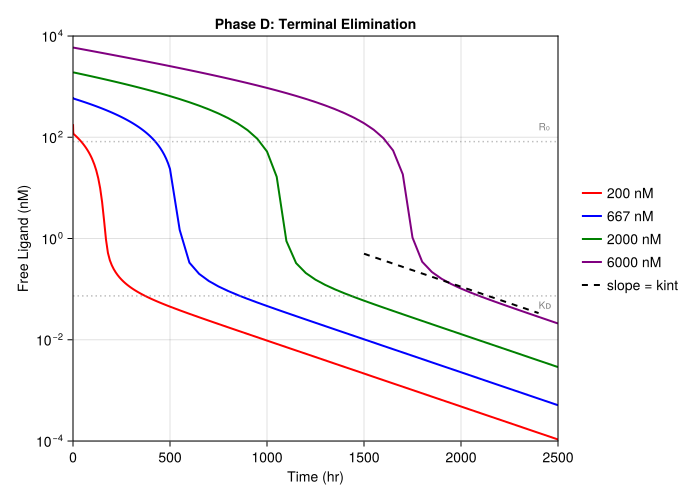
ImportantKey Insight from Peletier
The terminal slope in TMDD is typically determined by the internalization rate (\(k_{int}\)), not the linear elimination rate (\(k_{el}\)). This is a critical distinction from the Michaelis-Menten approximation, which predicts a different terminal slope.
4.6 Multi-Dose Visualization
Let’s reproduce the key figure from Peletier & Gabrielsson (2012) showing all four doses together:
Show/Hide Code
fig = Figure(size = (1100, 400))

# Left: Full semi-log view
ax1 = Axis(
    fig[1, 1],
    xlabel = "Time (hr)",
    ylabel = "Free Ligand (nM)",
    title = "Semi-log Scale",
    yscale = log10,
    limits = (0, 2500, 1e-4, 10000),
)

for (i, (dose, color)) in enumerate(zip(dose_labels, [:red, :blue, :green, :purple]))
    df_dose = filter(row -> row.Dose == dose, df_full)
    lines!(
        ax1,
        df_dose.time,
        max.(df_dose.L, 1e-5),
        linewidth = 2,
        color = color,
        label = dose,
    )
end

hlines!(ax1, [R0], color = :gray, linestyle = :dot, alpha = 0.5, label = "R₀")
hlines!(ax1, [KD], color = :gray, linestyle = :dot, alpha = 0.5, label = "Kᴅ")

# Middle: Linear scale view (early time)
df_linear = filter(row -> row.time <= 600, df_full)

ax2 = Axis(
    fig[1, 2],
    xlabel = "Time (hr)",
    ylabel = "Free Ligand (nM)",
    title = "Linear Scale",
)

for (i, (dose, color)) in enumerate(zip(dose_labels, [:red, :blue, :green, :purple]))
    df_dose = filter(row -> row.Dose == dose, df_linear)
    lines!(ax2, df_dose.time, df_dose.L, linewidth = 2, color = color, label = dose)
end

# Right: Close-up of Phase A
ax3 = Axis(
    fig[1, 3],
    xlabel = "Time (hr)",
    ylabel = "Free Ligand (nM)",
    title = "Phase A Close-up",
    limits = (0, 2, nothing, nothing),
)

for (i, (dose, color)) in enumerate(zip(dose_labels, [:red, :blue, :green, :purple]))
    df_dose = filter(row -> row.Dose == dose, df_phaseA)
    lines!(ax3, df_dose.time, df_dose.L, linewidth = 2, color = color, label = dose)
end

hlines!(ax3, [R0], color = :gray, linestyle = :dot, alpha = 0.5)

Legend(fig[1, 4], ax1, "L₀", framevisible = false)
fig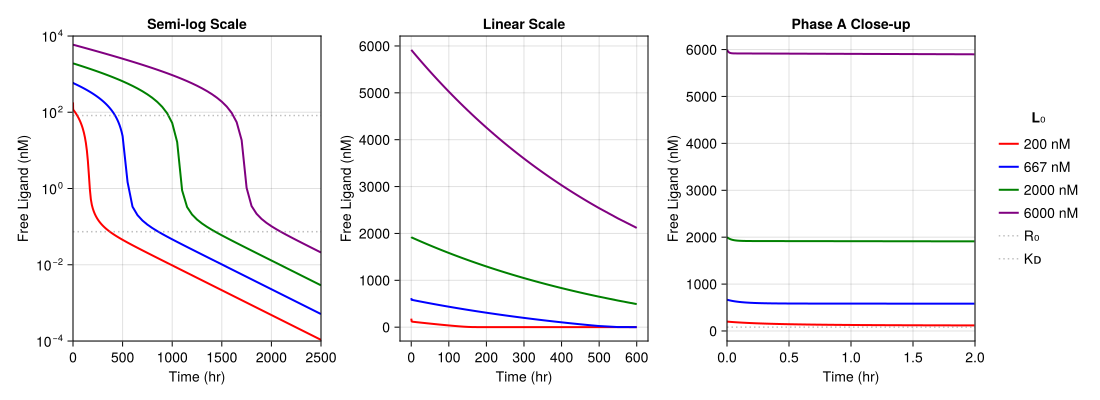
4.7 Receptor Dynamics: The Target’s Story
The receptor dynamics reveal crucial information about target engagement:
Show/Hide Code
fig = Figure(size = (1100, 400))

# Left: Free receptor
ax1 = Axis(
    fig[1, 1],
    xlabel = "Time (hr)",
    ylabel = "Free Receptor (nM)",
    title = "Free Receptor (R)",
    limits = (0, 2500, nothing, nothing),
)

for (i, (dose, color)) in enumerate(zip(dose_labels, [:red, :blue, :green, :purple]))
    df_dose = filter(row -> row.Dose == dose, df_full)
    lines!(ax1, df_dose.time, df_dose.R, linewidth = 2, color = color, label = dose)
end

hlines!(ax1, [R0], color = :gray, linestyle = :dash, alpha = 0.6)
text!(ax1, 2300, R0 * 1.05, text = "R₀", fontsize = 10, color = :gray)

# Middle: Complex
ax2 = Axis(fig[1, 2], xlabel = "Time (hr)", ylabel = "Complex (nM)", title = "Complex (RL)")

for (i, (dose, color)) in enumerate(zip(dose_labels, [:red, :blue, :green, :purple]))
    df_dose = filter(row -> row.Dose == dose, df_full)
    lines!(ax2, df_dose.time, df_dose.RL, linewidth = 2, color = color, label = dose)
end

hlines!(ax2, [R0], color = :gray, linestyle = :dash, alpha = 0.6)
text!(ax2, 2300, R0 * 1.05, text = "R₀", fontsize = 10, color = :gray)

# Right: Total receptor
ax3 = Axis(
    fig[1, 3],
    xlabel = "Time (hr)",
    ylabel = "Total Receptor (nM)",
    title = "Total Receptor (Rtot = R + RL)",
)

for (i, (dose, color)) in enumerate(zip(dose_labels, [:red, :blue, :green, :purple]))
    df_dose = filter(row -> row.Dose == dose, df_full)
    lines!(ax3, df_dose.time, df_dose.R_total, linewidth = 2, color = color, label = dose)
end

hlines!(ax3, [R0], color = :gray, linestyle = :dash, alpha = 0.6)
text!(ax3, 2300, R0 * 1.05, text = "R₀", fontsize = 10, color = :gray)

hlines!(ax3, [Rstar], color = :gray, linestyle = :dot, alpha = 0.6)
text!(ax3, 2300, Rstar * 0.95, text = "R*", fontsize = 10, color = :gray)

Legend(fig[1, 4], ax1, "L₀", framevisible = false)
fig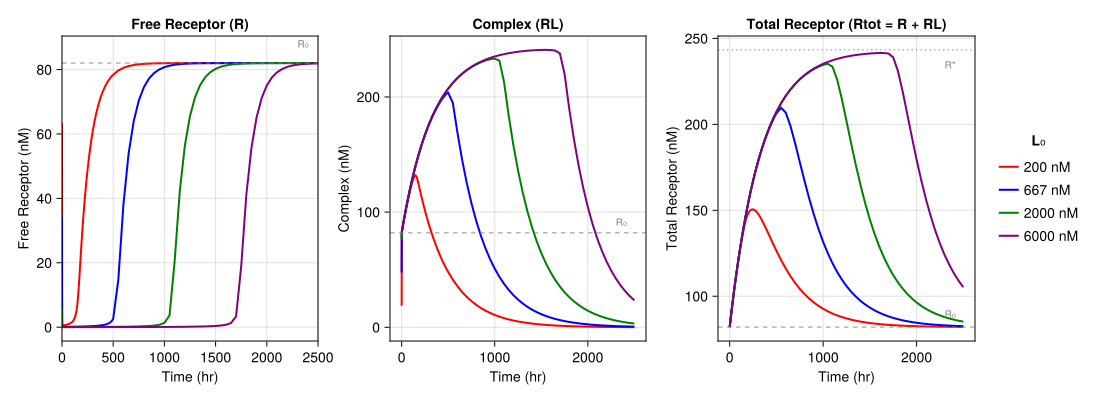
NoteThe Γ Curve and R*
The total receptor \(R_{tot}\) follows a characteristic “Γ curve”:
- Initially jumps to \(R_0\) (all bound as complex)
- Rises toward \(R^* = k_{syn}/k_{int}\) while ligand is present
- Returns to \(R_0\) after washout
The maximum receptor pool \(R^*\) represents the balance between synthesis and internalization, which exceeds \(R_0\) when \(k_{int} < k_{deg}\) (as is often the case for mAbs).
4.8 Log-Scale Receptor Dynamics
The receptor dynamics on log scale reveal bi-exponential behavior:
Show/Hide Code
fig = Figure(size = (900, 400))

# Free receptor on log scale
ax1 = Axis(
    fig[1, 1],
    xlabel = "Time (hr)",
    ylabel = "Free Receptor (nM)",
    title = "Free Receptor (log scale)",
    yscale = log10,
    limits = (0, 2500, 1e-3, 200),
)

for (i, (dose, color)) in enumerate(zip(dose_labels, [:red, :blue, :green, :purple]))
    df_dose = filter(row -> row.Dose == dose, df_full)
    lines!(
        ax1,
        df_dose.time,
        max.(df_dose.R, 1e-4),
        linewidth = 2,
        color = color,
        label = dose,
    )
end

hlines!(ax1, [R0], color = :gray, linestyle = :dash, alpha = 0.6)
text!(ax1, 2300, R0 * 1.3, text = "R₀", fontsize = 10, color = :gray)

# Total receptor on log scale
ax2 = Axis(
    fig[1, 2],
    xlabel = "Time (hr)",
    ylabel = "Total Receptor (nM)",
    title = "Total Receptor (log scale)",
    yscale = log10,
    limits = (0, 2500, 10, 500),
)

for (i, (dose, color)) in enumerate(zip(dose_labels, [:red, :blue, :green, :purple]))
    df_dose = filter(row -> row.Dose == dose, df_full)
    lines!(ax2, df_dose.time, df_dose.R_total, linewidth = 2, color = color, label = dose)
end

hlines!(ax2, [R0], color = :gray, linestyle = :dash, alpha = 0.6)
text!(ax2, 2300, R0 * 1.2, text = "R₀", fontsize = 10, color = :gray)

hlines!(ax2, [Rstar], color = :gray, linestyle = :dot, alpha = 0.6)
text!(ax2, 2300, Rstar * 0.9, text = "R*", fontsize = 10, color = :gray)

Legend(fig[1, 3], ax1, "L₀", framevisible = false)
fig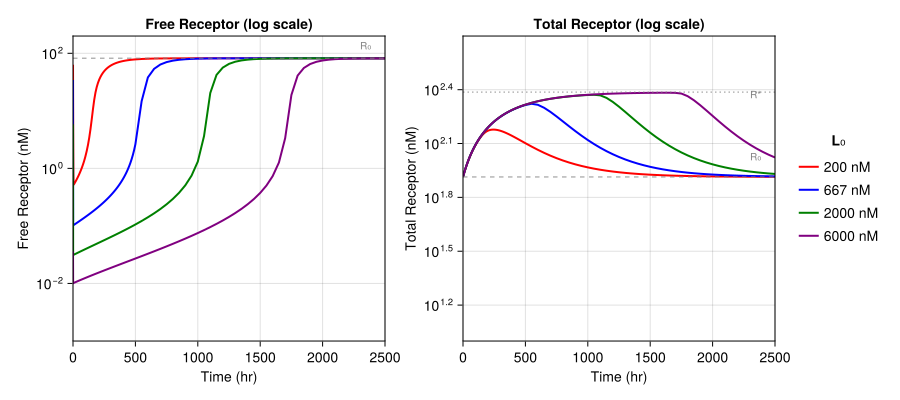
4.9 High Dose vs Low Dose: When Phases Disappear
The characteristic four-phase profile requires \(L_0 > R_0\). At low doses, some phases may be absent or difficult to observe:
Show/Hide Code
# Extended dose range including sub-R0 doses
extended_concs = [10.0, 40.0, 82.0, 200.0, 667.0, 2000.0, 6000.0, 12000.0]  # nM
extended_labels =
    ["10 nM", "40 nM", "82 nM", "200 nM", "667 nM", "2000 nM", "6000 nM", "12000 nM"]

pop_extended = [
    Subject(id = i, events = DosageRegimen(conc, time = 0, cmt = 1)) for
    (i, conc) in enumerate(extended_concs)
]

sim_extended = simobs(tmdd_model, pop_extended, peletier_params, obstimes = obstimes_full)
df_extended = DataFrame(sim_extended)
extended_label_df = DataFrame(id = string.(1:8), Dose = extended_labels)
df_extended = innerjoin(df_extended, extended_label_df, on = :id)

fig = Figure(size = (800, 500))
ax = Axis(
    fig[1, 1],
    xlabel = "Time (hr)",
    ylabel = "Free Ligand (nM)",
    title = "Dose-Dependent TMDD Profiles (8 doses)",
    yscale = log10,
    limits = (0, 2500, 1e-4, 20000),
)

colors = cgrad(:viridis, 8, categorical = true)
for (i, dose) in enumerate(extended_labels)
    df_dose = filter(row -> row.Dose == dose, df_extended)
    lines!(
        ax,
        df_dose.time,
        max.(df_dose.L, 1e-5),
        linewidth = 2,
        color = colors[i],
        label = dose,
    )
end

hlines!(ax, [R0], color = :gray, linestyle = :dash, alpha = 0.6)
text!(ax, 2300, R0 * 1.5, text = "R₀", fontsize = 10, color = :gray)

hlines!(ax, [KD], color = :gray, linestyle = :dot, alpha = 0.5)
text!(ax, 2300, KD * 0.5, text = "Kᴅ", fontsize = 10, color = :gray)

Legend(fig[1, 2], ax, "L₀", framevisible = false)
fig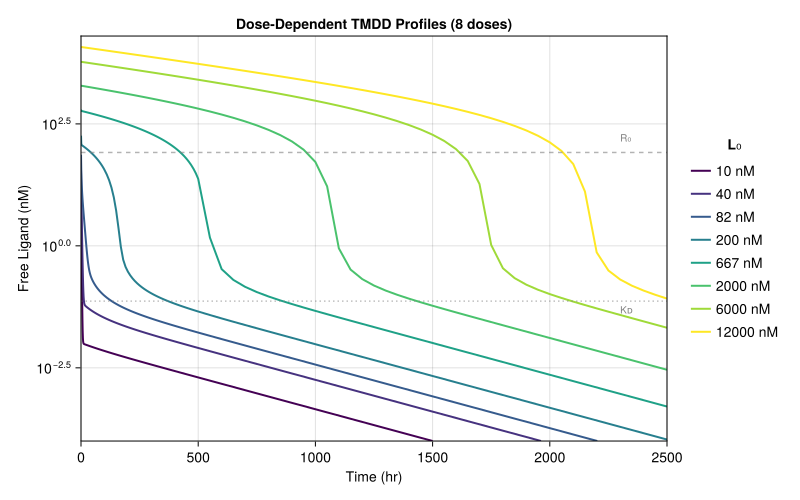
TipWhy the Signature Shape Requires L₀ > R₀
- Low doses (\(L_0 < R_0\)): Most ligand immediately bound; appears bi-exponential
- Near R₀ (\(L_0 \approx R_0\)): Brief Phase B, rapid transition
- High doses (\(L_0 >> R_0\)): Extended Phase B, clear four-phase structure
For clinical dose selection, this framework helps predict which profiles will show TMDD signatures.
4.10 Parameter Identification from the Profile
Each phase provides information about specific TMDD parameters:
| Phase | Observable Feature | Parameters Identified |
|---|---|---|
| A | Duration of rapid decline | \(k_{on}\), \(R_0\) |
| B | Slope during saturation | \(k_{el}\) (linear clearance) |
| C | Transition point, curvature | \(K_D\), \(k_{off}\) |
| D | Terminal slope | \(k_{int}\), \(K_M\) |
Show/Hide Code
fig = Figure(size = (900, 550))

df_single = filter(row -> row.Dose == "2000 nM", df_full)

ax = Axis(
    fig[1, 1],
    xlabel = "Time (hr)",
    ylabel = "Free Ligand (nM)",
    title = "Parameter Identification from TMDD Profile",
    yscale = log10,
    limits = (0, 2500, 1e-4, 5000),
)

lines!(ax, df_single.time, max.(df_single.L, 1e-5), linewidth = 3, color = :steelblue)

# Phase A annotation
bracket!(
    ax,
    Point2f(0, log10(1800)),
    Point2f(0.5, log10(1800)),
    orientation = :down,
    width = 20,
    color = :darkred,
)
text!(
    ax,
    0.25,
    1200,
    text = "kon, R₀",
    fontsize = 11,
    color = :darkred,
    align = (:center, :top),
)

# Phase B annotation - slope line
t_B = [10, 200]
L_B = 1500 * exp.(-peletier_params.tvKel .* (t_B .- 10))
lines!(ax, t_B, L_B, linewidth = 2, linestyle = :dash, color = :darkgreen)
text!(
    ax,
    80,
    800,
    text = "slope = kel",
    fontsize = 11,
    color = :darkgreen,
    rotation = -0.15,
)

# Phase C annotation - KD reference
vspan!(ax, 300, 700, color = (:darkorange, 0.1))
text!(
    ax,
    500,
    100,
    text = "KD, koff\nregion",
    fontsize = 11,
    color = :darkorange,
    align = (:center, :center),
)

# Phase D annotation - terminal slope
t_D = [1200, 2400]
L_D = 0.3 * exp.(-peletier_params.tvKint .* (t_D .- 1200))
lines!(ax, t_D, L_D, linewidth = 2, linestyle = :dash, color = :darkblue)
text!(
    ax,
    1800,
    0.15,
    text = "slope = kint",
    fontsize = 11,
    color = :darkblue,
    rotation = -0.05,
)

# Reference lines
hlines!(ax, [R0], color = :gray, linestyle = :dot, alpha = 0.5)
text!(ax, 2400, R0 * 1.5, text = "R₀", fontsize = 10, color = :gray)

hlines!(ax, [KD], color = :gray, linestyle = :dot, alpha = 0.5)
text!(ax, 2400, KD * 0.5, text = "Kᴅ", fontsize = 10, color = :gray)

fig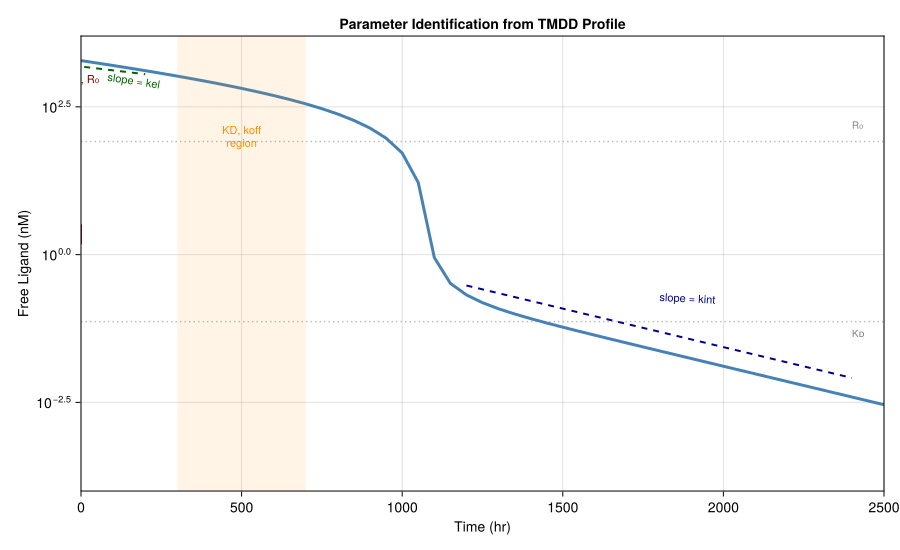
5 Part II: Constant-Rate Infusion
Constant-rate infusion provides additional insights into TMDD dynamics, particularly steady-state behavior and washout kinetics.
5.1 Steady-State Analysis
At steady state during infusion, all time derivatives equal zero. The steady-state concentrations depend on the infusion rate \(I\) (nM/hr):
Show/Hide Code
# Model with infusion support
tmdd_infusion = @model begin
    @param begin
        tvKel ∈ RealDomain(lower = 0)
        tvKon ∈ RealDomain(lower = 0)
        tvKoff ∈ RealDomain(lower = 0)
        tvKsyn ∈ RealDomain(lower = 0)
        tvKdeg ∈ RealDomain(lower = 0)
        tvKint ∈ RealDomain(lower = 0)
    end

    @pre begin
        Kel = tvKel
        Kon = tvKon
        Koff = tvKoff
        Ksyn = tvKsyn
        Kdeg = tvKdeg
        Kint = tvKint
    end

    @init begin
        Receptor = Ksyn / Kdeg
    end

    @dynamics begin
        Ligand' = -Kel * Ligand - Kon * Ligand * Receptor + Koff * Complex
        Receptor' = Ksyn - Kdeg * Receptor - Kon * Ligand * Receptor + Koff * Complex
        Complex' = Kon * Ligand * Receptor - Koff * Complex - Kint * Complex
    end

    @derived begin
        L = @. Ligand
        R = @. Receptor
        RL = @. Complex
    end
end

# Simulate various infusion rates to steady state
infusion_rates = 10.0 .^ range(-2, 2, length = 30)  # nM/hr
steady_state_L = Float64[]
steady_state_R = Float64[]

for rate in infusion_rates
    # Long infusion to reach steady state
    pop_inf = [
        Subject(
            id = 1,
            events = DosageRegimen(rate * 5000, time = 0, duration = 5000, cmt = 1),
        ),
    ]
    sim_inf = simobs(tmdd_infusion, pop_inf, peletier_params, obstimes = [4900])
    push!(steady_state_L, sim_inf[1].observations.L[1])
    push!(steady_state_R, sim_inf[1].observations.R[1])
end

fig = Figure(size = (800, 400))

ax1 = Axis(
    fig[1, 1],
    xlabel = "Infusion Rate (nM/hr)",
    ylabel = "Steady-State Concentration (nM)",
    title = "Steady-State vs Infusion Rate",
    xscale = log10,
    yscale = log10,
)

lines!(ax1, infusion_rates, steady_state_L, linewidth = 2, color = :blue, label = "Lss")
lines!(ax1, infusion_rates, steady_state_R, linewidth = 2, color = :red, label = "Rss")

hlines!(ax1, [R0], color = :gray, linestyle = :dash, alpha = 0.6)
text!(ax1, 0.02, R0 * 0.7, text = "R₀", fontsize = 10, color = :gray)

hlines!(ax1, [KD], color = :gray, linestyle = :dot, alpha = 0.5)
text!(ax1, 0.02, KD * 0.5, text = "Kᴅ", fontsize = 10, color = :gray)

Legend(fig[1, 2], ax1, framevisible = false)
fig
┌ Warning: Variable `L` is defined in the `@derived` block using `=` and hence `L` is not used for model fitting but only returned when simulating: │ If `L` is a random variable, it must be defined in the `@derived` block using `~`; │ if `L` should be returned when simulating, it should be defined in the `@observed` block using `=`; │ if `L` is an intermediate quantity that should not be returned when simulating, it should be defined using `:=`. └ @ Pumas ~/run/_work/PumasTutorials.jl/PumasTutorials.jl/custom_julia_depot/packages/Pumas/GZeMg/src/dsl/model_macro.jl:2351 ┌ Warning: Variable `R` is defined in the `@derived` block using `=` and hence `R` is not used for model fitting but only returned when simulating: │ If `R` is a random variable, it must be defined in the `@derived` block using `~`; │ if `R` should be returned when simulating, it should be defined in the `@observed` block using `=`; │ if `R` is an intermediate quantity that should not be returned when simulating, it should be defined using `:=`. └ @ Pumas ~/run/_work/PumasTutorials.jl/PumasTutorials.jl/custom_julia_depot/packages/Pumas/GZeMg/src/dsl/model_macro.jl:2351 ┌ Warning: Variable `RL` is defined in the `@derived` block using `=` and hence `RL` is not used for model fitting but only returned when simulating: │ If `RL` is a random variable, it must be defined in the `@derived` block using `~`; │ if `RL` should be returned when simulating, it should be defined in the `@observed` block using `=`; │ if `RL` is an intermediate quantity that should not be returned when simulating, it should be defined using `:=`. └ @ Pumas ~/run/_work/PumasTutorials.jl/PumasTutorials.jl/custom_julia_depot/packages/Pumas/GZeMg/src/dsl/model_macro.jl:2351
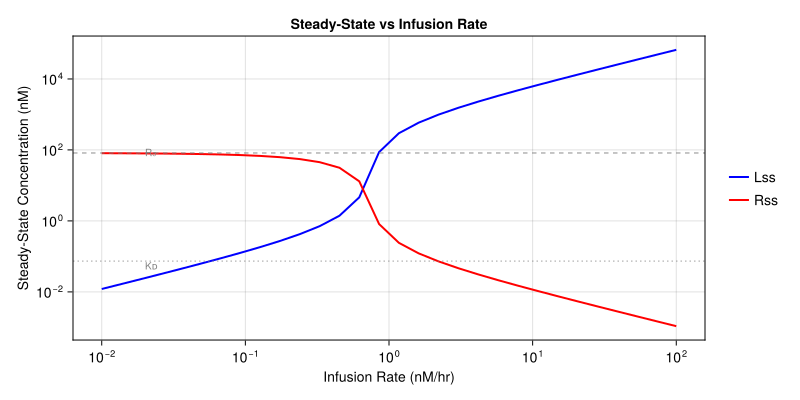
NoteSteady-State Interpretation
- At low infusion rates: \(L_{ss} \approx 0\), \(R_{ss} \approx R_0\) (target not suppressed)
- At high infusion rates: \(L_{ss}\) increases linearly, \(R_{ss} \rightarrow 0\) (target suppressed)
- The transition occurs around the infusion rate that produces \(L_{ss} \approx K_D\)
5.2 Build-up Dynamics
The approach to steady state during infusion shows characteristic TMDD behavior:
Show/Hide Code
# Infusion build-up at different rates
infusion_rates_buildup = [0.1, 0.5, 2.0, 10.0]  # nM/hr
infusion_labels = ["0.1 nM/hr", "0.5 nM/hr", "2.0 nM/hr", "10.0 nM/hr"]

obstimes_inf = 0:10:3000

fig = Figure(size = (900, 400))

ax1 = Axis(
    fig[1, 1],
    xlabel = "Time (hr)",
    ylabel = "Free Ligand (nM)",
    title = "Ligand Build-up During Infusion",
    yscale = log10,
    limits = (0, 3000, 0.001, 1000),
)

ax2 = Axis(
    fig[1, 2],
    xlabel = "Time (hr)",
    ylabel = "Free Receptor (nM)",
    title = "Receptor Suppression During Infusion",
)

colors = [:red, :blue, :green, :purple]

for (i, (rate, label, color)) in
    enumerate(zip(infusion_rates_buildup, infusion_labels, colors))
    pop_inf = [
        Subject(
            id = 1,
            events = DosageRegimen(rate * 3000, time = 0, duration = 3000, cmt = 1),
        ),
    ]
    sim_inf = simobs(tmdd_infusion, pop_inf, peletier_params, obstimes = obstimes_inf)
    df_inf = DataFrame(sim_inf)

    lines!(
        ax1,
        df_inf.time,
        max.(df_inf.L, 1e-4),
        linewidth = 2,
        color = color,
        label = label,
    )
    lines!(ax2, df_inf.time, df_inf.R, linewidth = 2, color = color, label = label)
end

hlines!(ax1, [KD], color = :gray, linestyle = :dash, alpha = 0.6)
text!(ax1, 2800, KD * 0.5, text = "Kᴅ", fontsize = 10, color = :gray)

hlines!(ax2, [R0], color = :gray, linestyle = :dash, alpha = 0.6)
text!(ax2, 2800, R0 * 0.95, text = "R₀", fontsize = 10, color = :gray)

Legend(fig[1, 3], ax1, "Rate", framevisible = false)
fig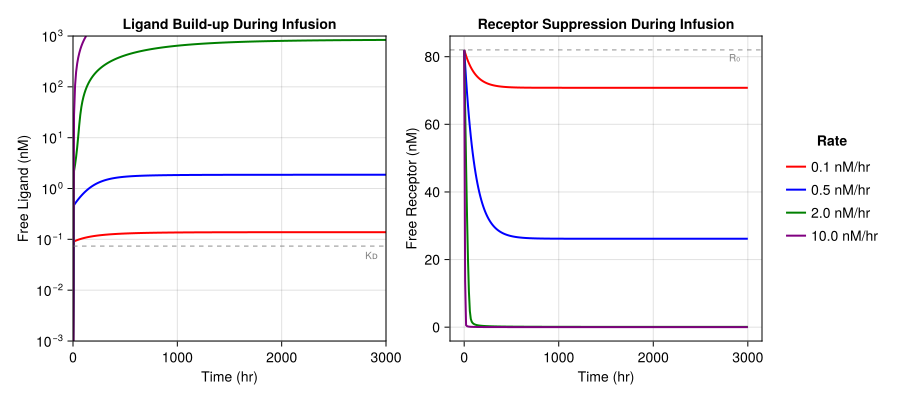
5.3 Washout Dynamics
After stopping infusion, the washout dynamics resemble post-bolus behavior:
Show/Hide Code
# Infusion followed by washout
rate = 5.0  # nM/hr
infusion_duration = 1000  # hr

pop_washout = [
    Subject(
        id = 1,
        events = DosageRegimen(
            rate * infusion_duration,
            time = 0,
            duration = infusion_duration,
            cmt = 1,
        ),
    ),
]

obstimes_washout = [0:10:1000; 1010:10:2000; 2050:50:4000]
sim_washout =
    simobs(tmdd_infusion, pop_washout, peletier_params, obstimes = obstimes_washout)
df_washout = DataFrame(sim_washout)

fig = Figure(size = (900, 400))

ax1 = Axis(
    fig[1, 1],
    xlabel = "Time (hr)",
    ylabel = "Free Ligand (nM)",
    title = "Ligand: Infusion and Washout",
    yscale = log10,
    limits = (0, 4000, 0.0001, 100),
)

lines!(ax1, df_washout.time, max.(df_washout.L, 1e-5), linewidth = 2, color = :steelblue)
vlines!(ax1, [infusion_duration], color = :gray, linestyle = :dash, alpha = 0.6)
text!(
    ax1,
    infusion_duration + 50,
    30,
    text = "Stop\ninfusion",
    fontsize = 10,
    color = :gray,
)

hlines!(ax1, [KD], color = :gray, linestyle = :dot, alpha = 0.5)
text!(ax1, 3800, KD * 0.5, text = "Kᴅ", fontsize = 10, color = :gray)

ax2 = Axis(
    fig[1, 2],
    xlabel = "Time (hr)",
    ylabel = "Free Receptor (nM)",
    title = "Receptor: Suppression and Recovery",
)

lines!(ax2, df_washout.time, df_washout.R, linewidth = 2, color = :firebrick)
vlines!(ax2, [infusion_duration], color = :gray, linestyle = :dash, alpha = 0.6)

hlines!(ax2, [R0], color = :gray, linestyle = :dash, alpha = 0.6)
text!(ax2, 3800, R0 * 0.95, text = "R₀", fontsize = 10, color = :gray)

fig
6 Part III: Comparison with Michaelis-Menten Approximation
The Michaelis-Menten (MM) quasi-steady-state approximation is commonly used to simplify TMDD models. Let’s compare it with the full model.
6.1 Michaelis-Menten Model
# MM approximation model
mm_model = @model begin
    @param begin
        tvKel ∈ RealDomain(lower = 0)
        tvVmax ∈ RealDomain(lower = 0)  # Maximum elimination rate
        tvKM ∈ RealDomain(lower = 0)    # Michaelis constant
    end

    @pre begin
        Kel = tvKel
        Vmax = tvVmax
        KM = tvKM
    end

    @dynamics begin
        Ligand' = -Kel * Ligand - Vmax * Ligand / (KM + Ligand)
    end

    @derived begin
        L = @. Ligand
    end
end

# Convert full TMDD parameters to MM equivalent
# Vmax = kint * Rtot ≈ kint * R0 (assuming Rtot ≈ R0 at high L)
# KM = (koff + kint) / kon
Vmax_equiv = peletier_params.tvKint * R0
KM_equiv = KM

mm_params = (tvKel = peletier_params.tvKel, tvVmax = Vmax_equiv, tvKM = KM_equiv)

println("MM Approximation Parameters:")
println("  Vmax = $(round(Vmax_equiv, digits=3)) nM/hr")
println("  KM = $(round(KM_equiv, digits=3)) nM")
┌ Warning: Variable `L` is defined in the `@derived` block using `=` and hence `L` is not used for model fitting but only returned when simulating: │ If `L` is a random variable, it must be defined in the `@derived` block using `~`; │ if `L` should be returned when simulating, it should be defined in the `@observed` block using `=`; │ if `L` is an intermediate quantity that should not be returned when simulating, it should be defined using `:=`. └ @ Pumas ~/run/_work/PumasTutorials.jl/PumasTutorials.jl/custom_julia_depot/packages/Pumas/GZeMg/src/dsl/model_macro.jl:2351 MM Approximation Parameters: Vmax = 0.246 nM/hr KM = 0.294 nM
6.2 Full Model vs MM Approximation
Show/Hide Code
# Simulate both models at same dose
dose_compare = 2000.0  # nM

pop_compare = [Subject(id = 1, events = DosageRegimen(dose_compare, time = 0, cmt = 1))]

sim_full_compare =
    simobs(tmdd_model, pop_compare, peletier_params, obstimes = obstimes_full)
sim_mm = simobs(mm_model, pop_compare, mm_params, obstimes = obstimes_full)

df_full_compare = DataFrame(sim_full_compare)
df_mm = DataFrame(sim_mm)

fig = Figure(size = (900, 500))

# Full time course
ax1 = Axis(
    fig[1, 1],
    xlabel = "Time (hr)",
    ylabel = "Free Ligand (nM)",
    title = "Full Model vs MM Approximation",
    yscale = log10,
    limits = (0, 2500, 1e-4, 5000),
)

lines!(
    ax1,
    df_full_compare.time,
    max.(df_full_compare.L, 1e-5),
    linewidth = 3,
    color = :steelblue,
    label = "Full TMDD",
)
lines!(
    ax1,
    df_mm.time,
    max.(df_mm.L, 1e-5),
    linewidth = 2,
    linestyle = :dash,
    color = :red,
    label = "MM Approx",
)

hlines!(ax1, [KD], color = :gray, linestyle = :dot, alpha = 0.5)
text!(ax1, 2400, KD * 0.5, text = "Kᴅ", fontsize = 10, color = :gray)

hlines!(ax1, [KM], color = :gray, linestyle = :dot, alpha = 0.5)
text!(ax1, 2400, KM * 2, text = "Kᴍ", fontsize = 10, color = :gray)

Legend(fig[1, 2], ax1, framevisible = false)

# Early time close-up (Phase A)
ax2 = Axis(
    fig[2, 1],
    xlabel = "Time (hr)",
    ylabel = "Free Ligand (nM)",
    title = "Phase A: MM Misses Rapid Binding",
    limits = (0, 5, 1000, 2200),
)

df_full_early = filter(row -> row.time <= 5, df_full_compare)
df_mm_early = filter(row -> row.time <= 5, df_mm)

lines!(
    ax2,
    df_full_early.time,
    df_full_early.L,
    linewidth = 3,
    color = :steelblue,
    label = "Full TMDD",
)
lines!(
    ax2,
    df_mm_early.time,
    df_mm_early.L,
    linewidth = 2,
    linestyle = :dash,
    color = :red,
    label = "MM Approx",
)

# Terminal phase close-up
ax3 = Axis(
    fig[2, 2],
    xlabel = "Time (hr)",
    ylabel = "Free Ligand (nM)",
    title = "Phase D: Different Terminal Slopes",
    yscale = log10,
    limits = (1000, 2500, 1e-4, 10),
)

df_full_late = filter(row -> row.time >= 1000, df_full_compare)
df_mm_late = filter(row -> row.time >= 1000, df_mm)

lines!(
    ax3,
    df_full_late.time,
    max.(df_full_late.L, 1e-5),
    linewidth = 3,
    color = :steelblue,
    label = "Full TMDD",
)
lines!(
    ax3,
    df_mm_late.time,
    max.(df_mm_late.L, 1e-5),
    linewidth = 2,
    linestyle = :dash,
    color = :red,
    label = "MM Approx",
)

# Add slope reference lines
t_term = [1500, 2400]
L_full_term = 0.3 * exp.(-peletier_params.tvKint .* (t_term .- 1500))
L_mm_term = 0.3 * exp.(-(peletier_params.tvKel + Vmax_equiv / KM_equiv) .* (t_term .- 1500))

lines!(ax3, t_term, L_full_term, linewidth = 1.5, linestyle = :dot, color = :steelblue)
lines!(ax3, t_term, max.(L_mm_term, 1e-5), linewidth = 1.5, linestyle = :dot, color = :red)

fig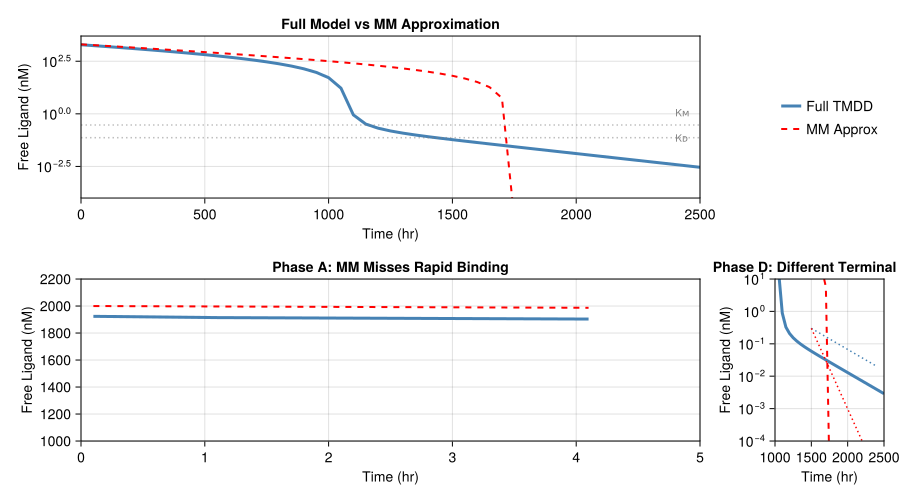
6.3 When MM Works (and When It Doesn’t)
| Aspect | Full TMDD | MM Approximation |
|---|---|---|
| Phase A | Captures rapid binding | Cannot represent |
| Phase B | ✓ Similar | ✓ Similar |
| Phase C | ✓ Similar | ✓ Similar (if \(K_M \approx K_D\)) |
| Phase D | Slope \(\approx k_{int}\) | Slope \(\approx k_{el} + V_{max}/K_M\) |
| Terminal t½ | Determined by slowest process | Often overestimated |
WarningPractical Implications
The MM approximation may:
- Miss rapid initial binding (Phase A) - affects early timepoints
- Predict incorrect terminal slope - affects extrapolation
- Bias \(K_M\) estimates when fitted to data spanning all phases
The full model is preferred when:
- Early timepoints are available and important
- Terminal phase is observed and informs dosing
- Receptor dynamics are of interest
7 Summary: The TMDD Fingerprint
The four-phase framework provides a powerful lens for understanding TMDD:
7.1 Key Takeaways
Phase A (Rapid Binding): Duration ~\(1/(k_{on}(L_0 - R_0))\); reveals \(k_{on}\), \(R_0\)
Phase B (Target Saturated): Slope ~\(k_{el}\); parallel lines across doses
Phase C (Transition): Occurs around \(L \sim K_D\); reveals binding affinity
Phase D (Terminal): Slope ~\(k_{int}\); often internalization-limited
7.2 When to Suspect TMDD in Your Data
7.3 Quick Reference Card
| Parameter | Typical Phase | How to Identify |
|---|---|---|
| \(k_{on}\) | A | Duration of rapid binding |
| \(R_0\) | A, C | Initial drop magnitude |
| \(k_{el}\) | B | Slope during saturation |
| \(k_{syn}\) | B, C | Receptor recovery rate |
| \(K_D\) | C | Transition concentration |
| \(k_{off}\) | C | Derived from \(K_D\) and \(k_{on}\) |
| \(k_{int}\) | D | Terminal slope |
| \(K_M\) | C, D | Curvature through transition |
8 References
Peletier, L. A., & Gabrielsson, J. (2012). Dynamics of target-mediated drug disposition: Characteristic profiles and parameter identification. Journal of Pharmacokinetics and Pharmacodynamics, 39(5), 429–451. https://doi.org/10.1007/s10928-012-9260-6