using Pumas
using PumasUtilities
using AlgebraOfGraphics
using CairoMakie
using DataFrames
using Random
TMDD Part 4: Special Cases and Extensions
1 Introduction
This is Part 4 of our comprehensive TMDD tutorial series. Here we explore specialized TMDD scenarios that extend beyond the standard model, including constant receptor models, irreversible binding, drug-drug interactions at the target level, and FcRn-mediated recycling.
Tutorial Series Overview:
- Part 1: Understanding TMDD - Conceptual foundations and parameter meaning 1b. Part 1b: TMDD Dynamics Through the Four Phases - Deep dive into phase characterization
- Part 2: The Full TMDD Model - Complete mechanistic model implementation
- Part 3: TMDD Approximations - QE, QSS, and Michaelis-Menten models
- Part 4: Special Cases and Extensions (this tutorial) - Advanced TMDD scenarios
- Part 5: Practical Workflows - Fitting, diagnostics, and model selection
2 Learning Objectives
By the end of this tutorial, you will be able to:
- Implement the constant receptor (\(R_{tot}\)) TMDD model
- Model irreversible (covalent) binding scenarios
- Handle two drugs competing for the same target
- Incorporate FcRn-mediated recycling for mAbs
- Model subcutaneous administration with absorption-site binding
- Understand when each special case applies
3 Libraries
4 Constant Total Receptor Model
4.1 When to Use
The constant \(R_{tot}\) model (Wagner assumption) applies when:
- Target turnover is rapid compared to drug disposition
- Receptor is continuously replenished from a large pool
- Receptor synthesis rate is high relative to drug binding
- Critically: \(k_{int} \approx k_{deg}\) (the complex and free receptor degrade at similar rates)
NoteKey Assumption
As noted in the literature (Gibiansky et al., 2008; Wagner, 1976), the constant \(R_{tot}\) assumption requires that \(k_{int} \approx k_{deg}\). When this condition holds, the total receptor (\(R + LR\)) remains constant because the degradation rate of the complex equals that of the free receptor.
Under these conditions, the total receptor concentration remains approximately constant:
\[ R_{tot} = R + LR \approx \text{constant} \]
4.2 Mathematical Formulation
Starting from the standard TMDD model and assuming \(R_{tot}\) is constant:
\[ \frac{dL}{dt} = -k_{el} \cdot L - k_{on} \cdot L \cdot (R_{tot} - LR) + k_{off} \cdot LR \]
\[ \frac{dLR}{dt} = k_{on} \cdot L \cdot (R_{tot} - LR) - k_{off} \cdot LR - k_{int} \cdot LR \]
Or equivalently:
\[ \frac{dLR}{dt} = k_{on} \cdot L \cdot R_{tot} - (k_{on} \cdot L + k_{off} + k_{int}) \cdot LR \]
4.3 Pumas Implementation
tmdd_constant_rtot = @model begin
    @metadata begin
        desc = "TMDD with Constant Total Receptor"
        timeu = u"hr"
    end

    @param begin
        tvCl ∈ RealDomain(lower = 0)
        tvVc ∈ RealDomain(lower = 0)
        tvRtot ∈ RealDomain(lower = 0)    # Constant total receptor
        tvKon ∈ RealDomain(lower = 0)
        tvKoff ∈ RealDomain(lower = 0)
        tvKint ∈ RealDomain(lower = 0)
    end

    @pre begin
        Cl = tvCl
        Vc = tvVc
        Rtot = tvRtot  # Constant
        Kon = tvKon
        Koff = tvKoff
        Kint = tvKint
    end

    @dosecontrol begin
        bioav = (Ligand = 1 / tvVc,)
    end

    @vars begin
        Kel := Cl / Vc
        KD := Koff / Kon
        # Free receptor from mass balance (Rtot is constant)
        R := Rtot - Complex
    end

    @dynamics begin
        # Free ligand
        Ligand' = -Kel * Ligand - Kon * Ligand * R + Koff * Complex

        # Complex (no receptor dynamics needed since Rtot is constant)
        Complex' = Kon * Ligand * R - Koff * Complex - Kint * Complex
    end

    @derived begin
        Free_Ligand = @. Ligand
        Free_Receptor = @. R
        Complex_Conc = @. Complex
        Target_Occupancy = @. Complex / Rtot
    end
end
┌ Warning: Variable `Free_Ligand` is defined in the `@derived` block using `=` and hence `Free_Ligand` is not used for model fitting but only returned when simulating: │ If `Free_Ligand` is a random variable, it must be defined in the `@derived` block using `~`; │ if `Free_Ligand` should be returned when simulating, it should be defined in the `@observed` block using `=`; │ if `Free_Ligand` is an intermediate quantity that should not be returned when simulating, it should be defined using `:=`. └ @ Pumas ~/run/_work/PumasTutorials.jl/PumasTutorials.jl/custom_julia_depot/packages/Pumas/GZeMg/src/dsl/model_macro.jl:2351 ┌ Warning: Variable `Free_Receptor` is defined in the `@derived` block using `=` and hence `Free_Receptor` is not used for model fitting but only returned when simulating: │ If `Free_Receptor` is a random variable, it must be defined in the `@derived` block using `~`; │ if `Free_Receptor` should be returned when simulating, it should be defined in the `@observed` block using `=`; │ if `Free_Receptor` is an intermediate quantity that should not be returned when simulating, it should be defined using `:=`. └ @ Pumas ~/run/_work/PumasTutorials.jl/PumasTutorials.jl/custom_julia_depot/packages/Pumas/GZeMg/src/dsl/model_macro.jl:2351 ┌ Warning: Variable `Complex_Conc` is defined in the `@derived` block using `=` and hence `Complex_Conc` is not used for model fitting but only returned when simulating: │ If `Complex_Conc` is a random variable, it must be defined in the `@derived` block using `~`; │ if `Complex_Conc` should be returned when simulating, it should be defined in the `@observed` block using `=`; │ if `Complex_Conc` is an intermediate quantity that should not be returned when simulating, it should be defined using `:=`. └ @ Pumas ~/run/_work/PumasTutorials.jl/PumasTutorials.jl/custom_julia_depot/packages/Pumas/GZeMg/src/dsl/model_macro.jl:2351 ┌ Warning: Variable `Target_Occupancy` is defined in the `@derived` block using `=` and hence `Target_Occupancy` is not used for model fitting but only returned when simulating: │ If `Target_Occupancy` is a random variable, it must be defined in the `@derived` block using `~`; │ if `Target_Occupancy` should be returned when simulating, it should be defined in the `@observed` block using `=`; │ if `Target_Occupancy` is an intermediate quantity that should not be returned when simulating, it should be defined using `:=`. └ @ Pumas ~/run/_work/PumasTutorials.jl/PumasTutorials.jl/custom_julia_depot/packages/Pumas/GZeMg/src/dsl/model_macro.jl:2351
PumasModel
  Parameters: tvCl, tvVc, tvRtot, tvKon, tvKoff, tvKint
  Random effects:
  Covariates:
  Dynamical system variables: Ligand, Complex
  Dynamical system type: Nonlinear ODE
  Derived: Free_Ligand, Free_Receptor, Complex_Conc, Target_Occupancy
  Observed: Free_Ligand, Free_Receptor, Complex_Conc, Target_Occupancy
4.4 Simulation Example
Show/Hide Code
# Parameters for constant Rtot model
# Note: kint ≈ kdeg for the constant Rtot assumption to hold
param_const_rtot = (
    tvCl = 0.006,
    tvVc = 3.0,
    tvRtot = 5.0,     # Constant at 5 nM (similar to R0 in other tutorials)
    tvKon = 0.33,
    tvKoff = 0.33,
    tvKint = 0.008,   # Set equal to kdeg (0.008 hr⁻¹) for constant Rtot
)

doses = [5.0, 50.0, 500.0]  # nmol - wide range for clear visualization
Random.seed!(42)

pop_const = [
    Subject(
        id = i,
        events = DosageRegimen(dose, time = 0, cmt = 1),
        observations = (
            Free_Ligand = nothing,
            Free_Receptor = nothing,
            Target_Occupancy = nothing,
        ),
    ) for (i, dose) in enumerate(doses)
]

obstimes = 0.1:2:672  # Extended time for mAb kinetics

sim_const = simobs(tmdd_constant_rtot, pop_const, param_const_rtot, obstimes = obstimes)
Simulated population (Vector{<:Subject})
Simulated subjects: 3
Simulated variables: Free_Ligand, Free_Receptor, Complex_Conc, Target_OccupancyShow/Hide Code
# Convert simulation to DataFrame
df_const = DataFrame(sim_const)
dose_label_df = DataFrame(id = string.(1:3), Dose = ["5 nmol", "50 nmol", "500 nmol"])
df_const = innerjoin(df_const, dose_label_df, on = :id)

# Stack for faceted plot
df_long = stack(
    df_const,
    [:Free_Receptor, :Target_Occupancy],
    variable_name = :Metric,
    value_name = :Value,
)
df_long.Metric =
    replace.(
        string.(df_long.Metric),
        "Free_Receptor" => "Free Receptor (nM)",
        "Target_Occupancy" => "Target Occupancy",
    )

plt =
    data(df_long) *
    mapping(:time => "Time (hr)", :Value; color = :Dose, layout = :Metric) *
    visual(Lines; linewidth = 2)

draw(plt; figure = (title = "Constant Rtot Model",))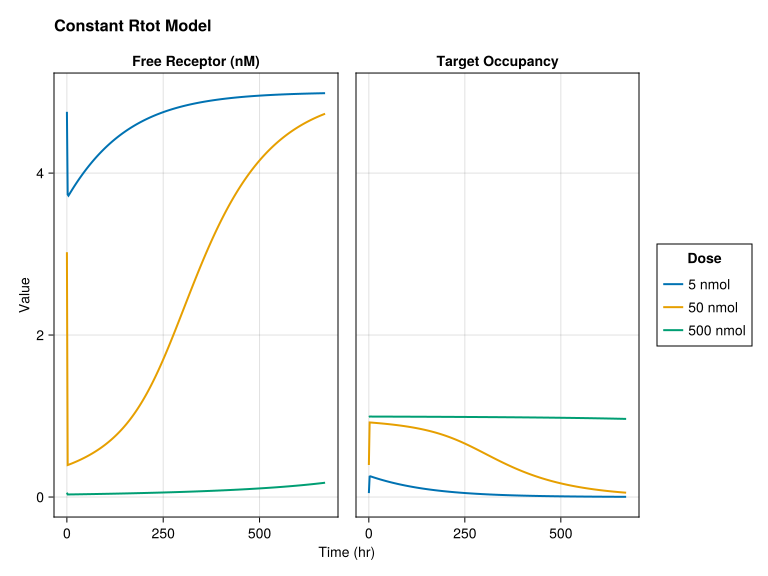
NoteKey Feature
With the constant \(R_{tot}\) model, the free receptor returns to exactly \(R_{tot}\) after drug washout, regardless of dose. This contrasts with the standard model where receptor can be temporarily depleted.
5 Irreversible Binding Model
5.1 When to Use
Irreversible binding (\(k_{off} = 0\)) applies for:
- Covalent inhibitors that form permanent bonds
- Very tight binders where \(k_{off}\) is negligibly small (\(k_{off} \ll k_{int}, k_{deg}\))
- Suicide substrates that inactivate the target
5.2 Mathematical Formulation
With \(k_{off} = 0\):
\[ \frac{dL}{dt} = -k_{el} \cdot L - k_{on} \cdot L \cdot R \]
\[ \frac{dR}{dt} = k_{syn} - k_{deg} \cdot R - k_{on} \cdot L \cdot R \]
\[ \frac{dLR}{dt} = k_{on} \cdot L \cdot R - k_{int} \cdot LR \]
Notice: the complex cannot dissociate, only be internalized/degraded.
TipThe \(K_{IB}\) Parameter
For irreversible binding models, Gibiansky & Gibiansky (2009) introduced the irreversible binding constant:
\[ K_{IB} = \frac{k_{deg}}{k_{on}} \]
This parameter plays an analogous role to \(K_D\) in reversible binding. When the irreversible binding model is further reduced to Michaelis-Menten, \(K_M = K_{IB}\) and \(V_{max} = k_{syn}\).
The relationship \(K_{IB} = k_{deg}/k_{on}\) differs from \(K_D = k_{off}/k_{on}\) because in irreversible binding, the receptor turnover (\(k_{deg}\)) determines the effective binding capacity rather than dissociation.
5.3 Pumas Implementation
tmdd_irreversible = @model begin
    @metadata begin
        desc = "TMDD with Irreversible Binding (Koff = 0)"
        timeu = u"hr"
    end

    @param begin
        tvCl ∈ RealDomain(lower = 0)
        tvVc ∈ RealDomain(lower = 0)
        tvKsyn ∈ RealDomain(lower = 0)
        tvKdeg ∈ RealDomain(lower = 0)
        tvKon ∈ RealDomain(lower = 0)      # Association only
        tvKint ∈ RealDomain(lower = 0)
    end

    @pre begin
        Cl = tvCl
        Vc = tvVc
        Ksyn = tvKsyn
        Kdeg = tvKdeg
        Kon = tvKon
        Kint = tvKint
    end

    @dosecontrol begin
        bioav = (Ligand = 1 / tvVc,)
    end

    @init begin
        Receptor = Ksyn / Kdeg
    end

    @vars begin
        Kel := Cl / Vc
        R0 := Ksyn / Kdeg
    end

    @dynamics begin
        # No Koff term - binding is irreversible
        Ligand' = -Kel * Ligand - Kon * Ligand * Receptor

        Receptor' = Ksyn - Kdeg * Receptor - Kon * Ligand * Receptor

        # Complex only cleared by internalization
        Complex' = Kon * Ligand * Receptor - Kint * Complex
    end

    @derived begin
        Free_Ligand = @. Ligand
        Free_Receptor = @. Receptor
        Complex_Conc = @. Complex
    end
end
┌ Warning: Variable `Free_Ligand` is defined in the `@derived` block using `=` and hence `Free_Ligand` is not used for model fitting but only returned when simulating: │ If `Free_Ligand` is a random variable, it must be defined in the `@derived` block using `~`; │ if `Free_Ligand` should be returned when simulating, it should be defined in the `@observed` block using `=`; │ if `Free_Ligand` is an intermediate quantity that should not be returned when simulating, it should be defined using `:=`. └ @ Pumas ~/run/_work/PumasTutorials.jl/PumasTutorials.jl/custom_julia_depot/packages/Pumas/GZeMg/src/dsl/model_macro.jl:2351 ┌ Warning: Variable `Free_Receptor` is defined in the `@derived` block using `=` and hence `Free_Receptor` is not used for model fitting but only returned when simulating: │ If `Free_Receptor` is a random variable, it must be defined in the `@derived` block using `~`; │ if `Free_Receptor` should be returned when simulating, it should be defined in the `@observed` block using `=`; │ if `Free_Receptor` is an intermediate quantity that should not be returned when simulating, it should be defined using `:=`. └ @ Pumas ~/run/_work/PumasTutorials.jl/PumasTutorials.jl/custom_julia_depot/packages/Pumas/GZeMg/src/dsl/model_macro.jl:2351 ┌ Warning: Variable `Complex_Conc` is defined in the `@derived` block using `=` and hence `Complex_Conc` is not used for model fitting but only returned when simulating: │ If `Complex_Conc` is a random variable, it must be defined in the `@derived` block using `~`; │ if `Complex_Conc` should be returned when simulating, it should be defined in the `@observed` block using `=`; │ if `Complex_Conc` is an intermediate quantity that should not be returned when simulating, it should be defined using `:=`. └ @ Pumas ~/run/_work/PumasTutorials.jl/PumasTutorials.jl/custom_julia_depot/packages/Pumas/GZeMg/src/dsl/model_macro.jl:2351
PumasModel
  Parameters: tvCl, tvVc, tvKsyn, tvKdeg, tvKon, tvKint
  Random effects:
  Covariates:
  Dynamical system variables: Ligand, Receptor, Complex
  Dynamical system type: Nonlinear ODE
  Derived: Free_Ligand, Free_Receptor, Complex_Conc
  Observed: Free_Ligand, Free_Receptor, Complex_Conc
5.4 Comparison: Reversible vs Irreversible
Show/Hide Code
# Define comparison models using consistent Gibiansky-based parameters
param_reversible = (
    tvCl = 0.006,
    tvVc = 3.0,
    tvKsyn = 0.04,
    tvKdeg = 0.008,
    tvKon = 0.33,
    tvKoff = 0.33,  # Reversible (KD = 1 nM)
    tvKint = 0.002,
)

param_irreversible =
    (tvCl = 0.006, tvVc = 3.0, tvKsyn = 0.04, tvKdeg = 0.008, tvKon = 0.33, tvKint = 0.002)

# Standard TMDD model for comparison
tmdd_reversible = @model begin
    @param begin
        tvCl ∈ RealDomain(lower = 0)
        tvVc ∈ RealDomain(lower = 0)
        tvKsyn ∈ RealDomain(lower = 0)
        tvKdeg ∈ RealDomain(lower = 0)
        tvKon ∈ RealDomain(lower = 0)
        tvKoff ∈ RealDomain(lower = 0)
        tvKint ∈ RealDomain(lower = 0)
    end

    @pre begin
        Cl = tvCl
        Vc = tvVc
        Ksyn = tvKsyn
        Kdeg = tvKdeg
        Kon = tvKon
        Koff = tvKoff
        Kint = tvKint
    end

    @dosecontrol begin
        bioav = (Ligand = 1 / tvVc,)
    end

    @init begin
        Receptor = Ksyn / Kdeg
    end

    @dynamics begin
        Ligand' = -(Cl / Vc) * Ligand - Kon * Ligand * Receptor + Koff * Complex
        Receptor' = Ksyn - Kdeg * Receptor - Kon * Ligand * Receptor + Koff * Complex
        Complex' = Kon * Ligand * Receptor - Koff * Complex - Kint * Complex
    end

    @derived begin
        Free_Ligand = @. Ligand
        Free_Receptor = @. Receptor
    end
end

single_pop = [
    Subject(
        id = 1,
        events = DosageRegimen(50, time = 0, cmt = 1),  # 50 nmol dose
        observations = (Free_Ligand = nothing, Free_Receptor = nothing),
    ),
]

sim_rev = simobs(tmdd_reversible, single_pop, param_reversible, obstimes = obstimes)
sim_irrev = simobs(tmdd_irreversible, single_pop, param_irreversible, obstimes = obstimes)

# Convert to DataFrames
df_rev = DataFrame(sim_rev)
df_rev.Binding .= "Reversible"

df_irrev = DataFrame(sim_irrev)
df_irrev.Binding .= "Irreversible"

df_binding = vcat(
    select(df_rev, :time, :Free_Ligand, :Free_Receptor, :Binding),
    select(df_irrev, :time, :Free_Ligand, :Free_Receptor, :Binding),
)

# Stack for faceted plot
df_long = stack(
    df_binding,
    [:Free_Ligand, :Free_Receptor],
    variable_name = :Species,
    value_name = :Concentration,
)
df_long.Species =
    replace.(
        string.(df_long.Species),
        "Free_Ligand" => "Free Ligand",
        "Free_Receptor" => "Free Receptor",
    )

plt =
    data(df_long) *
    mapping(
        :time => "Time (hr)",
        :Concentration => "Concentration (nM)";
        color = :Binding,
        linestyle = :Binding,
        layout = :Species,
    ) *
    visual(Lines; linewidth = 2)

draw(plt)
┌ Warning: Variable `Free_Ligand` is defined in the `@derived` block using `=` and hence `Free_Ligand` is not used for model fitting but only returned when simulating: │ If `Free_Ligand` is a random variable, it must be defined in the `@derived` block using `~`; │ if `Free_Ligand` should be returned when simulating, it should be defined in the `@observed` block using `=`; │ if `Free_Ligand` is an intermediate quantity that should not be returned when simulating, it should be defined using `:=`. └ @ Pumas ~/run/_work/PumasTutorials.jl/PumasTutorials.jl/custom_julia_depot/packages/Pumas/GZeMg/src/dsl/model_macro.jl:2351 ┌ Warning: Variable `Free_Receptor` is defined in the `@derived` block using `=` and hence `Free_Receptor` is not used for model fitting but only returned when simulating: │ If `Free_Receptor` is a random variable, it must be defined in the `@derived` block using `~`; │ if `Free_Receptor` should be returned when simulating, it should be defined in the `@observed` block using `=`; │ if `Free_Receptor` is an intermediate quantity that should not be returned when simulating, it should be defined using `:=`. └ @ Pumas ~/run/_work/PumasTutorials.jl/PumasTutorials.jl/custom_julia_depot/packages/Pumas/GZeMg/src/dsl/model_macro.jl:2351
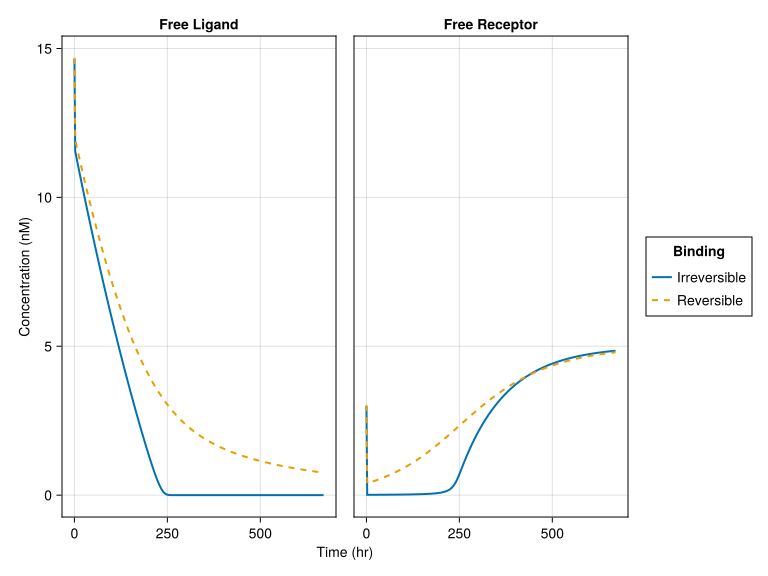
ImportantIrreversible Binding Effects
With irreversible binding:
- Free ligand clears faster (no release from complex)
- Receptor suppression is more pronounced
- Recovery depends entirely on new receptor synthesis
6 Two Drugs Competing for the Same Target
6.1 When to Use
Competition models apply for:
- Drug-drug interactions at the target level
- Biosimilar comparisons with the originator
- Combination therapies targeting the same receptor
- Displacement studies
6.2 Mathematical Formulation
The competitive binding equations, originally described by Gaddum (1926), extend the TMDD framework for two ligands:
For two ligands (\(L_1\) and \(L_2\)) competing for the same receptor:
\[ \frac{dL_1}{dt} = -k_{el,1} \cdot L_1 - k_{on,1} \cdot L_1 \cdot R + k_{off,1} \cdot L_1R \]
\[ \frac{dL_2}{dt} = -k_{el,2} \cdot L_2 - k_{on,2} \cdot L_2 \cdot R + k_{off,2} \cdot L_2R \]
\[ \frac{dR}{dt} = k_{syn} - k_{deg} \cdot R - k_{on,1} \cdot L_1 \cdot R + k_{off,1} \cdot L_1R - k_{on,2} \cdot L_2 \cdot R + k_{off,2} \cdot L_2R \]
\[ \frac{dL_1R}{dt} = k_{on,1} \cdot L_1 \cdot R - k_{off,1} \cdot L_1R - k_{int,1} \cdot L_1R \]
\[ \frac{dL_2R}{dt} = k_{on,2} \cdot L_2 \cdot R - k_{off,2} \cdot L_2R - k_{int,2} \cdot L_2R \]
6.3 Pumas Implementation
tmdd_competition = @model begin
    @metadata begin
        desc = "TMDD with Two Competing Ligands"
        timeu = u"hr"
    end

    @param begin
        # Drug 1 parameters
        tvCl1 ∈ RealDomain(lower = 0)
        tvVc1 ∈ RealDomain(lower = 0)
        tvKon1 ∈ RealDomain(lower = 0)
        tvKoff1 ∈ RealDomain(lower = 0)
        tvKint1 ∈ RealDomain(lower = 0)
        # Drug 2 parameters
        tvCl2 ∈ RealDomain(lower = 0)
        tvVc2 ∈ RealDomain(lower = 0)
        tvKon2 ∈ RealDomain(lower = 0)
        tvKoff2 ∈ RealDomain(lower = 0)
        tvKint2 ∈ RealDomain(lower = 0)
        # Receptor parameters
        tvKsyn ∈ RealDomain(lower = 0)
        tvKdeg ∈ RealDomain(lower = 0)
    end

    @pre begin
        Cl1 = tvCl1
        Vc1 = tvVc1
        Kon1 = tvKon1
        Koff1 = tvKoff1
        Kint1 = tvKint1

        Cl2 = tvCl2
        Vc2 = tvVc2
        Kon2 = tvKon2
        Koff2 = tvKoff2
        Kint2 = tvKint2

        Ksyn = tvKsyn
        Kdeg = tvKdeg
    end

    @dosecontrol begin
        bioav = (Ligand1 = 1 / tvVc1, Ligand2 = 1 / tvVc2)
    end

    @init begin
        Receptor = Ksyn / Kdeg
    end

    @vars begin
        Kel1 := Cl1 / Vc1
        Kel2 := Cl2 / Vc2
        R0 := Ksyn / Kdeg
        Rtot := Receptor + Complex1 + Complex2
    end

    @dynamics begin
        # Drug 1
        Ligand1' = -Kel1 * Ligand1 - Kon1 * Ligand1 * Receptor + Koff1 * Complex1

        # Drug 2
        Ligand2' = -Kel2 * Ligand2 - Kon2 * Ligand2 * Receptor + Koff2 * Complex2

        # Shared receptor - both drugs compete
        Receptor' =
            Ksyn - Kdeg * Receptor - Kon1 * Ligand1 * Receptor + Koff1 * Complex1 -
            Kon2 * Ligand2 * Receptor + Koff2 * Complex2

        # Complex 1 (Drug 1-Receptor)
        Complex1' = Kon1 * Ligand1 * Receptor - Koff1 * Complex1 - Kint1 * Complex1

        # Complex 2 (Drug 2-Receptor)
        Complex2' = Kon2 * Ligand2 * Receptor - Koff2 * Complex2 - Kint2 * Complex2
    end

    @derived begin
        Free_Ligand1 = @. Ligand1
        Free_Ligand2 = @. Ligand2
        Free_Receptor = @. Receptor
        Occupancy_Drug1 = @. Complex1 / Rtot
        Occupancy_Drug2 = @. Complex2 / Rtot
        Total_Occupancy = @. (Complex1 + Complex2) / Rtot
    end
end
┌ Warning: Variable `Free_Ligand1` is defined in the `@derived` block using `=` and hence `Free_Ligand1` is not used for model fitting but only returned when simulating: │ If `Free_Ligand1` is a random variable, it must be defined in the `@derived` block using `~`; │ if `Free_Ligand1` should be returned when simulating, it should be defined in the `@observed` block using `=`; │ if `Free_Ligand1` is an intermediate quantity that should not be returned when simulating, it should be defined using `:=`. └ @ Pumas ~/run/_work/PumasTutorials.jl/PumasTutorials.jl/custom_julia_depot/packages/Pumas/GZeMg/src/dsl/model_macro.jl:2351 ┌ Warning: Variable `Free_Ligand2` is defined in the `@derived` block using `=` and hence `Free_Ligand2` is not used for model fitting but only returned when simulating: │ If `Free_Ligand2` is a random variable, it must be defined in the `@derived` block using `~`; │ if `Free_Ligand2` should be returned when simulating, it should be defined in the `@observed` block using `=`; │ if `Free_Ligand2` is an intermediate quantity that should not be returned when simulating, it should be defined using `:=`. └ @ Pumas ~/run/_work/PumasTutorials.jl/PumasTutorials.jl/custom_julia_depot/packages/Pumas/GZeMg/src/dsl/model_macro.jl:2351 ┌ Warning: Variable `Free_Receptor` is defined in the `@derived` block using `=` and hence `Free_Receptor` is not used for model fitting but only returned when simulating: │ If `Free_Receptor` is a random variable, it must be defined in the `@derived` block using `~`; │ if `Free_Receptor` should be returned when simulating, it should be defined in the `@observed` block using `=`; │ if `Free_Receptor` is an intermediate quantity that should not be returned when simulating, it should be defined using `:=`. └ @ Pumas ~/run/_work/PumasTutorials.jl/PumasTutorials.jl/custom_julia_depot/packages/Pumas/GZeMg/src/dsl/model_macro.jl:2351 ┌ Warning: Variable `Occupancy_Drug1` is defined in the `@derived` block using `=` and hence `Occupancy_Drug1` is not used for model fitting but only returned when simulating: │ If `Occupancy_Drug1` is a random variable, it must be defined in the `@derived` block using `~`; │ if `Occupancy_Drug1` should be returned when simulating, it should be defined in the `@observed` block using `=`; │ if `Occupancy_Drug1` is an intermediate quantity that should not be returned when simulating, it should be defined using `:=`. └ @ Pumas ~/run/_work/PumasTutorials.jl/PumasTutorials.jl/custom_julia_depot/packages/Pumas/GZeMg/src/dsl/model_macro.jl:2351 ┌ Warning: Variable `Occupancy_Drug2` is defined in the `@derived` block using `=` and hence `Occupancy_Drug2` is not used for model fitting but only returned when simulating: │ If `Occupancy_Drug2` is a random variable, it must be defined in the `@derived` block using `~`; │ if `Occupancy_Drug2` should be returned when simulating, it should be defined in the `@observed` block using `=`; │ if `Occupancy_Drug2` is an intermediate quantity that should not be returned when simulating, it should be defined using `:=`. └ @ Pumas ~/run/_work/PumasTutorials.jl/PumasTutorials.jl/custom_julia_depot/packages/Pumas/GZeMg/src/dsl/model_macro.jl:2351 ┌ Warning: Variable `Total_Occupancy` is defined in the `@derived` block using `=` and hence `Total_Occupancy` is not used for model fitting but only returned when simulating: │ If `Total_Occupancy` is a random variable, it must be defined in the `@derived` block using `~`; │ if `Total_Occupancy` should be returned when simulating, it should be defined in the `@observed` block using `=`; │ if `Total_Occupancy` is an intermediate quantity that should not be returned when simulating, it should be defined using `:=`. └ @ Pumas ~/run/_work/PumasTutorials.jl/PumasTutorials.jl/custom_julia_depot/packages/Pumas/GZeMg/src/dsl/model_macro.jl:2351
PumasModel
  Parameters: tvCl1, tvVc1, tvKon1, tvKoff1, tvKint1, tvCl2, tvVc2, tvKon2, tvKoff2, tvKint2, tvKsyn, tvKdeg
  Random effects:
  Covariates:
  Dynamical system variables: Ligand1, Ligand2, Receptor, Complex1, Complex2
  Dynamical system type: Nonlinear ODE
  Derived: Free_Ligand1, Free_Ligand2, Free_Receptor, Occupancy_Drug1, Occupancy_Drug2, Total_Occupancy
  Observed: Free_Ligand1, Free_Ligand2, Free_Receptor, Occupancy_Drug1, Occupancy_Drug2, Total_Occupancy
6.4 Competition Simulation Example
Show/Hide Code
# Parameters: Drug 1 has higher affinity (lower KD)
# Using literature-based parameters
param_competition = (
    tvCl1 = 0.006,
    tvVc1 = 3.0,
    tvKon1 = 0.5,
    tvKoff1 = 0.1,
    tvKint1 = 0.002,   # High affinity (KD=0.2 nM)
    tvCl2 = 0.006,
    tvVc2 = 3.0,
    tvKon2 = 0.33,
    tvKoff2 = 0.66,
    tvKint2 = 0.002, # Lower affinity (KD=2 nM)
    tvKsyn = 0.04,
    tvKdeg = 0.008,
)

# Scenario: Drug 2 given first, Drug 1 added later
regimen_comp = DosageRegimen([
    DosageRegimen(50, time = 0, cmt = 2),    # Drug 2 at t=0 (50 nmol)
    DosageRegimen(50, time = 168, cmt = 1),  # Drug 1 at t=168 hr (1 week later)
])

pop_comp = [
    Subject(
        id = 1,
        events = regimen_comp,
        observations = (
            Free_Ligand1 = nothing,
            Free_Ligand2 = nothing,
            Free_Receptor = nothing,
            Occupancy_Drug1 = nothing,
            Occupancy_Drug2 = nothing,
            Total_Occupancy = nothing,
        ),
    ),
]

obstimes_comp = 0.1:2:672  # 4 weeks

sim_comp = simobs(tmdd_competition, pop_comp, param_competition, obstimes = obstimes_comp)

# Convert to DataFrame
df_comp = DataFrame(sim_comp)

# Panel 1: Free Drug Concentrations
df_drugs = stack(
    df_comp,
    [:Free_Ligand1, :Free_Ligand2],
    variable_name = :Drug,
    value_name = :Concentration,
)
df_drugs.Drug =
    replace.(
        string.(df_drugs.Drug),
        "Free_Ligand1" => "Drug 1 (high affinity)",
        "Free_Ligand2" => "Drug 2 (lower affinity)",
    )

plt1 =
    data(df_drugs) *
    mapping(:time => "Time (hr)", :Concentration => "Concentration (nM)"; color = :Drug) *
    visual(Lines; linewidth = 2)

# Panel 2: Free Receptor
plt2 =
    data(df_comp) *
    mapping(:time => "Time (hr)", :Free_Receptor => "Free Receptor (nM)") *
    visual(Lines; linewidth = 2, color = :green)

# Panel 3: Target Occupancy by Drug
df_occ = stack(
    df_comp,
    [:Occupancy_Drug1, :Occupancy_Drug2],
    variable_name = :Drug,
    value_name = :Occupancy,
)
df_occ.Drug =
    replace.(
        string.(df_occ.Drug),
        "Occupancy_Drug1" => "Drug 1",
        "Occupancy_Drug2" => "Drug 2",
    )

plt3 =
    data(df_occ) *
    mapping(
        :time => "Time (hr)",
        :Occupancy => "Target Occupancy (fraction)";
        color = :Drug,
    ) *
    visual(Lines; linewidth = 2)

# Panel 4: Total Occupancy
plt4 =
    data(df_comp) *
    mapping(:time => "Time (hr)", :Total_Occupancy => "Total Occupancy") *
    visual(Lines; linewidth = 2, color = :purple)

fig = Figure(size = (900, 600))
draw!(
    fig[1, 1],
    plt1;
    axis = (yscale = Makie.pseudolog10, title = "Free Drug Concentrations"),
)
draw!(fig[1, 2], plt2; axis = (title = "Free Receptor",))
draw!(fig[2, 1], plt3; axis = (title = "Target Occupancy by Each Drug",))
draw!(fig[2, 2], plt4; axis = (title = "Total Target Occupancy",))

# Add vertical lines for Drug 1 addition (at 168 hr = 1 week)
for i = 1:2, j = 1:2
    vlines!(fig[i, j][1, 1], [168], color = :gray, linestyle = :dash)
end

fig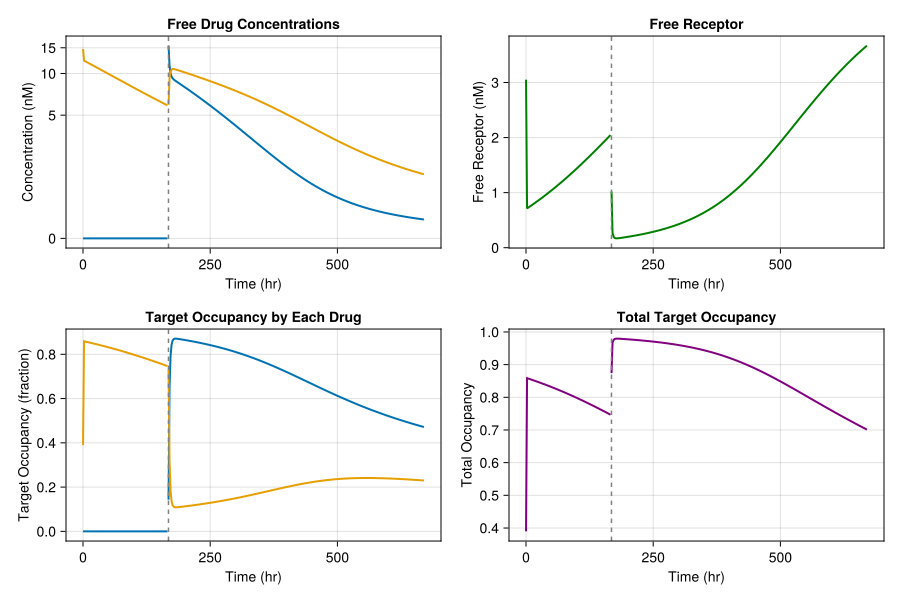
NoteCompetition Effects
When Drug 1 (higher affinity) is added at 168 hours (1 week):
- Drug 2 occupancy decreases as it is displaced
- Drug 1 rapidly captures available receptor
- Total occupancy remains high due to the higher-affinity competitor
7 FcRn-Mediated Recycling
7.1 Why FcRn Matters
Monoclonal antibodies have unusually long half-lives (weeks) due to the neonatal Fc receptor (FcRn) salvage pathway:
- Antibodies are taken up by endothelial cells via pinocytosis
- In the acidic endosome, IgG binds to FcRn
- FcRn-bound IgG is recycled to the cell surface and released
- Unbound IgG is degraded in lysosomes
This recycling reduces the effective clearance of IgG antibodies.
7.2 Model Structure
The FcRn model adds a recycling compartment:
tmdd_fcrn = @model begin
    @metadata begin
        desc = "TMDD with FcRn-Mediated Recycling"
        timeu = u"hr"
    end

    @param begin
        # PK parameters
        tvCl ∈ RealDomain(lower = 0)
        tvVc ∈ RealDomain(lower = 0)
        tvQ ∈ RealDomain(lower = 0)
        tvVp ∈ RealDomain(lower = 0)
        # TMDD parameters
        tvKsyn ∈ RealDomain(lower = 0)
        tvKdeg ∈ RealDomain(lower = 0)
        tvKSS ∈ RealDomain(lower = 0)
        tvKint ∈ RealDomain(lower = 0)
        # FcRn recycling parameters
        tvKup ∈ RealDomain(lower = 0)       # Pinocytosis uptake rate
        tvFR ∈ RealDomain(lower = 0, upper = 1)  # Fraction recycled
        tvKrec ∈ RealDomain(lower = 0)      # Recycling rate
    end

    @pre begin
        Cl = tvCl
        Vc = tvVc
        Q = tvQ
        Vp = tvVp
        Ksyn = tvKsyn
        Kdeg = tvKdeg
        KSS = tvKSS
        Kint = tvKint
        Kup = tvKup
        FR = tvFR
        Krec = tvKrec
    end

    @dosecontrol begin
        bioav = (Ltot = 1 / tvVc,)
    end

    @init begin
        Rtot = Ksyn / Kdeg
    end

    @vars begin
        Kel := Cl / Vc
        K12 := Q / Vc
        K21 := Q / Vp
        R0 := Ksyn / Kdeg
        # QSS binding
        L := 0.5 * ((Ltot - Rtot - KSS) + sqrt((Ltot - Rtot - KSS)^2 + 4 * KSS * Ltot))
        LR := Ltot - L
        R := Rtot - LR
        # Degradation rate for non-recycled fraction
        Kdeg_endo := Krec * (1 - FR) / FR
    end

    @dynamics begin
        # Central total ligand with FcRn recycling
        Ltot' =
            -Kel * L - Kint * LR - K12 * L + K21 * (Peripheral / Vc) - Kup * L +
            Krec * Endosomal

        # Peripheral
        Peripheral' = K12 * L * Vc - K21 * Peripheral

        # Receptor dynamics
        Rtot' = Ksyn - Kdeg * R - Kint * LR

        # Endosomal compartment (FcRn-bound)
        Endosomal' = Kup * L * FR - Krec * Endosomal
    end

    @derived begin
        Free_Ligand = @. L
        Endosomal_Conc = @. Endosomal
        Total_Receptor = @. Rtot
    end
end
┌ Warning: Variable `Free_Ligand` is defined in the `@derived` block using `=` and hence `Free_Ligand` is not used for model fitting but only returned when simulating: │ If `Free_Ligand` is a random variable, it must be defined in the `@derived` block using `~`; │ if `Free_Ligand` should be returned when simulating, it should be defined in the `@observed` block using `=`; │ if `Free_Ligand` is an intermediate quantity that should not be returned when simulating, it should be defined using `:=`. └ @ Pumas ~/run/_work/PumasTutorials.jl/PumasTutorials.jl/custom_julia_depot/packages/Pumas/GZeMg/src/dsl/model_macro.jl:2351 ┌ Warning: Variable `Endosomal_Conc` is defined in the `@derived` block using `=` and hence `Endosomal_Conc` is not used for model fitting but only returned when simulating: │ If `Endosomal_Conc` is a random variable, it must be defined in the `@derived` block using `~`; │ if `Endosomal_Conc` should be returned when simulating, it should be defined in the `@observed` block using `=`; │ if `Endosomal_Conc` is an intermediate quantity that should not be returned when simulating, it should be defined using `:=`. └ @ Pumas ~/run/_work/PumasTutorials.jl/PumasTutorials.jl/custom_julia_depot/packages/Pumas/GZeMg/src/dsl/model_macro.jl:2351 ┌ Warning: Variable `Total_Receptor` is defined in the `@derived` block using `=` and hence `Total_Receptor` is not used for model fitting but only returned when simulating: │ If `Total_Receptor` is a random variable, it must be defined in the `@derived` block using `~`; │ if `Total_Receptor` should be returned when simulating, it should be defined in the `@observed` block using `=`; │ if `Total_Receptor` is an intermediate quantity that should not be returned when simulating, it should be defined using `:=`. └ @ Pumas ~/run/_work/PumasTutorials.jl/PumasTutorials.jl/custom_julia_depot/packages/Pumas/GZeMg/src/dsl/model_macro.jl:2351
PumasModel
  Parameters: tvCl, tvVc, tvQ, tvVp, tvKsyn, tvKdeg, tvKSS, tvKint, tvKup, tvFR, tvKrec
  Random effects:
  Covariates:
  Dynamical system variables: Ltot, Peripheral, Rtot, Endosomal
  Dynamical system type: Nonlinear ODE
  Derived: Free_Ligand, Endosomal_Conc, Total_Receptor
  Observed: Free_Ligand, Endosomal_Conc, Total_Receptor
7.3 Impact of FcRn Recycling
Show/Hide Code
# Model without FcRn recycling (standard TMDD)
tmdd_no_fcrn = @model begin
    @param begin
        tvCl ∈ RealDomain(lower = 0)
        tvVc ∈ RealDomain(lower = 0)
        tvKsyn ∈ RealDomain(lower = 0)
        tvKdeg ∈ RealDomain(lower = 0)
        tvKSS ∈ RealDomain(lower = 0)
        tvKint ∈ RealDomain(lower = 0)
    end

    @pre begin
        Cl = tvCl
        Vc = tvVc
        Ksyn = tvKsyn
        Kdeg = tvKdeg
        KSS = tvKSS
        Kint = tvKint
    end

    @dosecontrol begin
        bioav = (Ltot = 1 / tvVc,)
    end

    @init begin
        Rtot = Ksyn / Kdeg
    end

    @vars begin
        Kel := Cl / Vc
        R0 := Ksyn / Kdeg
        L := 0.5 * ((Ltot - Rtot - KSS) + sqrt((Ltot - Rtot - KSS)^2 + 4 * KSS * Ltot))
        LR := Ltot - L
        R := Rtot - LR
    end

    @dynamics begin
        Ltot' = -Kel * L - Kint * LR
        Rtot' = Ksyn - Kdeg * R - Kint * LR
    end

    @derived begin
        Free_Ligand = @. L
    end
end

# Parameters using literature-based values
param_no_fcrn =
    (tvCl = 0.006, tvVc = 3.0, tvKsyn = 0.04, tvKdeg = 0.008, tvKSS = 1.0, tvKint = 0.002)

param_fcrn = (
    tvCl = 0.006,
    tvVc = 3.0,
    tvQ = 0.02,
    tvVp = 3.0,
    tvKsyn = 0.04,
    tvKdeg = 0.008,
    tvKSS = 1.0,
    tvKint = 0.002,
    tvKup = 0.01,     # Uptake rate
    tvFR = 0.7,       # 70% recycled
    tvKrec = 0.02,    # Recycling rate
)

pop_fcrn = [
    Subject(
        id = 1,
        events = DosageRegimen(50, time = 0, cmt = 1),
        observations = (Free_Ligand = nothing,),
    ),
]

obstimes_fcrn = 0.1:2:1008  # 6 weeks

sim_no_fcrn = simobs(tmdd_no_fcrn, pop_fcrn, param_no_fcrn, obstimes = obstimes_fcrn)
sim_fcrn = simobs(tmdd_fcrn, pop_fcrn, param_fcrn, obstimes = obstimes_fcrn)

# Convert to DataFrames
df_no_fcrn = DataFrame(sim_no_fcrn)
df_no_fcrn.Model .= "Without FcRn recycling"

df_fcrn = DataFrame(sim_fcrn)
df_fcrn.Model .= "With FcRn recycling (70%)"

df_fcrn_combined = vcat(
    select(df_no_fcrn, :time, :Free_Ligand, :Model),
    select(df_fcrn, :time, :Free_Ligand, :Model),
)

plt =
    data(df_fcrn_combined) *
    mapping(:time => "Time (hr)", :Free_Ligand => "Free Ligand (nM)"; color = :Model) *
    visual(Lines; linewidth = 2)

draw(plt; axis = (yscale = Makie.pseudolog10, title = "Effect of FcRn Recycling on mAb PK"))
┌ Warning: Variable `Free_Ligand` is defined in the `@derived` block using `=` and hence `Free_Ligand` is not used for model fitting but only returned when simulating: │ If `Free_Ligand` is a random variable, it must be defined in the `@derived` block using `~`; │ if `Free_Ligand` should be returned when simulating, it should be defined in the `@observed` block using `=`; │ if `Free_Ligand` is an intermediate quantity that should not be returned when simulating, it should be defined using `:=`. └ @ Pumas ~/run/_work/PumasTutorials.jl/PumasTutorials.jl/custom_julia_depot/packages/Pumas/GZeMg/src/dsl/model_macro.jl:2351
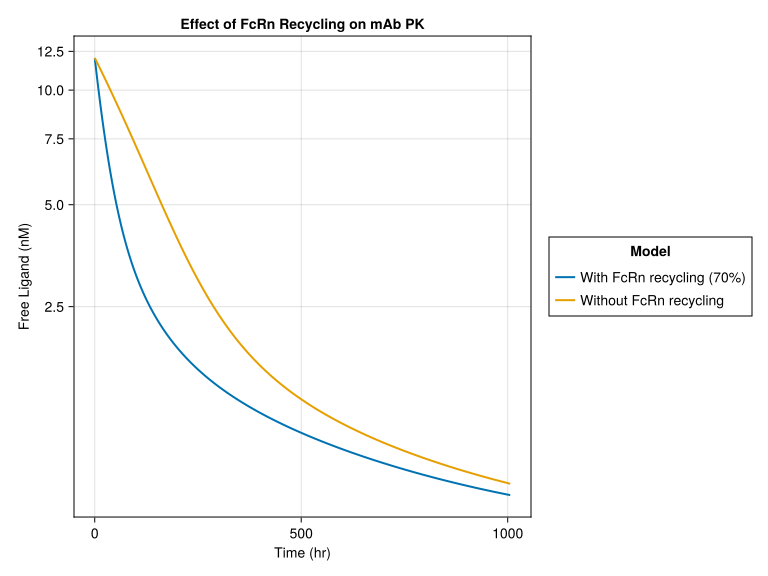
TipFcRn Recycling Effects
FcRn recycling:
- Extends terminal half-life significantly
- Reduces effective clearance
- Is saturable at very high doses (not modeled here)
- Can be engineered via Fc mutations (half-life extension technologies)
8 Subcutaneous Administration with Depot Binding
8.1 When to Use
For subcutaneous (SC) administration, target binding may occur at the injection site, affecting both bioavailability and absorption kinetics:
tmdd_sc = @model begin
    @metadata begin
        desc = "TMDD with SC Administration and Depot Binding"
        timeu = u"hr"
    end

    @param begin
        # Absorption parameters
        tvKa ∈ RealDomain(lower = 0)       # Absorption rate
        tvF ∈ RealDomain(lower = 0, upper = 1)  # Bioavailability
        # PK parameters
        tvCl ∈ RealDomain(lower = 0)
        tvVc ∈ RealDomain(lower = 0)
        # Central TMDD
        tvKsyn ∈ RealDomain(lower = 0)
        tvKdeg ∈ RealDomain(lower = 0)
        tvKSS ∈ RealDomain(lower = 0)
        tvKint ∈ RealDomain(lower = 0)
        # Depot binding
        tvRdepot ∈ RealDomain(lower = 0)   # Target concentration at SC site
        tvKSS_depot ∈ RealDomain(lower = 0) # Binding affinity at depot
    end

    @pre begin
        Ka = tvKa
        F = tvF
        Cl = tvCl
        Vc = tvVc
        Ksyn = tvKsyn
        Kdeg = tvKdeg
        KSS = tvKSS
        Kint = tvKint
        Rdepot = tvRdepot
        KSS_depot = tvKSS_depot
    end

    @dosecontrol begin
        bioav = (Depot = tvF,)
    end

    @init begin
        Rtot_central = Ksyn / Kdeg
    end

    @vars begin
        Kel := Cl / Vc
        R0 := Ksyn / Kdeg
        # Central compartment QSS binding
        L :=
            0.5 * (
                (Ltot - Rtot_central - KSS) +
                sqrt((Ltot - Rtot_central - KSS)^2 + 4 * KSS * Ltot)
            )
        LR := Ltot - L
        R := Rtot_central - LR
        # Depot binding reduces free drug available for absorption
        Depot_free := Depot / (1 + Rdepot / KSS_depot)
    end

    @dynamics begin
        # SC depot with binding
        Depot' = -Ka * Depot_free

        # Central total ligand
        Ltot' = Ka * Depot_free / Vc - Kel * L - Kint * LR

        # Receptor turnover
        Rtot_central' = Ksyn - Kdeg * R - Kint * LR
    end

    @derived begin
        Free_Ligand = @. L
        Depot_Amount = @. Depot
    end
end
┌ Warning: Variable `Free_Ligand` is defined in the `@derived` block using `=` and hence `Free_Ligand` is not used for model fitting but only returned when simulating: │ If `Free_Ligand` is a random variable, it must be defined in the `@derived` block using `~`; │ if `Free_Ligand` should be returned when simulating, it should be defined in the `@observed` block using `=`; │ if `Free_Ligand` is an intermediate quantity that should not be returned when simulating, it should be defined using `:=`. └ @ Pumas ~/run/_work/PumasTutorials.jl/PumasTutorials.jl/custom_julia_depot/packages/Pumas/GZeMg/src/dsl/model_macro.jl:2351 ┌ Warning: Variable `Depot_Amount` is defined in the `@derived` block using `=` and hence `Depot_Amount` is not used for model fitting but only returned when simulating: │ If `Depot_Amount` is a random variable, it must be defined in the `@derived` block using `~`; │ if `Depot_Amount` should be returned when simulating, it should be defined in the `@observed` block using `=`; │ if `Depot_Amount` is an intermediate quantity that should not be returned when simulating, it should be defined using `:=`. └ @ Pumas ~/run/_work/PumasTutorials.jl/PumasTutorials.jl/custom_julia_depot/packages/Pumas/GZeMg/src/dsl/model_macro.jl:2351
PumasModel
  Parameters: tvKa, tvF, tvCl, tvVc, tvKsyn, tvKdeg, tvKSS, tvKint, tvRdepot, tvKSS_depot
  Random effects:
  Covariates:
  Dynamical system variables: Depot, Ltot, Rtot_central
  Dynamical system type: Nonlinear ODE
  Derived: Free_Ligand, Depot_Amount
  Observed: Free_Ligand, Depot_Amount
8.2 SC vs IV Comparison
Show/Hide Code
param_sc = (
    tvKa = 0.01,
    tvF = 0.6,  # SC-specific (ka ~0.24/day, F=60% per Gibiansky)
    tvCl = 0.006,
    tvVc = 3.0,
    tvKsyn = 0.04,
    tvKdeg = 0.008,
    tvKSS = 1.0,
    tvKint = 0.002,
    tvRdepot = 2.0,
    tvKSS_depot = 1.0,  # Depot target binding
)

# SC dosing
pop_sc = [
    Subject(
        id = 1,
        events = DosageRegimen(100, time = 0, cmt = 1),  # 100 nmol SC
        observations = (Free_Ligand = nothing, Depot_Amount = nothing),
    ),
]

# IV dosing (use no-FcRn model for comparison)
pop_iv = [
    Subject(
        id = 1,
        events = DosageRegimen(100 * 0.6, time = 0, cmt = 1),  # Equivalent absorbed dose (60 nmol)
        observations = (Free_Ligand = nothing,),
    ),
]

sim_sc = simobs(tmdd_sc, pop_sc, param_sc, obstimes = obstimes_fcrn)
sim_iv = simobs(tmdd_no_fcrn, pop_iv, param_no_fcrn, obstimes = obstimes_fcrn)

# Convert to DataFrames
df_iv = DataFrame(sim_iv)
df_iv.Route .= "IV (equivalent dose)"

df_sc = DataFrame(sim_sc)
df_sc.Route .= "SC (with depot binding)"

df_route = vcat(
    select(df_iv, :time, :Free_Ligand, :Route),
    select(df_sc, :time, :Free_Ligand, :Route),
)

plt =
    data(df_route) *
    mapping(:time => "Time (hr)", :Free_Ligand => "Free Ligand (nM)"; color = :Route) *
    visual(Lines; linewidth = 2)

draw(plt; axis = (yscale = Makie.pseudolog10, title = "IV vs SC Administration"))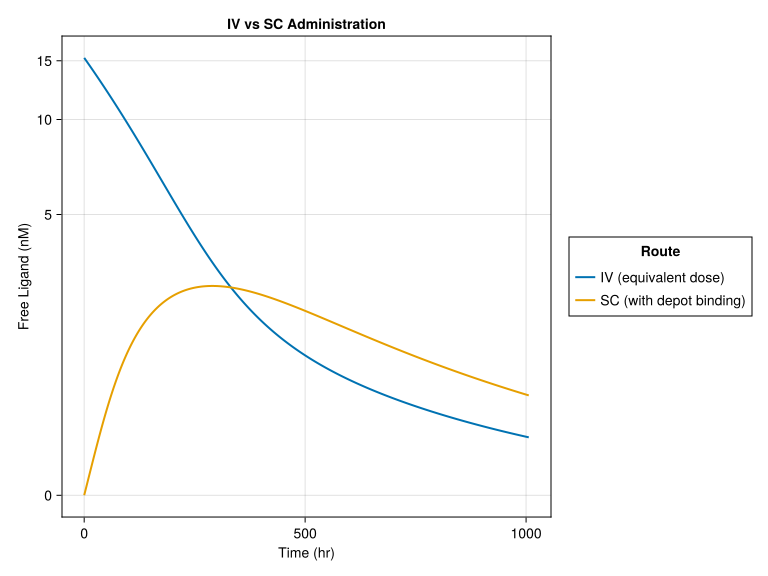
9 Summary of Special Cases
| Model | Key Feature | When to Use |
|---|---|---|
| Constant \(R_{tot}\) | Receptor pool maintained | Rapid target turnover, large receptor pool |
| Irreversible binding | \(k_{off} = 0\) | Covalent inhibitors, very tight binders |
| Competition | Two drugs, one target | DDI, biosimilar comparison, combination therapy |
| FcRn recycling | Antibody salvage | Therapeutic mAbs, half-life engineering |
| SC with depot binding | Absorption-site target | SC biologics, tissue targets |
NoteLimiting Case Analysis
Peletier & Gabrielsson (2012) provides rigorous mathematical analysis of TMDD limiting cases, including bounds on receptor concentrations and analytical approximations. Key insights include:
- The minimum free receptor concentration depends on the initial dose and binding parameters
- The time to reach minimum receptor is related to \(1/(k_{on} \cdot L_0)\)
- Recovery kinetics follow receptor synthesis rate \(k_{syn}\)
These analytical results are valuable for understanding special case behavior and validating numerical simulations.
TipSelecting the Right Model
- Start with the simplest model that captures your phenomenon
- Add mechanistic complexity only when scientifically justified
- Consider data availability for parameter estimation
- Validate with independent datasets when possible
For more information on the constant receptor assumption, see Wagner (1976). FcRn biology and its role in mAb pharmacokinetics is reviewed by Roopenian & Akilesh (2007) and Deng et al. (2011). The receptor-mediated endocytosis pathway is discussed by Krippendorff et al. (2009).
10 References
Deng, R., Iyer, S., Theil, F.-P., Mortensen, D. L., Fielder, P. J., & Prabhu, S. (2011). Projecting human pharmacokinetics of therapeutic antibodies from nonclinical data. mAbs, 3(1), 61–66. https://doi.org/10.4161/mabs.3.1.14211
Gaddum, J. H. (1926). The action of adrenalin and ergotamine on the uterus of the rabbit. The Journal of Physiology, 61(2), 141–150.
Gibiansky, L., & Gibiansky, E. (2009). Target-mediated drug disposition model: Approximations, identifiability of model parameters and applications to the population pharmacokinetic-pharmacodynamic modeling of biologics. Expert Opinion on Drug Metabolism & Toxicology, 5(7), 803–812. https://doi.org/10.1517/17425250903030043
Gibiansky, L., Gibiansky, E., Kakkar, T., & Ma, P. (2008). Approximations of the target-mediated drug disposition model and identifiability of model parameters. Journal of Pharmacokinetics and Pharmacodynamics, 35(5), 573–591. https://doi.org/10.1007/s10928-008-9102-8
Krippendorff, B.-F., Kuester, K., Kloft, C., & Huisinga, W. (2009). Nonlinear pharmacokinetics of therapeutic proteins resulting from receptor-mediated endocytosis. Journal of Pharmacokinetics and Pharmacodynamics, 36(3), 239–260. https://doi.org/10.1007/s10928-009-9120-1
Peletier, L. A., & Gabrielsson, J. (2012). Dynamics of target-mediated drug disposition: Characteristic profiles and parameter identification. Journal of Pharmacokinetics and Pharmacodynamics, 39(5), 429–451. https://doi.org/10.1007/s10928-012-9260-6
Roopenian, D. C., & Akilesh, S. (2007). FcRn: The neonatal fc receptor comes of age. Nature Reviews Immunology, 7(9), 715–725. https://doi.org/10.1038/nri2155
Wagner, J. G. (1976). Simple model to explain effects of plasma protein binding and tissue binding on calculated volumes of distribution, apparent elimination rate constants and clearances. European Journal of Clinical Pharmacology, 10(6), 425–432. https://doi.org/10.1007/BF00563089