using Pumas
using PumasUtilities
using AlgebraOfGraphics
using CairoMakie
using Random
using DataFrames
using DataFramesMeta
using Statistics
using StatsBase
TMDD Part 5: Practical Modeling Workflows
1 Introduction
This is Part 5 of our comprehensive TMDD tutorial series. Here we bring together everything we’ve learned into practical end-to-end workflows for TMDD model development, from exploratory analysis through model fitting and selection.
Tutorial Series Overview:
- Part 1: Understanding TMDD - Conceptual foundations and parameter meaning 1b. Part 1b: TMDD Dynamics Through the Four Phases - Deep dive into phase characterization
- Part 2: The Full TMDD Model - Complete mechanistic model implementation
- Part 3: TMDD Approximations - QE, QSS, and Michaelis-Menten models
- Part 4: Special Cases and Extensions - Advanced TMDD scenarios
- Part 5: Practical Workflows (this tutorial) - Fitting, diagnostics, and model selection
2 Learning Objectives
By the end of this tutorial, you will be able to:
- Perform exploratory data analysis to identify TMDD signatures
- Select appropriate initial parameter values for TMDD models
- Fit TMDD models using a stepwise approach (MM to QSS to Full)
- Generate diagnostic plots specific to TMDD
- Compare models using information criteria and scientific reasoning
- Simulate therapeutic scenarios for decision-making
3 Libraries
4 Workflow Overview
A typical TMDD modeling workflow includes:
- Data Exploration: Identify TMDD signatures
- Model Selection Strategy: Choose starting model
- Parameter Initialization: Set reasonable starting values
- Model Fitting: Estimate parameters
- Diagnostics: Evaluate model performance
- Model Comparison: Select best model
- Simulation and Prediction: Use model for decision-making
5 Generating Simulated Data
For this tutorial, we’ll generate simulated data from a known TMDD model to demonstrate the workflow. In practice, you would use your own clinical or preclinical data.
Show/Hide Code
# Define the "true" TMDD model for data generation
true_model = @model begin
    @param begin
        tvCl ∈ RealDomain(lower = 0)
        tvVc ∈ RealDomain(lower = 0)
        tvKsyn ∈ RealDomain(lower = 0)
        tvKdeg ∈ RealDomain(lower = 0)
        tvKSS ∈ RealDomain(lower = 0)
        tvKint ∈ RealDomain(lower = 0)
        Ω ∈ PDiagDomain(2)
        σ_prop ∈ RealDomain(lower = 0)
    end

    @random begin
        η ~ MvNormal(Ω)
    end

    @pre begin
        Cl = tvCl * exp(η[1])
        Vc = tvVc * exp(η[2])
        Ksyn = tvKsyn
        Kdeg = tvKdeg
        KSS = tvKSS
        Kint = tvKint
    end

    @dosecontrol begin
        bioav = (Ltot = 1 / tvVc,)
    end

    @init begin
        Rtot = Ksyn / Kdeg
    end

    @vars begin
        Kel := Cl / Vc
        R0 := Ksyn / Kdeg
        L := 0.5 * ((Ltot - Rtot - KSS) + sqrt((Ltot - Rtot - KSS)^2 + 4 * KSS * Ltot))
        LR := Ltot - L
        R := Rtot - LR
    end

    @dynamics begin
        Ltot' = -Kel * L - Kint * LR
        Rtot' = Ksyn - Kdeg * R - Kint * LR
    end

    @derived begin
        CONC := @. L
        DV ~ @. ProportionalNormal(CONC, σ_prop)
    end
end

# True parameter values based on typical mAb parameters
true_params = (
    tvCl = 0.006,      # ~0.15 L/day
    tvVc = 3.0,
    tvKsyn = 0.04,     # ~1 nmol/day
    tvKdeg = 0.008,    # ~0.2 day⁻¹
    tvKSS = 1.0,       # 1 nM
    tvKint = 0.002,    # ~0.04 day⁻¹
    Ω = Diagonal([0.04, 0.04]),  # 20% IIV on Cl and Vc
    σ_prop = 0.1,  # 10% proportional error
)

# Create population: 40 subjects across 4 dose groups
Random.seed!(123)

doses = [5.0, 15.0, 50.0, 150.0]  # nmol (wide range for clear TMDD visualization)
n_per_group = 10

# Observation times (typical sparse sampling for mAbs)
obs_times = [0.5, 1, 2, 4, 8, 24, 48, 72, 168, 336, 504, 672, 1008]

sim_population = Subject[]
for (dose_idx, dose) in enumerate(doses)
    for subj = 1:n_per_group
        id = (dose_idx - 1) * n_per_group + subj
        push!(
            sim_population,
            Subject(
                id = id,
                events = DosageRegimen(dose, time = 0, cmt = 1),
                covariates = (DOSE = dose, WT = 70.0),
                observations = (DV = nothing,),
            ),
        )
    end
end

# Simulate data
sim_data = simobs(true_model, sim_population, true_params, obstimes = obs_times)

# Convert to DataFrame
df = DataFrame(sim_data)
@rtransform! df :LLOQ = 0.01;
@rsubset! df :DV > :LLOQ;  # Remove BLQ observations
@rtransform! df :route = "IV";
first(df, 10)
10×27 DataFrame
| Row | id | time | DV | evid | bioav_Ltot | amt | cmt | rate | duration | ss | ii | route | DOSE | WT | tad | dosenum | Ltot | Rtot | η₁ | η₂ | Cl | Vc | Ksyn | Kdeg | KSS | Kint | LLOQ |
|---|---|---|---|---|---|---|---|---|---|---|---|---|---|---|---|---|---|---|---|---|---|---|---|---|---|---|---|
| String | Float64 | Float64? | Int64? | Float64? | Float64? | Symbol? | Float64? | Float64? | Int8? | Float64? | String | Float64? | Float64? | Float64? | Int64? | Float64? | Float64? | Float64? | Float64? | Float64? | Float64? | Float64? | Float64? | Float64? | Float64? | Float64 | |
| 1 | 1 | 0.5 | 0.369569 | 0 | missing | 0.0 | missing | 0.0 | 0.0 | 0 | 0.0 | IV | 5.0 | 70.0 | 0.5 | 1 | 1.66476 | 5.00392 | 0.195684 | -0.326576 | 0.00729686 | 2.16417 | 0.04 | 0.008 | 1.0 | 0.002 | 0.01 |
| 2 | 1 | 1.0 | 0.337308 | 0 | missing | 0.0 | missing | 0.0 | 0.0 | 0 | 0.0 | IV | 5.0 | 70.0 | 1.0 | 1 | 1.66285 | 5.00783 | 0.195684 | -0.326576 | 0.00729686 | 2.16417 | 0.04 | 0.008 | 1.0 | 0.002 | 0.01 |
| 3 | 1 | 2.0 | 0.346385 | 0 | missing | 0.0 | missing | 0.0 | 0.0 | 0 | 0.0 | IV | 5.0 | 70.0 | 2.0 | 1 | 1.65904 | 5.01558 | 0.195684 | -0.326576 | 0.00729686 | 2.16417 | 0.04 | 0.008 | 1.0 | 0.002 | 0.01 |
| 4 | 1 | 4.0 | 0.316171 | 0 | missing | 0.0 | missing | 0.0 | 0.0 | 0 | 0.0 | IV | 5.0 | 70.0 | 4.0 | 1 | 1.65146 | 5.03086 | 0.195684 | -0.326576 | 0.00729686 | 2.16417 | 0.04 | 0.008 | 1.0 | 0.002 | 0.01 |
| 5 | 1 | 8.0 | 0.307751 | 0 | missing | 0.0 | missing | 0.0 | 0.0 | 0 | 0.0 | IV | 5.0 | 70.0 | 8.0 | 1 | 1.63641 | 5.06054 | 0.195684 | -0.326576 | 0.00729686 | 2.16417 | 0.04 | 0.008 | 1.0 | 0.002 | 0.01 |
| 6 | 1 | 24.0 | 0.308507 | 0 | missing | 0.0 | missing | 0.0 | 0.0 | 0 | 0.0 | IV | 5.0 | 70.0 | 24.0 | 1 | 1.5777 | 5.16811 | 0.195684 | -0.326576 | 0.00729686 | 2.16417 | 0.04 | 0.008 | 1.0 | 0.002 | 0.01 |
| 7 | 1 | 48.0 | 0.2777 | 0 | missing | 0.0 | missing | 0.0 | 0.0 | 0 | 0.0 | IV | 5.0 | 70.0 | 48.0 | 1 | 1.49391 | 5.29961 | 0.195684 | -0.326576 | 0.00729686 | 2.16417 | 0.04 | 0.008 | 1.0 | 0.002 | 0.01 |
| 8 | 1 | 72.0 | 0.286412 | 0 | missing | 0.0 | missing | 0.0 | 0.0 | 0 | 0.0 | IV | 5.0 | 70.0 | 72.0 | 1 | 1.41487 | 5.40087 | 0.195684 | -0.326576 | 0.00729686 | 2.16417 | 0.04 | 0.008 | 1.0 | 0.002 | 0.01 |
| 9 | 1 | 168.0 | 0.187265 | 0 | missing | 0.0 | missing | 0.0 | 0.0 | 0 | 0.0 | IV | 5.0 | 70.0 | 168.0 | 1 | 1.13998 | 5.59876 | 0.195684 | -0.326576 | 0.00729686 | 2.16417 | 0.04 | 0.008 | 1.0 | 0.002 | 0.01 |
| 10 | 1 | 336.0 | 0.153013 | 0 | missing | 0.0 | missing | 0.0 | 0.0 | 0 | 0.0 | IV | 5.0 | 70.0 | 336.0 | 1 | 0.78303 | 5.57511 | 0.195684 | -0.326576 | 0.00729686 | 2.16417 | 0.04 | 0.008 | 1.0 | 0.002 | 0.01 |
6 Step 1: Exploratory Data Analysis
6.1 Dose-Normalized Concentration Plots
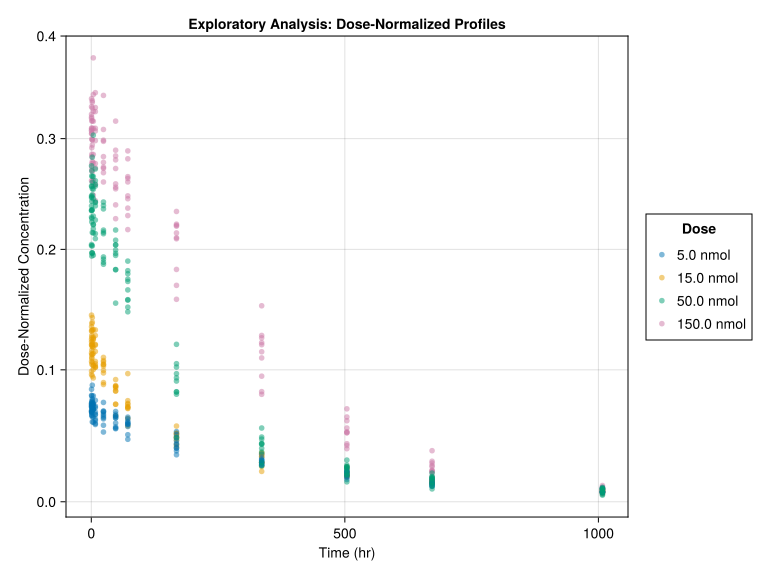
The hallmark of TMDD is non-superimposable dose-normalized profiles. Let’s check for this signature:
Show/Hide Code
# Add dose information and calculate dose-normalized concentration
df_plot = @chain df begin
    @rtransform :DOSE_NORM = :DV / :DOSE
    @rsubset :time > 0
    @rtransform :Dose_Label = string(:DOSE) * " nmol"
end

plt =
    data(df_plot) *
    mapping(
        :time => "Time (hr)",
        :DOSE_NORM => "Dose-Normalized Concentration";
        color = :Dose_Label => "Dose",
    ) *
    visual(Scatter; markersize = 8, alpha = 0.5)

draw(
    plt;
    axis = (
        yscale = Makie.pseudolog10,
        title = "Exploratory Analysis: Dose-Normalized Profiles",
    ),
)
NoteInterpreting Dose-Normalized Plots
If profiles are superimposable, linear PK is likely. If lower doses show faster terminal decline (as we see here), TMDD is a likely explanation.
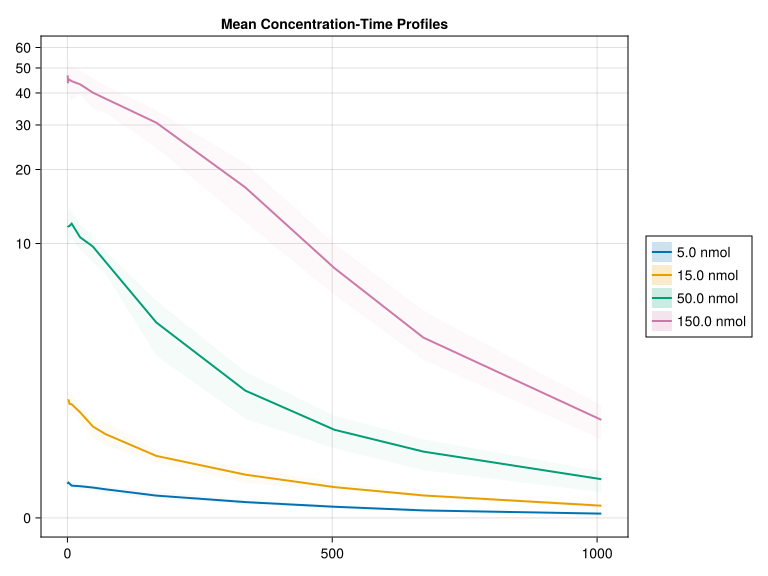
6.2 Mean Concentration by Dose
Show/Hide Code
df_summary = @chain df begin
    @rsubset :time > 0
    groupby([:time, :DOSE])
    @combine begin
        :mean_DV = mean(:DV)
        :lower = quantile(:DV, 0.05)
        :upper = quantile(:DV, 0.95)
    end
    @rtransform :Dose_Label = string(:DOSE) * " nmol"
end

# Create line and band layers
plt_line =
    data(df_summary) *
    mapping(
        :time => "Time (hr)",
        :mean_DV => "Mean Concentration (nM)";
        color = :Dose_Label => "Dose",
    ) *
    visual(Lines; linewidth = 2)

plt_band =
    data(df_summary) *
    mapping(:time, :lower, :upper; color = :Dose_Label) *
    visual(Band; alpha = 0.2)

draw(
    plt_band + plt_line;
    axis = (yscale = Makie.pseudolog10, title = "Mean Concentration-Time Profiles"),
)
6.3 Apparent Terminal Half-Life by Dose
Show/Hide Code
# Calculate approximate apparent terminal half-life from terminal slope
# Using data from the terminal phase (last few time points)

println("Apparent Terminal Half-Life by Dose (estimated from terminal slope):")
for dose in doses
    # Get terminal phase data for this dose (last 3 time points with positive DV)
    df_dose = filter(row -> row.DOSE == dose && row.DV > 0, df)
    sort!(df_dose, :time)

    # Use data from later time points for terminal slope
    df_terminal = filter(row -> row.time >= 336, df_dose)  # After 2 weeks

    if nrow(df_terminal) >= 2
        # Calculate mean log-concentration at each time point
        df_mean = @chain df_terminal begin
            groupby(:time)
            @combine :mean_logDV = mean(log.(:DV))
        end

        if nrow(df_mean) >= 2
            # Linear regression on log scale to get terminal slope
            times = df_mean.time
            log_conc = df_mean.mean_logDV

            # Simple linear regression: slope = Σ(x-x̄)(y-ȳ) / Σ(x-x̄)²
            t_mean = mean(times)
            lc_mean = mean(log_conc)
            slope =
                sum((times .- t_mean) .* (log_conc .- lc_mean)) /
                sum((times .- t_mean) .^ 2)

            # Half-life = ln(2) / |slope|
            half_life = -log(2) / slope
            println("  $(dose) nmol: $(round(half_life, digits=1)) hr")
        end
    end
end
Apparent Terminal Half-Life by Dose (estimated from terminal slope):
5.0 nmol: 341.5 hr
15.0 nmol: 335.2 hr
50.0 nmol: 292.2 hr
150.0 nmol: 185.9 hr
ImportantTMDD Signature Confirmed
The increasing apparent half-life with dose is a classic TMDD signature. At low doses, target-mediated clearance dominates, leading to faster elimination.
7 Step 2: Model Selection Strategy
Based on our exploratory analysis:
- TMDD is likely (dose-dependent half-life, non-superimposable profiles)
- Only ligand data available (no receptor measurements)
- Multiple doses (can estimate saturable kinetics)
Recommended approach:
- Start with Michaelis-Menten (MM) model - most parsimonious
- If MM is insufficient, try QSS model
- Full model only if QSS fails and additional data become available
8 Step 3: Define Candidate Models
8.1 Michaelis-Menten Model
mm_model = @model begin
    @param begin
        tvCl ∈ RealDomain(lower = 0)
        tvVc ∈ RealDomain(lower = 0)
        tvVmax ∈ RealDomain(lower = 0)
        tvKM ∈ RealDomain(lower = 0)
        Ω ∈ PDiagDomain(2)
        σ_prop ∈ RealDomain(lower = 0)
    end

    @random begin
        η ~ MvNormal(Ω)
    end

    @pre begin
        Cl = tvCl * exp(η[1])
        Vc = tvVc * exp(η[2])
        Vmax = tvVmax
        KM = tvKM
    end

    @dosecontrol begin
        bioav = (Ltot = 1 / tvVc,)
    end

    @dynamics begin
        Ltot' = -(Cl / Vc) * Ltot - Vmax * Ltot / (KM + Ltot)
    end

    @derived begin
        CONC := @. Ltot
        DV ~ @. ProportionalNormal(CONC, σ_prop)
    end
end
PumasModel
Parameters: tvCl, tvVc, tvVmax, tvKM, Ω, σ_prop
Random effects: η
Covariates:
Dynamical system variables: Ltot
Dynamical system type: Nonlinear ODE
Derived: DV
Observed: DV8.2 Quasi-Steady-State (QSS) Model
qss_model = @model begin
    @param begin
        tvCl ∈ RealDomain(lower = 0)
        tvVc ∈ RealDomain(lower = 0)
        tvKsyn ∈ RealDomain(lower = 0)
        tvKdeg ∈ RealDomain(lower = 0)
        tvKSS ∈ RealDomain(lower = 0)
        tvKint ∈ RealDomain(lower = 0)
        Ω ∈ PDiagDomain(2)
        σ_prop ∈ RealDomain(lower = 0)
    end

    @random begin
        η ~ MvNormal(Ω)
    end

    @pre begin
        Cl = tvCl * exp(η[1])
        Vc = tvVc * exp(η[2])
        Ksyn = tvKsyn
        Kdeg = tvKdeg
        KSS = tvKSS
        Kint = tvKint
    end

    @dosecontrol begin
        bioav = (Ltot = 1 / tvVc,)
    end

    @init begin
        Rtot = Ksyn / Kdeg
    end

    @vars begin
        Kel := Cl / Vc
        R0 := Ksyn / Kdeg
        L := 0.5 * ((Ltot - Rtot - KSS) + sqrt((Ltot - Rtot - KSS)^2 + 4 * KSS * Ltot))
        LR := Ltot - L
        R := Rtot - LR
    end

    @dynamics begin
        Ltot' = -Kel * L - Kint * LR
        Rtot' = Ksyn - Kdeg * R - Kint * LR
    end

    @derived begin
        CONC := @. L
        DV ~ @. ProportionalNormal(CONC, σ_prop)
    end
end
PumasModel
Parameters: tvCl, tvVc, tvKsyn, tvKdeg, tvKSS, tvKint, Ω, σ_prop
Random effects: η
Covariates:
Dynamical system variables: Ltot, Rtot
Dynamical system type: Nonlinear ODE
Derived: DV
Observed: DV9 Step 4: Parameter Initialization
Choosing good initial values is crucial for TMDD model convergence. Peletier & Gabrielsson (2012) provides guidance on extracting parameter estimates from different phases of the TMDD concentration-time profile.
9.1 Four-Phase Parameter Identification Strategy
| Phase | Observable Feature | Initial Estimate Strategy |
|---|---|---|
| A | Rapid initial decline | \(k_{on}\) from duration (~\(1/(k_{on} \cdot C_0)\)) |
| B | Slope during saturation | \(k_{el} = CL/V_c\) from linear portion |
| C | Inflection point | \(K_D\) or \(K_{SS}\) from transition concentration |
| D | Terminal slope | \(k_{int}\) from \(\lambda_z \approx k_{int}\) |
Additionally:
- Initial concentration (\(C_0\)) at high dose estimates \(V_c\)
- Dose-dependence of terminal slope estimates \(R_0\) and binding parameters
- Time to receptor recovery informs \(k_{syn}\) (since \(R_0 = k_{syn}/k_{deg}\))
9.2 Strategy for MM Model
# Initial estimates for MM model
# Based on exploratory analysis

# 1. Vc from early time points (assume rapid distribution)
#    Approximate from C0 = Dose/Vc
df_high_dose_early = filter(row -> row.DOSE == 150.0 && row.time < 1, df)
mean_c0_high_dose = mean(df_high_dose_early.DV)

Vc_init = 150.0 / mean_c0_high_dose  # High dose / C0

# 2. Cl from terminal slope at high dose (where TMDD is saturated)
#    Approximate: Cl ≈ Vc * kel (typical mAb ~0.15 L/day)
Cl_init = 0.006  # Start with typical mAb clearance

# 3. Vmax from difference in clearance at low vs high dose
#    Vmax = R0 * kint (for R0 ~ 5 nM, kint ~ 0.002 hr⁻¹)
Vmax_init = 0.01  # Estimate from dose-dependent clearance

# 4. KM from concentration where half-maximal saturation occurs
#    Typically near KSS for TMDD drugs
KM_init = 1.0

init_mm = (
    tvCl = Cl_init,
    tvVc = Vc_init,
    tvVmax = Vmax_init,
    tvKM = KM_init,
    Ω = Diagonal([0.1, 0.1]),
    σ_prop = 0.15,
)

println("MM Model Initial Estimates:")
println("  Cl: $(init_mm.tvCl) L/hr")
println("  Vc: $(round(init_mm.tvVc, digits=2)) L")
println("  Vmax: $(init_mm.tvVmax) nM/hr")
println("  KM: $(init_mm.tvKM) nM")
MM Model Initial Estimates:
Cl: 0.006 L/hr
Vc: 3.2 L
Vmax: 0.01 nM/hr
KM: 1.0 nM9.3 Strategy for QSS Model
# Initial estimates for QSS model
# Based on typical mAb values from the literature

init_qss = (
    tvCl = 0.006,      # ~0.15 L/day
    tvVc = 3.0,
    tvKsyn = 0.04,     # ~1 nmol/day → R0 = 5 nM
    tvKdeg = 0.008,    # ~0.2 day⁻¹ (receptor t½ ~87 hr)
    tvKSS = 1.0,       # ≈ KM from MM model
    tvKint = 0.002,    # ~0.04 day⁻¹
    Ω = Diagonal([0.1, 0.1]),
    σ_prop = 0.15,
)

println("\nQSS Model Initial Estimates:")
println("  Cl: $(init_qss.tvCl) L/hr")
println("  Vc: $(init_qss.tvVc) L")
println("  Ksyn: $(init_qss.tvKsyn) nM/hr")
println("  Kdeg: $(init_qss.tvKdeg) hr⁻¹")
println("  KSS: $(init_qss.tvKSS) nM")
println("  Kint: $(init_qss.tvKint) hr⁻¹")
println("  Implied R0: $(init_qss.tvKsyn / init_qss.tvKdeg) nM")
QSS Model Initial Estimates:
  Cl: 0.006 L/hr
  Vc: 3.0 L
  Ksyn: 0.04 nM/hr
  Kdeg: 0.008 hr⁻¹
  KSS: 1.0 nM
  Kint: 0.002 hr⁻¹
  Implied R0: 5.0 nM
10 Step 5: Model Fitting
10.1 Prepare Data for Fitting
# Convert simulated observations to a fitting-ready population
# The simobs output contains the actual simulated observations
fitting_pop = Subject.(sim_data)

length(fitting_pop)4010.2 Fit Michaelis-Menten Model
# Fit MM model
fit_mm = fit(mm_model, fitting_pop, init_mm, FOCE())
[ Info: Checking the initial parameter values. [ Info: The initial negative log likelihood and its gradient are finite. Check passed. Iter Function value Gradient norm 0 3.364434e+06 6.818388e+07 * time: 0.0343778133392334 1 3.519213e+03 5.651334e+03 * time: 2.9081640243530273 2 3.518594e+03 5.650052e+03 * time: 2.959514856338501 3 1.687761e+03 1.776548e+03 * time: 3.013497829437256 4 1.282388e+03 9.243676e+02 * time: 3.0643489360809326 5 1.061823e+03 5.486075e+02 * time: 3.1156609058380127 6 9.929534e+02 3.707387e+02 * time: 3.16617488861084 7 9.742209e+02 2.823710e+02 * time: 3.21323299407959 8 9.714914e+02 2.483856e+02 * time: 3.2596359252929688 9 9.713384e+02 2.397794e+02 * time: 3.4109718799591064 10 9.713352e+02 2.388137e+02 * time: 3.4519150257110596 11 9.713327e+02 2.383435e+02 * time: 3.48842191696167 12 9.713216e+02 2.369857e+02 * time: 3.5252888202667236 13 9.712970e+02 2.351086e+02 * time: 3.561478853225708 14 9.712283e+02 2.317302e+02 * time: 3.5977249145507812 15 9.710545e+02 2.261265e+02 * time: 3.636586904525757 16 9.706023e+02 2.162634e+02 * time: 3.6779048442840576 17 9.694623e+02 1.986852e+02 * time: 3.71915602684021 18 9.666983e+02 1.745125e+02 * time: 3.8265528678894043 19 9.607506e+02 1.721701e+02 * time: 3.863579034805298 20 9.512752e+02 1.464048e+02 * time: 3.9047489166259766 21 9.418000e+02 1.387710e+02 * time: 3.9477698802948 22 9.332831e+02 1.314877e+02 * time: 3.990118980407715 23 9.308423e+02 1.286175e+02 * time: 4.032932996749878 24 9.307221e+02 1.297247e+02 * time: 4.072722911834717 25 9.307202e+02 1.296801e+02 * time: 4.113924980163574 26 9.307197e+02 1.296728e+02 * time: 4.179018020629883 27 9.307155e+02 1.296276e+02 * time: 4.214260816574097 28 9.307074e+02 1.295651e+02 * time: 4.252461910247803 29 9.306832e+02 1.294229e+02 * time: 4.288534879684448 30 9.306227e+02 1.291367e+02 * time: 4.330066919326782 31 9.304610e+02 1.284860e+02 * time: 4.370190858840942 32 9.300401e+02 1.269775e+02 * time: 4.410547971725464 33 9.289415e+02 1.233412e+02 * time: 4.478890895843506 34 9.261505e+02 1.145870e+02 * time: 4.526841878890991 35 9.195523e+02 9.456213e+01 * time: 4.5774829387664795 36 9.071592e+02 1.349089e+02 * time: 4.632100820541382 37 8.943907e+02 1.195659e+02 * time: 4.6943199634552 38 8.886761e+02 5.422672e+01 * time: 4.778235912322998 39 8.872060e+02 2.710995e+01 * time: 4.833794832229614 40 8.871050e+02 2.471533e+01 * time: 4.892765998840332 41 8.871043e+02 2.449244e+01 * time: 4.941339015960693 42 8.871043e+02 2.448809e+01 * time: 5.0060508251190186 43 8.871041e+02 2.444573e+01 * time: 5.050829887390137 44 8.871037e+02 2.440328e+01 * time: 5.098407983779907 45 8.871026e+02 2.432028e+01 * time: 5.146807909011841 46 8.870999e+02 2.419252e+01 * time: 5.192831993103027 47 8.870925e+02 2.397320e+01 * time: 5.263871908187866 48 8.870735e+02 2.360382e+01 * time: 5.313395023345947 49 8.870238e+02 2.296024e+01 * time: 5.363200902938843 50 8.868957e+02 2.182429e+01 * time: 5.417749881744385 51 8.865706e+02 2.749364e+01 * time: 5.471300840377808 52 8.857736e+02 4.136772e+01 * time: 5.543864011764526 53 8.839389e+02 5.772643e+01 * time: 5.5972490310668945 54 8.802225e+02 6.921488e+01 * time: 5.651752948760986 55 8.750152e+02 5.837689e+01 * time: 5.705978870391846 56 8.711918e+02 2.182791e+01 * time: 5.77829384803772 57 8.697930e+02 1.671071e+01 * time: 5.8291850090026855 58 8.694603e+02 1.951235e+01 * time: 5.876224994659424 59 8.665494e+02 2.538943e+01 * time: 5.926687002182007 60 8.647183e+02 3.467844e+01 * time: 6.058679819107056 61 8.610116e+02 6.252763e+01 * time: 6.189846992492676 62 8.501078e+02 1.054226e+02 * time: 6.233170032501221 63 8.466983e+02 3.275473e+01 * time: 6.331082820892334 64 8.456780e+02 8.965742e+00 * time: 6.365073919296265 65 8.456140e+02 2.517938e+00 * time: 6.4022979736328125 66 8.456120e+02 3.061814e-01 * time: 6.435933828353882 67 8.456120e+02 2.937864e-02 * time: 6.466768026351929 68 8.456120e+02 4.546395e-03 * time: 6.494282960891724 69 8.456120e+02 4.546395e-03 * time: 6.575270891189575 70 8.456120e+02 7.674538e-03 * time: 6.604362964630127 71 8.456120e+02 6.998250e-03 * time: 6.637022972106934 72 8.456120e+02 6.313822e-03 * time: 6.669155836105347 73 8.456120e+02 5.682749e-03 * time: 6.721380949020386 74 8.456120e+02 5.677089e-03 * time: 6.762728929519653 75 8.456120e+02 5.671403e-03 * time: 6.806579828262329 76 8.456120e+02 5.665729e-03 * time: 6.848994016647339 77 8.456120e+02 5.660063e-03 * time: 6.892773866653442 78 8.456120e+02 5.654402e-03 * time: 6.955157041549683 79 8.456120e+02 5.648748e-03 * time: 6.999406814575195 80 8.456120e+02 5.648183e-03 * time: 7.04712700843811 81 8.456120e+02 5.647619e-03 * time: 7.094743013381958 82 8.456120e+02 5.647053e-03 * time: 7.162590980529785 83 8.456120e+02 5.646489e-03 * time: 7.211717844009399 84 8.456120e+02 5.645924e-03 * time: 7.25959587097168 85 8.456120e+02 5.645360e-03 * time: 7.306959867477417 86 8.456120e+02 5.644796e-03 * time: 7.3766138553619385 87 8.456120e+02 5.644739e-03 * time: 7.431213855743408 88 8.456120e+02 5.644683e-03 * time: 7.484139919281006 89 8.456120e+02 5.644678e-03 * time: 7.563501834869385 90 8.456120e+02 5.036251e-03 * time: 7.595824956893921 91 8.456120e+02 4.534151e-03 * time: 7.629776954650879 92 8.456120e+02 4.529631e-03 * time: 7.672767877578735 93 8.456120e+02 4.525089e-03 * time: 7.715134859085083 94 8.456120e+02 4.520562e-03 * time: 7.777467966079712 95 8.456120e+02 4.516041e-03 * time: 7.821061849594116 96 8.456120e+02 4.511525e-03 * time: 7.864289999008179 97 8.456120e+02 4.507013e-03 * time: 7.90819787979126 98 8.456120e+02 4.506562e-03 * time: 7.976538896560669 99 8.456120e+02 4.506112e-03 * time: 8.024526834487915 100 8.456120e+02 4.505661e-03 * time: 8.073148012161255 101 8.456120e+02 4.505209e-03 * time: 8.120620965957642 102 8.456120e+02 4.504760e-03 * time: 8.1892409324646 103 8.456120e+02 4.504309e-03 * time: 8.237663984298706 104 8.456120e+02 4.503859e-03 * time: 8.286031007766724 105 8.456120e+02 4.503408e-03 * time: 8.333678960800171 106 8.456120e+02 4.503363e-03 * time: 8.408282041549683 107 8.456120e+02 4.503318e-03 * time: 8.462530851364136 108 8.456120e+02 4.503274e-03 * time: 8.515559911727905 109 8.456120e+02 4.503228e-03 * time: 8.59009599685669 110 8.456120e+02 4.503183e-03 * time: 8.64520788192749 111 8.456120e+02 4.503138e-03 * time: 8.699323892593384 112 8.456120e+02 4.503134e-03 * time: 8.757581949234009 113 8.456120e+02 4.503129e-03 * time: 8.839018821716309 114 8.456120e+02 4.503124e-03 * time: 8.899449825286865 115 8.456120e+02 4.503121e-03 * time: 8.957912921905518 116 8.456120e+02 4.503115e-03 * time: 9.037052869796753 117 8.456120e+02 4.503111e-03 * time: 9.095418930053711 118 8.456120e+02 4.503106e-03 * time: 9.153954029083252 119 8.456120e+02 4.503102e-03 * time: 9.21189284324646 120 8.456120e+02 4.503097e-03 * time: 9.290822982788086 121 8.456120e+02 4.503096e-03 * time: 9.355470895767212 122 8.456120e+02 4.503096e-03 * time: 9.42389988899231 123 8.456120e+02 4.503097e-03 * time: 9.524910926818848 124 8.456120e+02 4.503097e-03 * time: 9.612368822097778 125 8.456120e+02 4.213909e-03 * time: 9.65330696105957 126 8.456120e+02 4.181613e-03 * time: 9.713326930999756 127 8.456120e+02 4.178367e-03 * time: 9.755992889404297 128 8.456120e+02 4.175133e-03 * time: 9.801694869995117 129 8.456120e+02 4.171904e-03 * time: 9.845258951187134 130 8.456120e+02 4.171580e-03 * time: 9.917616844177246 131 8.456120e+02 4.171258e-03 * time: 9.967074871063232 132 8.456120e+02 4.170934e-03 * time: 10.018596887588501 133 8.456120e+02 4.170611e-03 * time: 10.068647861480713 134 8.456120e+02 4.170287e-03 * time: 10.141400814056396 135 8.456120e+02 4.170255e-03 * time: 10.19813084602356 136 8.456120e+02 4.170221e-03 * time: 10.253835916519165 137 8.456120e+02 4.170218e-03 * time: 10.315024852752686 138 8.456120e+02 4.170215e-03 * time: 10.398185968399048 139 8.456120e+02 4.170212e-03 * time: 10.460577011108398 140 8.456120e+02 4.170211e-03 * time: 10.548280000686646 141 8.456120e+02 4.170212e-03 * time: 10.623708963394165 142 8.456120e+02 4.170212e-03 * time: 10.712993860244751 143 8.456120e+02 4.170212e-03 * time: 10.800220966339111
FittedPumasModel

Dynamical system type:               Nonlinear ODE
Solver(s): (OrdinaryDiffEqVerner.Vern7,OrdinaryDiffEqRosenbrock.Rodas5P)

Number of subjects:                             40

Observation records:         Active        Missing
    DV:                         520              0
    Total:                      520              0

Number of parameters:      Constant      Optimized
                                  0              7

Likelihood approximation:                     FOCE
Likelihood optimizer:                         BFGS

Termination Reason:              NoObjectiveChange
Log-likelihood value:                   -845.61199

------------------------
         Estimate
------------------------
tvCl         0.018989
tvVc         5.5428
tvVmax       0.00024241
tvKM     47368.0
Ω₁,₁         0.0034195
Ω₂,₂         0.0034195
σ_prop       0.51214
------------------------
# View parameter estimates
coef(fit_mm)(tvCl = 0.018989092348128882, tvVc = 5.542806138090067, tvVmax = 0.0002424139504615842, tvKM = 47367.99121761668, Ω = [0.003419537697620273 0.0; 0.0 0.003419537697683042], σ_prop = 0.512143657304441)10.3 Fit QSS Model
# Use MM results to inform QSS initial values
mm_coefs = coef(fit_mm)

# Update QSS initial values based on MM fit
init_qss_updated = (
    tvCl = mm_coefs.tvCl,
    tvVc = mm_coefs.tvVc,
    tvKsyn = 0.04,      # ~1 nmol/day → R0 = 5 nM
    tvKdeg = 0.008,     # ~0.2 day⁻¹
    tvKSS = mm_coefs.tvKM,  # KM ≈ KSS
    tvKint = mm_coefs.tvVmax / 5,  # Vmax/R0 ≈ Kint (R0 ≈ 5)
    Ω = mm_coefs.Ω,
    σ_prop = mm_coefs.σ_prop,
)

# Fit QSS model
fit_qss = fit(qss_model, fitting_pop, init_qss_updated, FOCE())
[ Info: Checking the initial parameter values. [ Info: The initial negative log likelihood and its gradient are finite. Check passed. Iter Function value Gradient norm 0 8.456120e+02 3.364426e-01 * time: 1.6927719116210938e-5 1 8.456120e+02 1.547311e-01 * time: 1.3961570262908936 2 8.456120e+02 1.218466e-01 * time: 1.926259994506836 3 8.456120e+02 1.230834e-01 * time: 2.0652518272399902 4 8.456120e+02 6.209838e-02 * time: 3.639029026031494 5 8.456120e+02 5.952754e-02 * time: 3.731865882873535 6 8.456120e+02 5.952754e-02 * time: 3.936138868331909 7 8.456120e+02 5.675769e-02 * time: 4.040306806564331 8 8.456120e+02 5.524358e-02 * time: 4.129786014556885 9 8.456120e+02 5.523216e-02 * time: 4.22786283493042 10 8.456120e+02 5.399013e-02 * time: 4.378058910369873 11 8.456120e+02 5.279127e-02 * time: 4.4564208984375 12 8.456120e+02 5.271078e-02 * time: 4.5414488315582275 13 8.456120e+02 5.264431e-02 * time: 4.630644798278809 14 8.456120e+02 5.257574e-02 * time: 4.761714935302734 15 8.456120e+02 5.195255e-02 * time: 4.840817928314209 16 8.456120e+02 5.137605e-02 * time: 4.923983812332153 17 8.456120e+02 5.137605e-02 * time: 5.067312002182007
FittedPumasModel

Dynamical system type:               Nonlinear ODE
Solver(s): (OrdinaryDiffEqVerner.Vern7,OrdinaryDiffEqRosenbrock.Rodas5P)

Number of subjects:                             40

Observation records:         Active        Missing
    DV:                         520              0
    Total:                      520              0

Number of parameters:      Constant      Optimized
                                  0              9

Likelihood approximation:                     FOCE
Likelihood optimizer:                         BFGS

Termination Reason:                      NoXChange
Log-likelihood value:                   -845.61198

-----------------------
         Estimate
-----------------------
tvCl         0.018989
tvVc         5.5422
tvKsyn       0.040002
tvKdeg       0.0079996
tvKSS    47364.0
tvKint       4.8483e-5
Ω₁,₁         0.0034197
Ω₂,₂         0.0034197
σ_prop       0.51215
-----------------------
# View parameter estimates
coef(fit_qss)(tvCl = 0.018989246211922342, tvVc = 5.5421732034806634, tvKsyn = 0.04000154361767202, tvKdeg = 0.007999646915130998, tvKSS = 47364.222488029125, tvKint = 4.848263298119195e-5, Ω = [0.0034196679943480565 0.0; 0.0 0.0034196680760198717], σ_prop = 0.5121485169973713)11 Step 6: Model Diagnostics
11.1 Goodness-of-Fit: Observations vs Predictions
Show/Hide Code
# Generate predictions
pred_mm = predict(fit_mm)
pred_qss = predict(fit_qss)

# Extract predictions
df_mm_pred = DataFrame(pred_mm)
df_mm_pred.Model .= "MM Model"

df_qss_pred = DataFrame(pred_qss)
df_qss_pred.Model .= "QSS Model"

df_gof = vcat(
    select(df_mm_pred, :DV_pred, :DV, :Model),
    select(df_qss_pred, :DV_pred, :DV, :Model),
)

# Create scatter layer
plt =
    data(df_gof) *
    mapping(:DV_pred => "Population Predictions", :DV => "Observations"; layout = :Model) *
    visual(Scatter; markersize = 6, alpha = 0.4)

fg = draw(plt; axis = (aspect = 1,))

# Add line of identity to each panel
for i = 1:2
    ablines!(fg.figure[1, i], 0, 1; color = :black, linestyle = :dash)
end

fg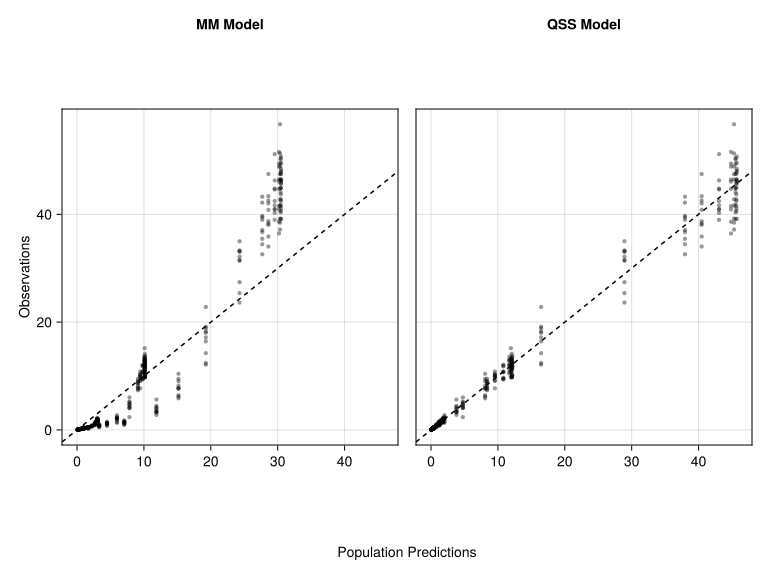
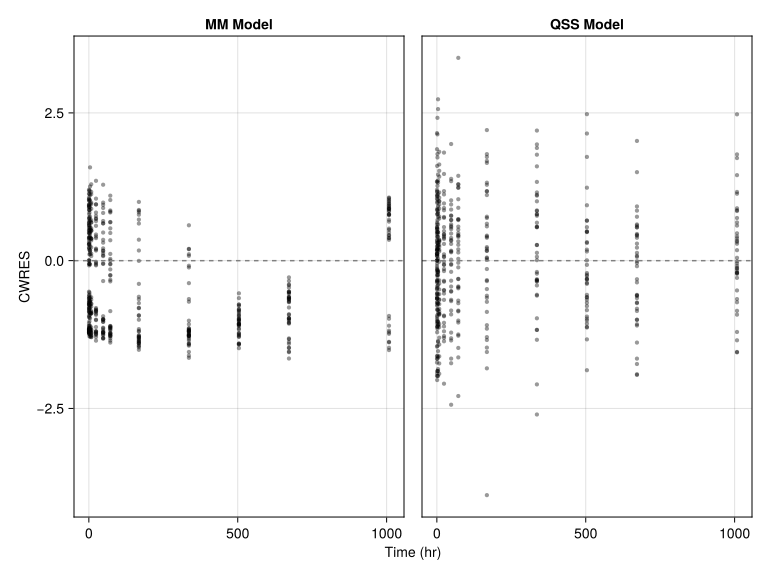
11.2 Residual Diagnostics
Show/Hide Code
# Calculate residuals
insp_mm = inspect(fit_mm)
insp_qss = inspect(fit_qss)

df_insp_mm = DataFrame(insp_mm)
df_insp_mm.Model .= "MM Model"

df_insp_qss = DataFrame(insp_qss)
df_insp_qss.Model .= "QSS Model"

df_resid = vcat(
    select(df_insp_mm, :time, :DV_wres, :Model),
    select(df_insp_qss, :time, :DV_wres, :Model),
)

# Create scatter layer
plt =
    data(df_resid) *
    mapping(:time => "Time (hr)", :DV_wres => "CWRES"; layout = :Model) *
    visual(Scatter; markersize = 6, alpha = 0.4)

fg = draw(plt)

# Add zero reference line to each panel
for i = 1:2
    hlines!(fg.figure[1, i], [0]; color = :gray, linestyle = :dash)
end

fg
[ Info: Calculating predictions. [ Info: Calculating weighted residuals. [ Info: Calculating empirical bayes. [ Info: Evaluating dose control parameters. [ Info: Evaluating individual parameters. [ Info: Done. [ Info: Calculating predictions. [ Info: Calculating weighted residuals. [ Info: Calculating empirical bayes. [ Info: Evaluating dose control parameters. [ Info: Evaluating individual parameters. [ Info: Done.
11.3 Individual Fits
Show/Hide Code
# Select one subject from each dose group
selected_ids = ["1", "11", "21", "31"]

# Create dose lookup from original data
dose_lookup = Dict(row.id => row.DOSE for row in eachrow(unique(select(df, :id, :DOSE))))

# Prepare data for individual fits
df_obs_select = filter(row -> row.id in selected_ids, df)
df_obs_select = @rtransform df_obs_select :Type = "Observed"
df_obs_select = @rtransform df_obs_select :Subject =
    "Subject " * string(:id) * " (" * string(:DOSE) * " nmol)"
df_obs_select = select(df_obs_select, :time, :DV, :Type, :Subject)
rename!(df_obs_select, :DV => :Conc)

# For inspect DataFrames, add DOSE from lookup
df_mm_select = filter(row -> row.id in selected_ids, df_insp_mm)
df_mm_select.DOSE = [dose_lookup[id] for id in df_mm_select.id]
df_mm_select = @rtransform df_mm_select :Type = "MM IPRED"
df_mm_select = @rtransform df_mm_select :Subject =
    "Subject " * string(:id) * " (" * string(:DOSE) * " nmol)"
df_mm_select = select(df_mm_select, :time, :DV_ipred, :Type, :Subject)
rename!(df_mm_select, :DV_ipred => :Conc)

df_qss_select = filter(row -> row.id in selected_ids, df_insp_qss)
df_qss_select.DOSE = [dose_lookup[id] for id in df_qss_select.id]
df_qss_select = @rtransform df_qss_select :Type = "QSS IPRED"
df_qss_select = @rtransform df_qss_select :Subject =
    "Subject " * string(:id) * " (" * string(:DOSE) * " nmol)"
df_qss_select = select(df_qss_select, :time, :DV_ipred, :Type, :Subject)
rename!(df_qss_select, :DV_ipred => :Conc)

df_indiv = vcat(df_obs_select, df_mm_select, df_qss_select)

# Create scatter for observed and lines for predictions
plt_obs =
    data(filter(row -> row.Type == "Observed", df_indiv)) *
    mapping(:time => "Time (hr)", :Conc => "Concentration (nM)"; layout = :Subject) *
    visual(Scatter; color = :black, markersize = 8)

plt_pred =
    data(filter(row -> row.Type != "Observed", df_indiv)) *
    mapping(
        :time => "Time (hr)",
        :Conc => "Concentration (nM)";
        color = :Type,
        layout = :Subject,
    ) *
    visual(Lines; linewidth = 2)

draw(plt_obs + plt_pred; axis = (yscale = Makie.pseudolog10,))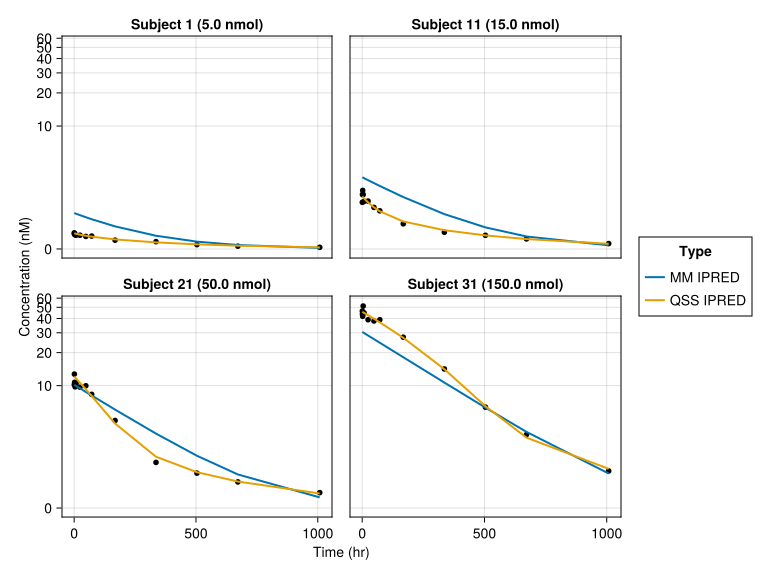
12 Step 7: Model Comparison
12.1 Information Criteria
# Compare models using AIC and BIC
println("Model Comparison:")
println("="^50)
println("Metric\t\tMM Model\tQSS Model")
println("-"^50)
println(
    "Log-likelihood\t$(round(loglikelihood(fit_mm), digits=1))\t\t$(round(loglikelihood(fit_qss), digits=1))",
)
println("AIC\t\t$(round(aic(fit_mm), digits=1))\t\t$(round(aic(fit_qss), digits=1))")
println("BIC\t\t$(round(bic(fit_mm), digits=1))\t\t$(round(bic(fit_qss), digits=1))")
println("Parameters\t$(length(coef(fit_mm)))\t\t$(length(coef(fit_qss)))")
println("="^50)

# Determine better model
if aic(fit_qss) < aic(fit_mm)
    println("\n✓ QSS model preferred based on AIC")
else
    println("\n✓ MM model preferred based on AIC")
end
Model Comparison:
==================================================
Metric MM Model QSS Model
--------------------------------------------------
Log-likelihood -845.6 -845.6
AIC 1705.2 1709.2
BIC 1735.0 1747.5
Parameters 6 8
==================================================
✓ MM model preferred based on AIC12.2 Scientific Considerations
Beyond statistical criteria, consider:
| Aspect | MM Model | QSS Model |
|---|---|---|
| Receptor dynamics | Cannot predict | Can predict |
| Target engagement | Cannot estimate | Can estimate |
| Mechanistic interpretation | Limited | Moderate |
| Identifiability | Good | May need constraints |
| Extrapolation | Risky | Better mechanistic basis |
TipModel Selection Recommendation
For this dataset:
- If only PK predictions are needed, the MM model is adequate
- If target engagement or receptor dynamics are needed, use the QSS model
- The QSS model provides more mechanistic insights for dose selection
13 Step 8: Simulation for Decision-Making
13.1 Dose-Response Predictions
Using the fitted model, we can simulate therapeutic scenarios:
Show/Hide Code
# Use the best-fit model for predictions
best_fit = fit_qss
best_model = qss_model
best_params = coef(best_fit)

# Simulation parameters (remove random effects for typical subject)
sim_params = (
    tvCl = best_params.tvCl,
    tvVc = best_params.tvVc,
    tvKsyn = best_params.tvKsyn,
    tvKdeg = best_params.tvKdeg,
    tvKSS = best_params.tvKSS,
    tvKint = best_params.tvKint,
    Ω = Diagonal([0.0, 0.0]),  # No IIV for typical subject
    σ_prop = 0.0,
)

# Define dosing scenarios (using nmol doses)
scenarios = [
    (dose = 15.0, interval = 168, label = "15 nmol Q1W"),
    (dose = 50.0, interval = 336, label = "50 nmol Q2W"),
    (dose = 150.0, interval = 672, label = "150 nmol Q4W"),
]

sim_times = 0:1:2016  # 12 weeks

# Simulate all scenarios and combine into DataFrame
df_scenarios = DataFrame()
for scenario in scenarios
    n_doses = ceil(Int, 2016 / scenario.interval) + 1
    regimen = DosageRegimen(
        scenario.dose,
        time = 0,
        cmt = 1,
        addl = n_doses - 1,
        ii = scenario.interval,
    )

    pop = [Subject(id = 1, events = regimen, observations = (DV = nothing,))]

    sim = simobs(qss_model, pop, sim_params, obstimes = sim_times)
    sim_df = DataFrame(sim)
    sim_df.Regimen .= scenario.label
    append!(df_scenarios, sim_df)
end

plt =
    data(df_scenarios) *
    mapping(
        :time => "Time (hr)",
        :DV => "Free Ligand Concentration (nM)";
        color = :Regimen,
    ) *
    visual(Lines; linewidth = 2)

fg = draw(
    plt;
    axis = (yscale = Makie.pseudolog10, title = "Simulated PK for Different Regimens"),
)

# Add KSS reference line
hlines!(fg.figure[1, 1], [best_params.tvKSS], color = :gray, linestyle = :dash)

fg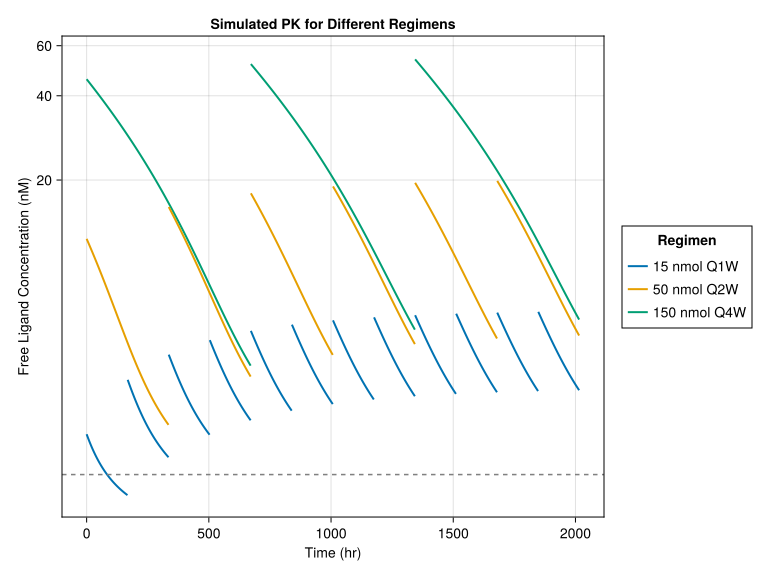
13.2 Target Suppression Predictions
Show/Hide Code
# Compute receptor fraction from state variables after simulation
# Using the QSS relationship: R = Rtot - LR, where LR = Ltot - L

# Parameters for receptor calculation
R0 = sim_params.tvKsyn / sim_params.tvKdeg  # Baseline receptor
KSS = sim_params.tvKSS

# Calculate receptor fraction from df_scenarios
df_receptor = copy(df_scenarios)

# Compute free ligand L from QSS relationship
# Note: We use DV as proxy for free ligand concentration L
# For receptor, we need to work backwards from the state variables
# Since Ltot and Rtot aren't directly in output, we'll compute R_frac
# using the steady-state approximation at each time point

# At quasi-steady-state: L ≈ DV (free ligand)
# LR = R0 * L / (KSS + L) (from QSS assumption with constant R approximation)
# R = R0 - LR = R0 * KSS / (KSS + L)
# R_frac = R / R0 = KSS / (KSS + L)

df_receptor.L = df_receptor.DV
df_receptor.R_frac = KSS ./ (KSS .+ df_receptor.L)

plt =
    data(df_receptor) *
    mapping(
        :time => "Time (hr)",
        :R_frac => "Free Receptor (fraction of baseline)";
        color = :Regimen,
    ) *
    visual(Lines; linewidth = 2)

fg = draw(plt; axis = (title = "Predicted Target Suppression",))

# Add reference lines
hlines!(fg.figure[1, 1], [1.0], color = :gray, linestyle = :dash)
hlines!(fg.figure[1, 1], [0.1], color = :red, linestyle = :dot)

fg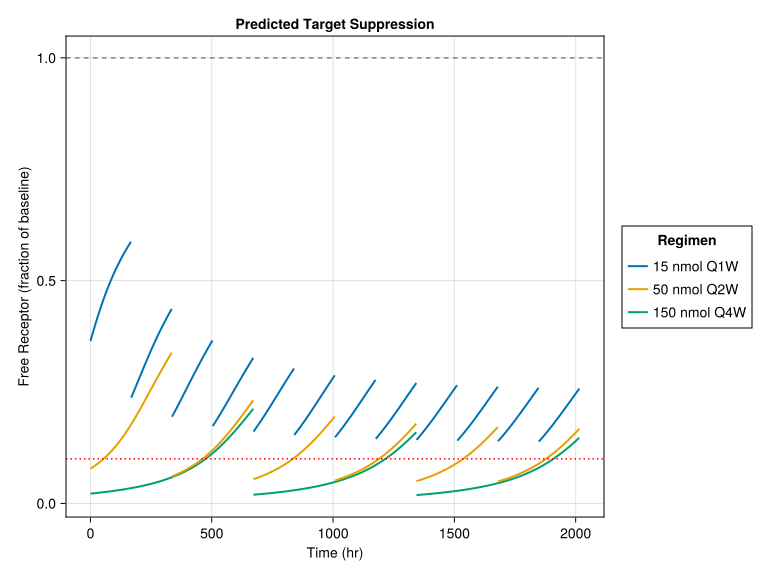
14 Workflow Summary
The complete TMDD modeling workflow:
Exploratory Analysis
- Plot dose-normalized concentrations
- Check for non-superimposable profiles
- Estimate apparent half-life by dose
Model Strategy
- Start with simplest model (MM)
- Progress to QSS if mechanistic insights needed
- Use full model only with receptor data
Parameter Initialization
- Use exploratory analysis to inform initial values
- Leverage simpler model fits for complex models
Fitting and Diagnostics
- Check convergence
- Evaluate residuals and GOF plots
- Verify individual fits
- Use four-phase analysis (Peletier & Gabrielsson, 2012) to verify model captures expected TMDD behavior
Model Selection
- Compare AIC/BIC
- Consider scientific objectives
- Balance parsimony with mechanism
Simulation
- Predict therapeutic scenarios
- Evaluate target engagement
- Support dose selection decisions
TipKey Takeaways
- Always start with exploratory analysis to identify TMDD signatures
- Begin with simple models and add complexity as needed
- Good initial values are critical for convergence
- Model selection should consider both statistics and scientific purpose
- The final model should support the intended application
For comprehensive reviews of TMDD modeling approaches, see Gibiansky et al. (2008) and Dua et al. (2015). Population modeling concepts are discussed in Mould & Upton (2012).
15 References
Dua, P., Hawkins, E., & Graaf, P. H. van der. (2015). A tutorial on target-mediated drug disposition (TMDD) models. CPT: Pharmacometrics & Systems Pharmacology, 4(6), 324–337. https://doi.org/10.1002/psp4.41
Gibiansky, L., Gibiansky, E., Kakkar, T., & Ma, P. (2008). Approximations of the target-mediated drug disposition model and identifiability of model parameters. Journal of Pharmacokinetics and Pharmacodynamics, 35(5), 573–591. https://doi.org/10.1007/s10928-008-9102-8
Mould, D. R., & Upton, R. N. (2012). Basic concepts in population modeling, simulation, and model-based drug development. CPT: Pharmacometrics & Systems Pharmacology, 1, e6. https://doi.org/10.1038/psp.2012.4
Peletier, L. A., & Gabrielsson, J. (2012). Dynamics of target-mediated drug disposition: Characteristic profiles and parameter identification. Journal of Pharmacokinetics and Pharmacodynamics, 39(5), 429–451. https://doi.org/10.1007/s10928-012-9260-6