flowchart LR
    subgraph Input["Dosing"]
        Dose[Dose]
    end

    subgraph Virtual["Virtual Compartment"]
        A["Drug Amount A(t)"]
    end

    subgraph PD["Pharmacodynamic Model"]
        E["Effect E(t)"]
    end

    Dose -->|Input| A
    A -->|KDE| Elimination["Elimination"]
    A -->|EDK50| E

    style Virtual fill:#e3f2fd
    style PD fill:#fff3e0

K-PD Models: Kinetics of Drug Action Without PK Data
1 Learning Objectives
By the end of this tutorial, you will be able to:
- Understand the K-PD modeling framework and its historical development
- Model pharmacodynamic responses when PK concentration data is unavailable
- Apply the virtual compartment approach with EDK50 and KDE parameters
- Implement K-PD models in Pumas
- Recognize the limitations and assumptions of the K-PD approach
- Decide when to use K-PD versus traditional PK-PD modeling
2 Introduction
K-PD (Kinetics of Pharmacodynamics) is a modeling methodology for describing pharmacodynamic responses without PK concentration data. The approach uses a virtual compartment to link dose directly to effect, enabling PD modeling when plasma concentrations are unavailable (Jacqmin et al. 2007; Gabrielsson et al. 2000).
2.1 Historical Context
The K-PD framework was formally established by Jacqmin and colleagues, who recognized that many clinical studies collect response data without corresponding plasma concentration measurements (Jacqmin et al. 2007). Traditional PK-PD modeling requires drug concentrations to drive the effect model, but the K-PD approach introduces a virtual compartment that links dose directly to response without explicit PK measurements.
Earlier work by Gabrielsson and Jusko demonstrated that dose-response-time data alone can provide estimates of turnover parameters and system dynamics (Gabrielsson et al. 2000). This approach has been validated across multiple therapeutic areas, but comes with important limitations regarding study design and drug properties (González-Sales et al. 2017).
2.2 When to Use K-PD Models
K-PD models are appropriate when PK concentration data is unavailable:
- Phase I studies with limited sampling
- Sparse sampling designs where PK collection is impractical
- Exploratory dose-finding studies
- Retrospective analysis of response-only data
- Studies where bioanalytical assays are unavailable
WarningCritical Assumption
K-PD modeling assumes linear (first-order) drug elimination. The approach is not valid for drugs with nonlinear (Michaelis-Menten) pharmacokinetics (González-Sales et al. 2017).
NoteK-PD vs Traditional PK-PD
Traditional PK-PD: Requires plasma concentration measurements to drive the effect model.
K-PD: Uses a virtual compartment with dose as input; no concentration measurements needed. The trade-off is that K-PD cannot predict concentrations or separate PK from PD variability.
3 The K-PD Virtual Compartment Approach
When PK concentration data is unavailable, the K-PD approach uses a virtual compartment to represent drug kinetics. Instead of measuring actual plasma concentrations, the model uses dose and time to infer a driving function for the PD model (Jacqmin et al. 2007).
3.1 Key Parameters
The K-PD model introduces two fundamental parameters that replace traditional PK parameters:
\text{KDE} = \frac{CL}{V}
\text{EDK50} = EC_{50} \times CL
Where:
| Parameter | Description | Units |
|---|---|---|
| KDE | Elimination rate constant from virtual compartment (= CL/V) | 1/time |
| EDK50 | Apparent in vivo potency; infusion rate producing 50% effect at steady | amount/time |
| EC50 | Concentration producing 50% of maximum effect | concentration |
| CL | Clearance (not directly estimated) | volume/time |
| V | Volume of distribution (not directly estimated) | volume |
TipInterpreting EDK50
EDK50 represents the infusion rate that would produce 50% of the maximum effect at steady state. Unlike EC50 (a concentration), EDK50 is directly related to dosing rate and can guide dose selection even without knowing absolute concentrations.
3.2 Virtual Compartment Dynamics
The virtual compartment follows first-order kinetics:
\frac{dA}{dt} = \text{Input}(t) - \text{KDE} \cdot A
For an Emax model, the effect becomes:
E = E_0 + \frac{E_{max} \cdot A \cdot \text{KDE}}{EDK50 + A \cdot \text{KDE}}
At steady state infusion:
A_{ss} \cdot KDE = \text{Infusion Rate}
So when Infusion Rate = EDK50:
E = E_0 + \frac{E_{max}}{2}
3.3 K-PD Model Without PK Measurements
kpd_virtual_model = @model begin
    @metadata begin
        desc = "K-PD Model: Virtual Compartment Without PK Measurements"
        timeu = u"hr"
    end

    @param begin
        """
        Elimination rate constant from virtual compartment (1/hr)
        """
        pop_KDE ∈ RealDomain(; lower = 0, init = 0.1)
        """
        Apparent potency - infusion rate producing 50% effect (mg/hr)
        """
        pop_EDK50 ∈ RealDomain(; lower = 0, init = 10.0)
        """
        Baseline effect
        """
        pop_E0 ∈ RealDomain(; lower = 0, init = 100.0)
        """
        Maximum effect
        """
        pop_Emax ∈ RealDomain(; init = 50.0)

        # Random effects
        Ω_pd ∈ PDiagDomain(2)
        σ_add ∈ RealDomain(; lower = 0, init = 5.0)
    end

    @random begin
        η_pd ~ MvNormal(Ω_pd)
    end

    @pre begin
        KDE = pop_KDE * exp(η_pd[1])
        EDK50 = pop_EDK50 * exp(η_pd[2])
        E0 = pop_E0
        Emax = pop_Emax
    end

    @init begin
        # Virtual compartment starts empty
        A = 0.0
    end

    @dynamics begin
        # Virtual compartment - first-order elimination
        # Ka is assumed very fast (instant absorption) for simplicity
        A' = -KDE * A
    end

    @vars begin
        # Rate out of virtual compartment
        rate_out = KDE * A
        # Effect using Emax model driven by rate
        Effect = E0 + Emax * rate_out / (EDK50 + rate_out)
    end

    @derived begin
        effect ~ @. Normal(Effect, σ_add)
    end
end
PumasModel
Parameters: pop_KDE, pop_EDK50, pop_E0, pop_Emax, Ω_pd, σ_add
Random effects: η_pd
Covariates:
Dynamical system variables: A
Dynamical system type: Matrix exponential
Derived: effect, rate_out, Effect
Observed: effect, rate_out, Effect3.4 Demonstration: K-PD Without Concentrations
Let’s simulate a scenario where we only have PD measurements:
# K-PD parameters (without explicit PK)
params_virtual = (
    pop_KDE = 0.2,     # Elimination rate: ~3.5 hr half-life
    pop_EDK50 = 5.0,   # Infusion rate producing 50% effect
    pop_E0 = 100.0,
    pop_Emax = -80.0,  # Inhibitory effect
    Ω_pd = Diagonal([0.0, 0.0]),
    σ_add = 0.0,
)

# Single dose administered to depot (virtual compartment with Ka)
dosing_virtual = DosageRegimen(100, time = 0, cmt = 1)
subject_virtual = Subject(id = 1, events = dosing_virtual)

# Simulate
sim_virtual = simobs(
    kpd_virtual_model,
    subject_virtual,
    params_virtual,
    obstimes = 0:0.5:48,
    simulate_error = false,
)

# Create plot
virtual_df = DataFrame(sim_virtual)

fig = Figure(size = (700, 400))
ax = Axis(
    fig[1, 1],
    xlabel = "Time (hr)",
    ylabel = "Effect",
    title = "K-PD Model: Effect Predicted from Dose (No Concentration Data)",
)
lines!(ax, virtual_df.time, virtual_df.Effect, linewidth = 2, color = :coral)
hlines!(ax, [100 - 80 / 2], linestyle = :dash, color = :gray, label = "50% Effect")
text!(ax, 25, 65, text = "Effect at EDK50", fontsize = 11)

fig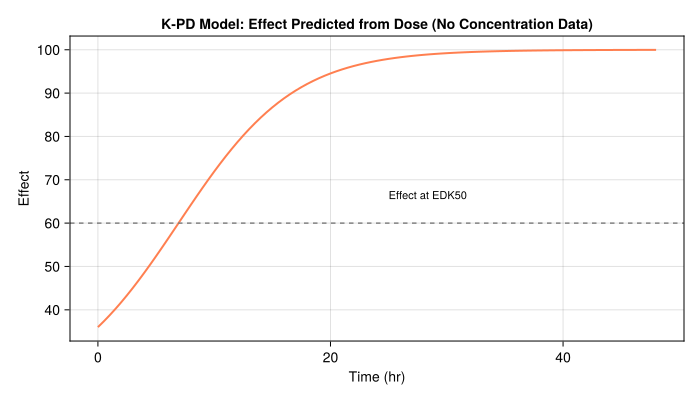
NoteKey Insight
The K-PD model describes the time course of effect using only:
- Dose and dosing schedule
- KDE (apparent elimination rate)
- EDK50 (apparent potency)
- PD parameters (E0, Emax)
No plasma concentrations are needed!
4 Limitations and Assumptions
The K-PD approach, while powerful, comes with important limitations that must be considered before applying it to a given dataset (Jacqmin et al. 2007; González-Sales et al. 2017).
4.1 Critical Assumptions
WarningAssumption 1: Linear Pharmacokinetics
K-PD is only valid for drugs with linear (first-order) elimination. For drugs with nonlinear (Michaelis-Menten) elimination, parameter estimates (KDE, EDK50) will be biased, predictions at different doses will be unreliable, and traditional PK-PD modeling should be used instead (González-Sales et al. 2017).
WarningAssumption 2: Identifiability
K-PD parameters are only identifiable under specific conditions. A wide dose range with at least 3-4 different dose levels is recommended. Multiple time points with minimum 4 PD samples per subject are needed (González-Sales et al. 2017). Both onset and offset of effect should be captured for adequate response characterization.
4.2 Known Limitations
| Limitation | Description | Mitigation |
|---|---|---|
| IIV overestimation | Total inter-individual variability is always overestimated in K-PD | Account for this in interpretation |
| No PK predictions | Cannot predict concentrations or exposure metrics (AUC, Cmax) | Use PK-PD if concentration data exists |
| Dose proportionality | Assumes linear PK; deviations from dose proportionality invalidate the model | Verify linearity before applying K-PD |
| Absorption variability | Cannot separate absorption from distribution variability | Use sparse PK sampling if possible |
| Bioavailability changes | Changes in F between formulations or foods will alter apparent EDK50 | Conduct dedicated bioavailability studies |
4.3 Study Design Considerations
Based on the methodological literature (Jacqmin et al. 2007; Gabrielsson et al. 2000; González-Sales et al. 2017):
Minimum Requirements:
- At least 3-4 dose levels spanning the expected therapeutic range
- Minimum of 4 PD observations per subject capturing effect time course
- Wide dose range to ensure identifiability of EDK50
Improved Designs:
- Multiple routes of administration improve parameter identifiability
- Multiple dosing (not just single dose) strengthens inference
- Design points matter more than sample size - strategic timing improves precision
TipWhen to Collect PK Data Instead
If your study can collect even 1 PK sample plus 2 PD samples, this may provide better parameter estimates than K-PD with 3 PD samples alone (González-Sales et al. 2017). Consider sparse PK sampling as an alternative to pure K-PD modeling.
5 K-PD vs PK-PD: Choosing the Right Approach
The decision between K-PD and traditional PK-PD modeling depends on data availability, drug properties, and study objectives.
5.1 Decision Framework
flowchart TD
    A[Do you have concentration data?] -->|Yes| B[Use PK-PD Modeling]
    A -->|No| C[Is elimination linear?]
    C -->|Yes| D["Are there ≥4 PD samples?"]
    C -->|No| E["K-PD NOT valid - Need PK data"]
    D -->|Yes| F[Is there a wide dose range?]
    D -->|No| G["Consider sparse PK sampling"]
    F -->|Yes| H[K-PD is appropriate]
    F -->|No| I["K-PD may have identifiability issues"]

    style B fill:#c8e6c9
    style H fill:#c8e6c9
    style E fill:#ffcdd2
    style I fill:#fff9c4
5.2 Comparison Table
| Criterion | K-PD Modeling | PK-PD Modeling |
|---|---|---|
| Data required | Dose + PD response only | Concentration + PD response |
| Parameters | KDE, EDK50 (composite) | CL, V, EC50 (separable) |
| Concentration prediction | Not possible | Yes |
| Exposure metrics | Cannot calculate AUC, Cmax directly | Full exposure characterization |
| Nonlinear PK | Invalid | Valid with appropriate model |
| IIV partitioning | Combined PK+PD variability | Separate PK and PD variability |
| Dose optimization | Limited (EDK50-based) | Exposure-based optimization |
| Regulatory acceptance | Limited; exploratory use | Standard for registration |
5.3 Recommendations by Scenario
Use K-PD when:
- Concentration measurements are not feasible
- Exploratory dose-finding studies
- Retrospective analysis of response-only data
- Phase 0/Phase I studies with PD-only endpoints
- Drug has very short half-life making PK sampling impractical
Use PK-PD when:
- Any concentration data is available (even sparse)
- Regulatory submissions are planned
- Nonlinear PK is suspected
- Precise exposure-response characterization is needed
- Dose optimization across populations is required
NoteBest Practice
When possible, design studies to collect at least sparse PK data. Even 1-2 concentration samples per subject can significantly improve parameter estimation compared to pure K-PD analysis (González-Sales et al. 2017).
6 Summary
In this tutorial, we covered:
- K-PD definition: A methodology for modeling PD responses without PK concentration data
- Virtual compartment approach: Using KDE and EDK50 parameters when concentration data is unavailable (Jacqmin et al. 2007)
- Key parameters: KDE (apparent elimination rate constant) and EDK50 (apparent potency)
- Limitations: Linear PK assumption, identifiability requirements, IIV overestimation (González-Sales et al. 2017)
- Study design: Minimum requirements for reliable K-PD modeling
6.1 Key Takeaways
- K-PD enables PD modeling when concentration data is unavailable
- EDK50 represents the infusion rate producing 50% effect at steady state
- K-PD is only valid for drugs with linear elimination
- Minimum 4 PD samples and wide dose range needed for reliable K-PD
- When possible, collect sparse PK data for improved parameter estimation
6.2 When to Use K-PD
- PK concentration data is unavailable or impractical to collect
- Drug elimination follows first-order kinetics
- Exploratory dose-finding studies
- Retrospective analysis of response-only data
6.3 When NOT to Use K-PD
- Drug has nonlinear (Michaelis-Menten) elimination
- Concentration data is available (use PK-PD instead)
- Regulatory submissions require exposure-response characterization
- Fewer than 4 PD samples per subject
- Narrow dose range in study design
6.4 Next Steps
For guidance on choosing between model types: See Model Selection Tutorial
References
Gabrielsson, J., W. J. Jusko, and L. Alari. 2000. “Modeling of Dose-Response-Time Data: Four Examples of Estimating the Turnover Parameters and Generating Kinetic Functions from Direct Response Data.” Biopharmaceutics & Drug Disposition 21 (2): 41–52.
González-Sales, M., M. J. Fernández-Terán, S. Pérez León, A. G. Jácome, and I. F. Trocóniz. 2017. “Limitations of the K-PD Model in Pharmacodynamic Modelling: Comparison with a PK-PD Model.” British Journal of Clinical Pharmacology 83 (6): 1240–50.
Jacqmin, P., E. Snoeck, E. A. van Schaick, et al. 2007. “Modelling Response Time Profiles in the Absence of Drug Concentrations: Definition and Performance Evaluation of the K-PD Model.” Journal of Pharmacokinetics and Pharmacodynamics 34 (1): 57–85.