flowchart TD
    subgraph Physiological System
        kin[k_in<br/>Production Rate] --> R[Response<br/>Variable R]
        R --> kout[k_out<br/>Removal Rate]
    end

    Drug --> |Inhibit or<br/>Stimulate| kin
    Drug --> |Inhibit or<br/>Stimulate| kout

    style R fill:#e8f5e9

Indirect Response Pharmacodynamic Models
1 Learning Objectives
By the end of this tutorial, you will be able to:
- Understand the turnover (indirect response) framework
- Distinguish between the four indirect response model types
- Choose the appropriate IDR type based on drug mechanism
- Implement all four IDR models in Pumas
- Compare response characteristics across model types
- Apply IDR models to real-world scenarios
2 Introduction
Indirect response (IDR) models describe drug effects that are mediated through modulation of physiological processes with inherent production and elimination rates (Dayneka et al. 1993; Sharma and Jusko 1998). Unlike direct response models, where effect immediately follows concentration, IDR models capture situations where:
- Effect persists after drug concentration declines
- Drug action is mediated through physiological turnover
- Response involves synthesis/degradation of endogenous substances
2.1 The Turnover Concept
Many physiological variables are maintained at homeostasis through a balance between production (k_{in}) and removal (k_{out}):
\frac{dR}{dt} = k_{in} - k_{out} \cdot R
At steady state (baseline, no drug):
\frac{dR}{dt} = 0 \implies R_{ss} = \frac{k_{in}}{k_{out}}
NoteKey Insight
The drug doesn’t directly cause the effect. Instead, it modifies the rate of production or removal, and the effect emerges as the system moves to a new equilibrium. This is why effects often outlast drug concentrations.
2.2 Clinical Examples of Turnover Processes
| Response Variable | Production | Removal | Turnover Time |
|---|---|---|---|
| Clotting factors | Hepatic synthesis | Degradation | 1-3 days |
| Blood glucose | Hepatic production | Cellular uptake | Hours |
| Cortisol | Adrenal secretion | Metabolism | ~1 hour |
| Platelets | Bone marrow | Clearance | 7-10 days |
| LDL cholesterol | Hepatic synthesis | LDL receptors | ~3 days |
3 The Four Indirect Response Types
Drugs can affect turnover processes in four distinct ways:
flowchart LR
    subgraph Type1["IDR Type I"]
        direction TB
        kin1[k_in] -->|Drug INHIBITS| R1[R decreases]
    end

    subgraph Type2["IDR Type II"]
        direction TB
        kout2[k_out] -->|Drug INHIBITS| R2[R increases]
    end

    subgraph Type3["IDR Type III"]
        direction TB
        kin3[k_in] -->|Drug STIMULATES| R3[R increases]
    end

    subgraph Type4["IDR Type IV"]
        direction TB
        kout4[k_out] -->|Drug STIMULATES| R4[R decreases]
    end

    style Type1 fill:#ffebee
    style Type2 fill:#e8f5e9
    style Type3 fill:#e8f5e9
    style Type4 fill:#ffebee
| Type | Drug Action | Effect on k_{in} | Effect on k_{out} | Response Direction |
|---|---|---|---|---|
| I | Inhibition of k_{in} | ↓ | — | Decreases |
| II | Inhibition of k_{out} | — | ↓ | Increases |
| III | Stimulation of k_{in} | ↑ | — | Increases |
| IV | Stimulation of k_{out} | — | ↑ | Decreases |
4 Mathematical Framework
4.1 General IDR Equations
Baseline condition (no drug):
\frac{dR}{dt} = k_{in,0} - k_{out} \cdot R
With drug effect, the modulated rate becomes:
\frac{dR}{dt} = k_{in,0} \cdot \left(1 - \frac{I_{max} \cdot C}{IC_{50} + C}\right) - k_{out} \cdot R
The production rate is reduced by the drug.
\frac{dR}{dt} = k_{in,0} - k_{out} \cdot \left(1 - \frac{I_{max} \cdot C}{IC_{50} + C}\right) \cdot R
The removal rate is reduced by the drug.
\frac{dR}{dt} = k_{in,0} \cdot \left(1 + \frac{E_{max} \cdot C}{EC_{50} + C}\right) - k_{out} \cdot R
The production rate is increased by the drug.
\frac{dR}{dt} = k_{in,0} - k_{out} \cdot \left(1 + \frac{E_{max} \cdot C}{EC_{50} + C}\right) \cdot R
The removal rate is increased by the drug.
4.2 Key Parameters
| Parameter | Description | Units |
|---|---|---|
| k_{in,0} | Baseline production rate | response/time |
| k_{out} | First-order removal rate constant | 1/time |
| I_{max} | Maximum fractional inhibition (0 to 1) | dimensionless |
| E_{max} | Maximum fractional stimulation | dimensionless |
| IC_{50}/EC_{50} | Concentration for 50% effect | mass/volume |
TipTurnover Half-Life
The turnover half-life determines how quickly the response variable returns to baseline after drug removal:
t_{1/2,turnover} = \frac{\ln(2)}{k_{out}}
A process with t_{1/2} = 24 hours (e.g., clotting factors) takes ~4-5 days to fully recover after drug cessation.
5 Pumas Implementation
5.1 IDR Type I: Inhibition of Production
idr_type1 = @model begin
    @metadata begin
        desc = "Indirect Response Model Type I: Inhibition of kin"
        timeu = u"hr"
    end

    @param begin
        # PK parameters
        pop_Ka ∈ RealDomain(; lower = 0, init = 1.0)
        pop_CL ∈ RealDomain(; lower = 0, init = 0.5)
        pop_Vc ∈ RealDomain(; lower = 0, init = 20.0)

        # PD parameters
        """
        Baseline response (R0 = kin0/kout)
        """
        pop_R0 ∈ RealDomain(; lower = 0, init = 100.0)
        """
        Turnover time (1/kout)
        """
        pop_turnover ∈ RealDomain(; lower = 0, init = 10.0)
        """
        Maximum fractional inhibition of kin
        """
        pop_Imax ∈ RealDomain(; lower = 0, upper = 1, init = 0.9)
        """
        Concentration at 50% inhibition
        """
        pop_IC50 ∈ RealDomain(; lower = 0, init = 2.0)

        # BSV and RUV
        Ω_pk ∈ PDiagDomain(3)
        Ω_pd ∈ PDiagDomain(1)
        σ_prop_pk ∈ RealDomain(; lower = 0, init = 0.1)
        σ_add_pd ∈ RealDomain(; lower = 0, init = 5.0)
    end

    @random begin
        η_pk ~ MvNormal(Ω_pk)
        η_pd ~ MvNormal(Ω_pd)
    end

    @pre begin
        # PK parameters
        CL = pop_CL * exp(η_pk[1])
        Vc = pop_Vc * exp(η_pk[2])
        Ka = pop_Ka * exp(η_pk[3])

        # PD parameters
        R0 = pop_R0 * exp(η_pd[1])
        kout = 1 / pop_turnover
        kin0 = R0 * kout  # Derived from steady-state condition
        Imax = pop_Imax
        IC50 = pop_IC50
    end

    @init begin
        Response = R0  # Start at baseline
    end

    @vars begin
        # Plasma concentration
        Cp = Central / Vc
        # IDR Type I: Drug inhibits production
        inhibition = Imax * Cp / (IC50 + Cp)
        kin = kin0 * (1 - inhibition)
        # Response for plotting
        Resp = Response
    end

    @dynamics begin
        # PK
        Depot' = -Ka * Depot
        Central' = Ka * Depot - (CL / Vc) * Central
        # Response dynamics
        Response' = kin - kout * Response
    end

    @derived begin
        conc ~ @. ProportionalNormal(Cp, σ_prop_pk)
        response ~ @. Normal(Response, σ_add_pd)
    end
end
PumasModel
Parameters: pop_Ka, pop_CL, pop_Vc, pop_R0, pop_turnover, pop_Imax, pop_IC50, Ω_pk, Ω_pd, σ_prop_pk, σ_add_pd
Random effects: η_pk, η_pd
Covariates:
Dynamical system variables: Depot, Central, Response
Dynamical system type: Nonlinear ODE
Derived: conc, response, Cp, inhibition, kin, Resp
Observed: conc, response, Cp, inhibition, kin, Resp5.2 IDR Type II: Inhibition of Removal
idr_type2 = @model begin
    @metadata begin
        desc = "Indirect Response Model Type II: Inhibition of kout"
        timeu = u"hr"
    end

    @param begin
        pop_Ka ∈ RealDomain(; lower = 0, init = 1.0)
        pop_CL ∈ RealDomain(; lower = 0, init = 0.5)
        pop_Vc ∈ RealDomain(; lower = 0, init = 20.0)
        pop_R0 ∈ RealDomain(; lower = 0, init = 100.0)
        pop_turnover ∈ RealDomain(; lower = 0, init = 10.0)
        pop_Imax ∈ RealDomain(; lower = 0, upper = 1, init = 0.9)
        pop_IC50 ∈ RealDomain(; lower = 0, init = 2.0)
        Ω_pk ∈ PDiagDomain(3)
        Ω_pd ∈ PDiagDomain(1)
        σ_prop_pk ∈ RealDomain(; lower = 0, init = 0.1)
        σ_add_pd ∈ RealDomain(; lower = 0, init = 5.0)
    end

    @random begin
        η_pk ~ MvNormal(Ω_pk)
        η_pd ~ MvNormal(Ω_pd)
    end

    @pre begin
        CL = pop_CL * exp(η_pk[1])
        Vc = pop_Vc * exp(η_pk[2])
        Ka = pop_Ka * exp(η_pk[3])
        R0 = pop_R0 * exp(η_pd[1])
        kout0 = 1 / pop_turnover
        kin = R0 * kout0
        Imax = pop_Imax
        IC50 = pop_IC50
    end

    @init begin
        Response = R0
    end

    @vars begin
        # Plasma concentration
        Cp = Central / Vc
        # IDR Type II: Drug inhibits removal
        inhibition = Imax * Cp / (IC50 + Cp)
        kout = kout0 * (1 - inhibition)
        # Response for plotting
        Resp = Response
    end

    @dynamics begin
        Depot' = -Ka * Depot
        Central' = Ka * Depot - (CL / Vc) * Central
        # Response dynamics
        Response' = kin - kout * Response
    end

    @derived begin
        conc ~ @. ProportionalNormal(Cp, σ_prop_pk)
        response ~ @. Normal(Response, σ_add_pd)
    end
end
PumasModel
Parameters: pop_Ka, pop_CL, pop_Vc, pop_R0, pop_turnover, pop_Imax, pop_IC50, Ω_pk, Ω_pd, σ_prop_pk, σ_add_pd
Random effects: η_pk, η_pd
Covariates:
Dynamical system variables: Depot, Central, Response
Dynamical system type: Nonlinear ODE
Derived: conc, response, Cp, inhibition, kout, Resp
Observed: conc, response, Cp, inhibition, kout, Resp5.3 IDR Type III: Stimulation of Production
idr_type3 = @model begin
    @metadata begin
        desc = "Indirect Response Model Type III: Stimulation of kin"
        timeu = u"hr"
    end

    @param begin
        pop_Ka ∈ RealDomain(; lower = 0, init = 1.0)
        pop_CL ∈ RealDomain(; lower = 0, init = 0.5)
        pop_Vc ∈ RealDomain(; lower = 0, init = 20.0)
        pop_R0 ∈ RealDomain(; lower = 0, init = 100.0)
        pop_turnover ∈ RealDomain(; lower = 0, init = 10.0)
        """
        Maximum fractional stimulation of kin
        """
        pop_Emax ∈ RealDomain(; lower = 0, init = 2.0)
        pop_EC50 ∈ RealDomain(; lower = 0, init = 2.0)
        Ω_pk ∈ PDiagDomain(3)
        Ω_pd ∈ PDiagDomain(1)
        σ_prop_pk ∈ RealDomain(; lower = 0, init = 0.1)
        σ_add_pd ∈ RealDomain(; lower = 0, init = 5.0)
    end

    @random begin
        η_pk ~ MvNormal(Ω_pk)
        η_pd ~ MvNormal(Ω_pd)
    end

    @pre begin
        CL = pop_CL * exp(η_pk[1])
        Vc = pop_Vc * exp(η_pk[2])
        Ka = pop_Ka * exp(η_pk[3])
        R0 = pop_R0 * exp(η_pd[1])
        kout = 1 / pop_turnover
        kin0 = R0 * kout
        Emax = pop_Emax
        EC50 = pop_EC50
    end

    @init begin
        Response = R0
    end

    @vars begin
        # Plasma concentration
        Cp = Central / Vc
        # IDR Type III: Drug stimulates production
        stimulation = Emax * Cp / (EC50 + Cp)
        kin = kin0 * (1 + stimulation)
        # Response for plotting
        Resp = Response
    end

    @dynamics begin
        Depot' = -Ka * Depot
        Central' = Ka * Depot - (CL / Vc) * Central
        # Response dynamics
        Response' = kin - kout * Response
    end

    @derived begin
        conc ~ @. ProportionalNormal(Cp, σ_prop_pk)
        response ~ @. Normal(Response, σ_add_pd)
    end
end
PumasModel
Parameters: pop_Ka, pop_CL, pop_Vc, pop_R0, pop_turnover, pop_Emax, pop_EC50, Ω_pk, Ω_pd, σ_prop_pk, σ_add_pd
Random effects: η_pk, η_pd
Covariates:
Dynamical system variables: Depot, Central, Response
Dynamical system type: Nonlinear ODE
Derived: conc, response, Cp, stimulation, kin, Resp
Observed: conc, response, Cp, stimulation, kin, Resp5.4 IDR Type IV: Stimulation of Removal
idr_type4 = @model begin
    @metadata begin
        desc = "Indirect Response Model Type IV: Stimulation of kout"
        timeu = u"hr"
    end

    @param begin
        pop_Ka ∈ RealDomain(; lower = 0, init = 1.0)
        pop_CL ∈ RealDomain(; lower = 0, init = 0.5)
        pop_Vc ∈ RealDomain(; lower = 0, init = 20.0)
        pop_R0 ∈ RealDomain(; lower = 0, init = 100.0)
        pop_turnover ∈ RealDomain(; lower = 0, init = 10.0)
        pop_Emax ∈ RealDomain(; lower = 0, init = 2.0)
        pop_EC50 ∈ RealDomain(; lower = 0, init = 2.0)
        Ω_pk ∈ PDiagDomain(3)
        Ω_pd ∈ PDiagDomain(1)
        σ_prop_pk ∈ RealDomain(; lower = 0, init = 0.1)
        σ_add_pd ∈ RealDomain(; lower = 0, init = 5.0)
    end

    @random begin
        η_pk ~ MvNormal(Ω_pk)
        η_pd ~ MvNormal(Ω_pd)
    end

    @pre begin
        CL = pop_CL * exp(η_pk[1])
        Vc = pop_Vc * exp(η_pk[2])
        Ka = pop_Ka * exp(η_pk[3])
        R0 = pop_R0 * exp(η_pd[1])
        kout0 = 1 / pop_turnover
        kin = R0 * kout0
        Emax = pop_Emax
        EC50 = pop_EC50
    end

    @init begin
        Response = R0
    end

    @vars begin
        # Plasma concentration
        Cp = Central / Vc
        # IDR Type IV: Drug stimulates removal
        stimulation = Emax * Cp / (EC50 + Cp)
        kout = kout0 * (1 + stimulation)
        # Response for plotting
        Resp = Response
    end

    @dynamics begin
        Depot' = -Ka * Depot
        Central' = Ka * Depot - (CL / Vc) * Central
        # Response dynamics
        Response' = kin - kout * Response
    end

    @derived begin
        conc ~ @. ProportionalNormal(Cp, σ_prop_pk)
        response ~ @. Normal(Response, σ_add_pd)
    end
end
PumasModel
Parameters: pop_Ka, pop_CL, pop_Vc, pop_R0, pop_turnover, pop_Emax, pop_EC50, Ω_pk, Ω_pd, σ_prop_pk, σ_add_pd
Random effects: η_pk, η_pd
Covariates:
Dynamical system variables: Depot, Central, Response
Dynamical system type: Nonlinear ODE
Derived: conc, response, Cp, stimulation, kout, Resp
Observed: conc, response, Cp, stimulation, kout, Resp6 Comparative Simulation
Let’s simulate all four IDR types with the same PK parameters to compare their behavior:
# Parameters for inhibition models (Types I, II)
params_inhib = (
    pop_Ka = 1.0,
    pop_CL = 0.5,
    pop_Vc = 20.0,
    pop_R0 = 100.0,
    pop_turnover = 10.0,  # t1/2 ≈ 7 hr
    pop_Imax = 0.8,
    pop_IC50 = 2.0,
    Ω_pk = Diagonal([0.0, 0.0, 0.0]),  # No variability for comparison
    Ω_pd = Diagonal([0.0]),
    σ_prop_pk = 0.0,
    σ_add_pd = 0.0,
)

# Parameters for stimulation models (Types III, IV)
params_stim = (
    pop_Ka = 1.0,
    pop_CL = 0.5,
    pop_Vc = 20.0,
    pop_R0 = 100.0,
    pop_turnover = 10.0,  # t1/2 ≈ 7 hr
    pop_Emax = 1.5,
    pop_EC50 = 2.0,
    Ω_pk = Diagonal([0.0, 0.0, 0.0]),  # No variability for comparison
    Ω_pd = Diagonal([0.0]),
    σ_prop_pk = 0.0,
    σ_add_pd = 0.0,
)

# Dosing and subject
dosing = DosageRegimen(100, time = 0, cmt = 1)
subject = Subject(id = 1, events = dosing)

# Simulate all four types (no residual error for clean visualization)
sim1 = simobs(idr_type1, subject, params_inhib, obstimes = 0:0.5:72, simulate_error = false)
sim2 = simobs(idr_type2, subject, params_inhib, obstimes = 0:0.5:72, simulate_error = false)
sim3 = simobs(idr_type3, subject, params_stim, obstimes = 0:0.5:72, simulate_error = false)
sim4 = simobs(idr_type4, subject, params_stim, obstimes = 0:0.5:72, simulate_error = false)
SimulatedObservations
Simulated variables: conc, response, Cp, stimulation, kout, Resp
Time: 0.0:0.5:72.0# Convert simulations to DataFrames
df1 = DataFrame(sim1)
df1.idr_type .= "Type I: Inhibition of kin"
df2 = DataFrame(sim2)
df2.idr_type .= "Type II: Inhibition of kout"
df3 = DataFrame(sim3)
df3.idr_type .= "Type III: Stimulation of kin"
df4 = DataFrame(sim4)
df4.idr_type .= "Type IV: Stimulation of kout"
# PK plot (use df1 since PK is same for all) - using vars: Cp
pk_plt =
data(df1) *
mapping(:time => "Time (hr)", :Cp => "Concentration (mg/L)") *
visual(Lines, linewidth = 2, color = :steelblue)
fig = Figure(size = (900, 700))
draw!(fig[1, 1:2], pk_plt; axis = (title = "Plasma Concentration (Common to All)",))
# Draw individual response panels
for (i, (df, title, color, pos)) in enumerate(
zip(
[df1, df2, df3, df4],
[
"Type I: Inhibition of kin",
"Type II: Inhibition of kout",
"Type III: Stimulation of kin",
"Type IV: Stimulation of kout",
],
[:red, :green, :purple, :orange],
[(2, 1), (2, 2), (3, 1), (3, 2)],
),
)
plt =
data(df) *
mapping(:time => "Time (hr)", :Resp => "Response") *
visual(Lines, linewidth = 2, color = color)
ax = Axis(fig[pos...], xlabel = "Time (hr)", ylabel = "Response", title = title)
draw!(ax, plt)
hlines!(ax, [100], linestyle = :dash, color = :gray)
end
fig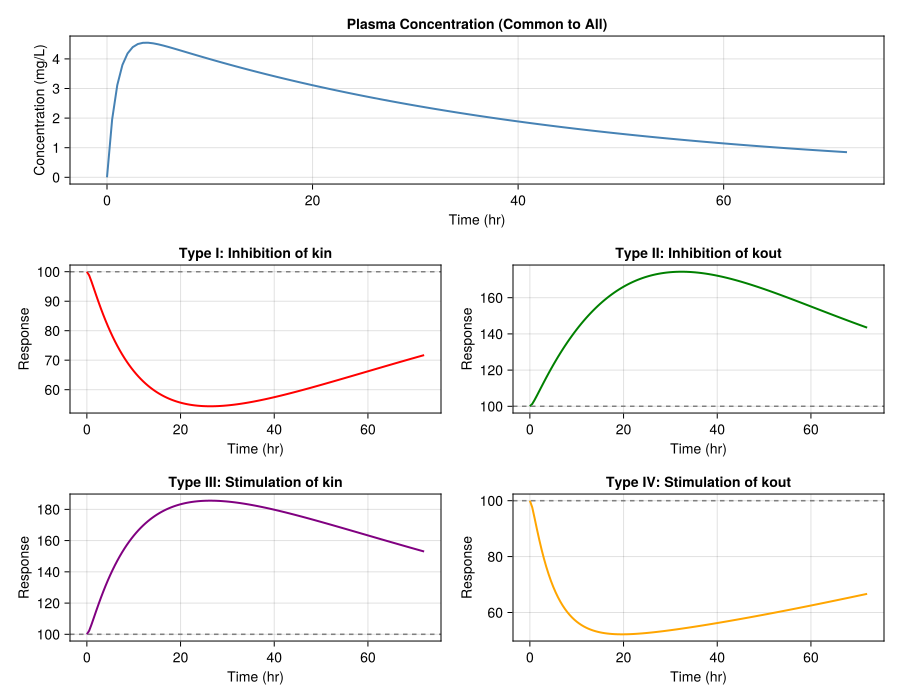
6.1 Key Observations
NoteResponse Characteristics
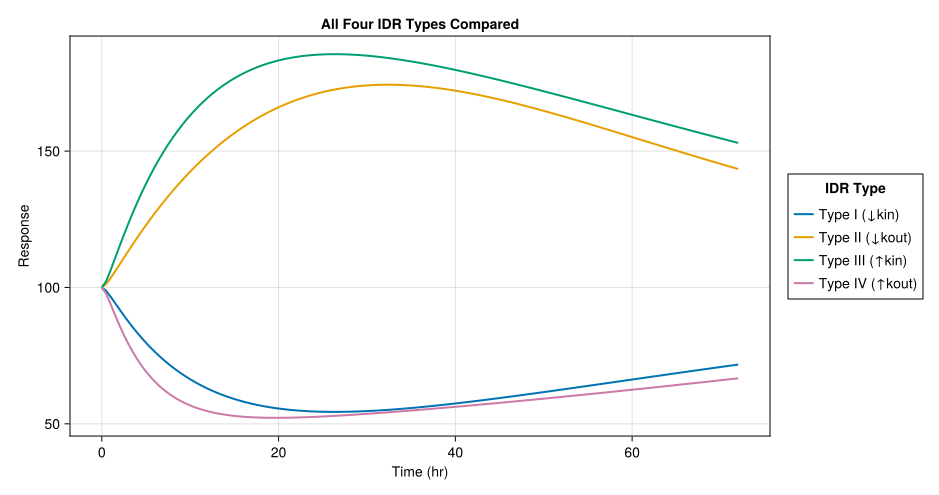
Types I and IV → Response decreases
- Type I: Reduced production leads to gradual decline
- Type IV: Increased removal leads to faster decline
Types II and III → Response increases
- Type II: Reduced removal causes accumulation
- Type III: Increased production causes rise
All types: Response returns to baseline after drug clears, governed by the turnover half-life.
6.2 Overlay Comparison
# Prepare labeled DataFrames (reuse df1-df4 from previous block) - using vars: Resp
df1_labeled = select(df1, :time, :Resp)
df1_labeled.type .= "Type I (↓kin)"
df2_labeled = select(df2, :time, :Resp)
df2_labeled.type .= "Type II (↓kout)"
df3_labeled = select(df3, :time, :Resp)
df3_labeled.type .= "Type III (↑kin)"
df4_labeled = select(df4, :time, :Resp)
df4_labeled.type .= "Type IV (↑kout)"

overlay_df = vcat(df1_labeled, df2_labeled, df3_labeled, df4_labeled)

plt =
    data(overlay_df) *
    mapping(:time => "Time (hr)", :Resp => "Response", color = :type => "IDR Type") *
    visual(Lines, linewidth = 2)

draw(
    plt;
    axis = (
        xlabel = "Time (hr)",
        ylabel = "Response",
        title = "All Four IDR Types Compared",
        width = 700,
        height = 400,
    ),
)
7 Choosing the Right IDR Type
The choice of IDR model depends on the mechanism of drug action:
Inhibition of production rate
| Drug | Target | Response Variable |
|---|---|---|
| Corticosteroids | ACTH release | Cortisol levels |
| Statins | HMG-CoA reductase | LDL cholesterol |
| Methotrexate | DNA synthesis | Cell proliferation |
Clinical scenario: A drug suppresses the synthesis of a biomarker. After drug removal, the biomarker slowly returns as production resumes (Chakraborty et al. 1999).
Inhibition of removal rate
| Drug | Target | Response Variable |
|---|---|---|
| PPIs | H⁺/K⁺-ATPase | Gastric acid |
| ACE inhibitors | Angiotensin degradation | Bradykinin levels |
| Warfarin | Clotting factor degradation | Clotting factors |
Clinical scenario: A drug blocks the clearance of a substance, causing it to accumulate above baseline (Hamberg et al. 2007).
Stimulation of production rate
| Drug | Target | Response Variable |
|---|---|---|
| Erythropoietin | RBC production | Hemoglobin |
| G-CSF | Neutrophil production | WBC count |
| Insulin secretagogues | β-cell secretion | Insulin levels |
Clinical scenario: A drug enhances the synthesis of an endogenous factor, leading to supranormal levels during treatment.
Stimulation of removal rate
| Drug | Target | Response Variable |
|---|---|---|
| Diuretics | Sodium excretion | Body sodium |
| Enzyme inducers | Metabolic clearance | Drug levels |
| Laxatives | GI motility | Gut contents |
Clinical scenario: A drug accelerates the elimination of a substance, causing levels to drop below baseline.
8 Effect of Turnover Time
The turnover time (1/k_{out}) significantly affects the response dynamics:
turnover_times = [2.0, 10.0, 30.0]
labels = ["τ = 2 hr (fast)", "τ = 10 hr (moderate)", "τ = 30 hr (slow)"]

# Simulate for each turnover time and collect results (no residual error for visualization)
turnover_results = map(zip(turnover_times, labels)) do (τ, label)
    params_var = merge(params_inhib, (; pop_turnover = τ))
    sim_var = simobs(
        idr_type1,
        subject,
        params_var,
        obstimes = 0:0.5:120,
        simulate_error = false,
    )
    df = DataFrame(sim_var)
    df.turnover_label .= label
    df
end
turnover_df = vcat(turnover_results...)

plt =
    data(turnover_df) *
    mapping(
        :time => "Time (hr)",
        :Resp => "Response",
        color = :turnover_label => "Turnover Time",
    ) *
    visual(Lines, linewidth = 2)

draw(
    plt;
    axis = (
        xlabel = "Time (hr)",
        ylabel = "Response",
        title = "Impact of Turnover Time on Response",
        width = 700,
        height = 350,
    ),
)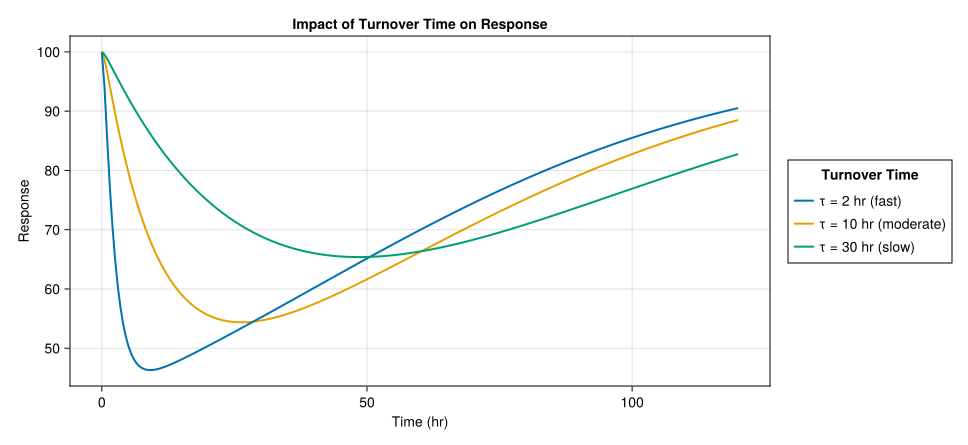
TipInterpretation
- Fast turnover (τ = 2 hr): Response changes quickly, returns to baseline fast
- Slow turnover (τ = 30 hr): Response changes gradually, takes days to normalize
The turnover time determines the “memory” of the system.
9 Fitting Workflow (Type I Example)
9.1 Generate Synthetic Data
# Parameters with variability
params_fit = (
    pop_Ka = 1.0,
    pop_CL = 0.5,
    pop_Vc = 20.0,
    pop_R0 = 100.0,
    pop_turnover = 10.0,
    pop_Imax = 0.8,
    pop_IC50 = 2.0,
    Ω_pk = Diagonal([0.09, 0.09, 0.09]),
    Ω_pd = Diagonal([0.04]),
    σ_prop_pk = 0.1,
    σ_add_pd = 5.0,
)

# Population
population = map(1:20) do i
    Subject(id = i, events = dosing)
end

Random.seed!(789)
sim_data =
    simobs(idr_type1, population, params_fit, obstimes = [1, 2, 4, 8, 12, 24, 36, 48])
df_sim = DataFrame(sim_data)
9.2 Fit the Model
fit_pop = read_pumas(
    df_sim;
    id = :id,
    time = :time,
    amt = :amt,
    evid = :evid,
    cmt = :cmt,
    observations = [:conc, :response],
)

init_params = (
    pop_Ka = 0.8,
    pop_CL = 0.4,
    pop_Vc = 25.0,
    pop_R0 = 90.0,
    pop_turnover = 8.0,
    pop_Imax = 0.7,
    pop_IC50 = 1.5,
    Ω_pk = Diagonal([0.05, 0.05, 0.05]),
    Ω_pd = Diagonal([0.02]),
    σ_prop_pk = 0.15,
    σ_add_pd = 8.0,
)

fit_result = fit(idr_type1, fit_pop, init_params, FOCE())
[ Info: Checking the initial parameter values. [ Info: The initial negative log likelihood and its gradient are finite. Check passed. Iter Function value Gradient norm 0 7.085109e+02 1.353322e+02 * time: 0.04062986373901367 1 6.676093e+02 1.026426e+02 * time: 3.854595899581909 2 6.352060e+02 3.470667e+01 * time: 4.191179037094116 3 6.275786e+02 1.973835e+01 * time: 4.637328863143921 4 6.263351e+02 2.294340e+01 * time: 4.891809940338135 5 6.246890e+02 1.400429e+01 * time: 5.199867010116577 6 6.236123e+02 1.884212e+01 * time: 5.446619987487793 7 6.224128e+02 1.524427e+01 * time: 5.712301015853882 8 6.203079e+02 3.965261e+00 * time: 5.980268955230713 9 6.198527e+02 1.928390e+00 * time: 6.235260009765625 10 6.197635e+02 1.504441e+00 * time: 6.487905979156494 11 6.197324e+02 1.293137e+00 * time: 6.75119686126709 12 6.196555e+02 9.028813e-01 * time: 7.014227867126465 13 6.195852e+02 9.506778e-01 * time: 7.287097930908203 14 6.195478e+02 4.925143e-01 * time: 7.5316338539123535 15 6.195421e+02 1.543739e-01 * time: 7.793207883834839 16 6.195417e+02 2.895508e-02 * time: 8.062871932983398 17 6.195416e+02 2.595519e-02 * time: 8.312728881835938 18 6.195416e+02 2.191265e-02 * time: 8.557783842086792 19 6.195416e+02 2.069051e-02 * time: 8.793735980987549 20 6.195416e+02 1.370350e-02 * time: 9.044224977493286 21 6.195416e+02 5.600722e-03 * time: 9.293107032775879 22 6.195416e+02 3.295600e-03 * time: 9.538151025772095 23 6.195416e+02 3.295599e-03 * time: 9.891592979431152 24 6.195416e+02 3.295600e-03 * time: 10.327850818634033 25 6.195416e+02 7.699019e-03 * time: 10.577200889587402 26 6.195416e+02 2.768621e-03 * time: 10.870498895645142 27 6.195416e+02 2.024137e-03 * time: 11.134114027023315 28 6.195416e+02 2.024085e-03 * time: 11.459604024887085 29 6.195416e+02 2.024015e-03 * time: 11.762655973434448 30 6.195416e+02 2.024015e-03 * time: 12.101696014404297 31 6.195416e+02 2.024014e-03 * time: 12.463152885437012 32 6.195416e+02 2.024012e-03 * time: 12.819613933563232 33 6.195416e+02 2.024012e-03 * time: 13.172699928283691 34 6.195416e+02 2.023976e-03 * time: 13.530910968780518 35 6.195416e+02 2.023971e-03 * time: 13.895092964172363 36 6.195416e+02 2.023940e-03 * time: 14.227072954177856 37 6.195416e+02 2.023938e-03 * time: 14.544360876083374 38 6.195416e+02 2.023933e-03 * time: 14.900079011917114 39 6.195416e+02 2.023932e-03 * time: 15.25920295715332 40 6.195416e+02 3.119575e-03 * time: 15.553557872772217 41 6.195416e+02 3.120151e-03 * time: 15.872731924057007 42 6.195416e+02 3.120151e-03 * time: 16.27544093132019 43 6.195416e+02 3.120150e-03 * time: 16.723474979400635 44 6.195416e+02 3.119868e-03 * time: 17.14495301246643 45 6.195416e+02 3.119867e-03 * time: 17.530094861984253 46 6.195416e+02 3.119867e-03 * time: 17.97455883026123 47 6.195416e+02 3.104140e-03 * time: 18.49885582923889 48 6.195416e+02 3.100282e-03 * time: 18.979233026504517 49 6.195416e+02 3.096266e-03 * time: 19.368947982788086 50 6.195416e+02 3.091929e-03 * time: 19.725111961364746 51 6.195416e+02 3.091879e-03 * time: 20.09873104095459 52 6.195416e+02 3.091879e-03 * time: 20.60769295692444 53 6.195416e+02 3.090670e-03 * time: 20.958541870117188 54 6.195416e+02 3.090610e-03 * time: 21.310533046722412 55 6.195416e+02 3.090606e-03 * time: 21.689612865447998 56 6.195416e+02 3.090606e-03 * time: 22.167908906936646 57 6.195416e+02 3.090606e-03 * time: 22.63885188102722
FittedPumasModel

Dynamical system type:               Nonlinear ODE
Solver(s): (OrdinaryDiffEqVerner.Vern7,OrdinaryDiffEqRosenbrock.Rodas5P)

Number of subjects:                             20

Observation records:         Active        Missing
    conc:                       160              0
    response:                   160              0
    Total:                      320              0

Number of parameters:      Constant      Optimized
                                  0             13

Likelihood approximation:                     FOCE
Likelihood optimizer:                         BFGS

Termination Reason:              NoObjectiveChange
Log-likelihood value:                    -619.5416

--------------------------
               Estimate
--------------------------
pop_Ka           0.91427
pop_CL           0.47733
pop_Vc          19.669
pop_R0         101.24
pop_turnover     9.5599
pop_Imax         0.72667
pop_IC50         1.7911
Ω_pk₁,₁          0.12033
Ω_pk₂,₂          0.093923
Ω_pk₃,₃          0.10366
Ω_pd₁,₁          0.027331
σ_prop_pk        0.084668
σ_add_pd         4.6919
--------------------------coef(fit_result)(pop_Ka = 0.9142688797198602, pop_CL = 0.47732977659950515, pop_Vc = 19.669413611396415, pop_R0 = 101.23600266516392, pop_turnover = 9.55992068585086, pop_Imax = 0.7266710393631256, pop_IC50 = 1.791073623305339, Ω_pk = [0.12032823667064554 0.0 0.0; 0.0 0.09392300997240452 0.0; 0.0 0.0 0.1036624996343916], Ω_pd = [0.027330709909330377;;], σ_prop_pk = 0.08466773836082403, σ_add_pd = 4.69193327565113)10 Model Diagnostics
insp = inspect(fit_result)[ Info: Calculating predictions. [ Info: Calculating weighted residuals. [ Info: Calculating empirical bayes. [ Info: Evaluating dose control parameters. [ Info: Evaluating individual parameters. [ Info: Done.
FittedPumasModelInspection

Likelihood approximation used for weighted residuals: FOCEgoodness_of_fit(insp; observations = [:response])
11 Summary
In this tutorial, we covered:
- Turnover concept: Physiological variables maintained by production/removal balance
- Four IDR types: Distinguished by drug action on k_{in} or k_{out}
- Response direction: Types I/IV decrease response; Types II/III increase it
- Turnover time: Governs speed of response and recovery
- Pumas implementation: Complete models for all four types
- Model selection: Based on drug mechanism of action
11.1 Key Takeaways
- IDR models explain why effects outlast drug concentrations
- The turnover half-life determines response dynamics
- Choose model type based on mechanism (inhibition vs stimulation, production vs removal)
- Effects are reversible - response returns to baseline after drug clears
11.2 Next Steps
If your drug shows:
- Irreversible effects: Consider K-PD Models
- Need to compare models: See Model Selection Tutorial
References
Chakraborty, A., W. Krzyzanski, and W. J. Jusko. 1999. “Mathematical Modeling of Circadian Cortisol Concentrations Using Indirect Response Models: Comparison of Several Methods.” Journal of Pharmacokinetics and Biopharmaceutics 27 (1): 23–43.
Dayneka, N. L., V. Garg, and W. J. Jusko. 1993. “Comparison of Four Basic Models of Indirect Pharmacodynamic Responses.” Journal of Pharmacokinetics and Biopharmaceutics 21 (4): 457–78.
Hamberg, A. K., M. L. Dahl, T. M. Barber, and M. Wadelius. 2007. “A PK-PD Model for Predicting the Impact of Age, CYP2C9, and VKORC1 Genotype on Individualization of Warfarin Therapy.” Clinical Pharmacology & Therapeutics 81 (4): 529–38.
Sharma, A., and W. J. Jusko. 1998. “Characteristics of Indirect Pharmacodynamic Models and Applications to Clinical Drug Responses.” British Journal of Clinical Pharmacology 45 (3): 229–39.